
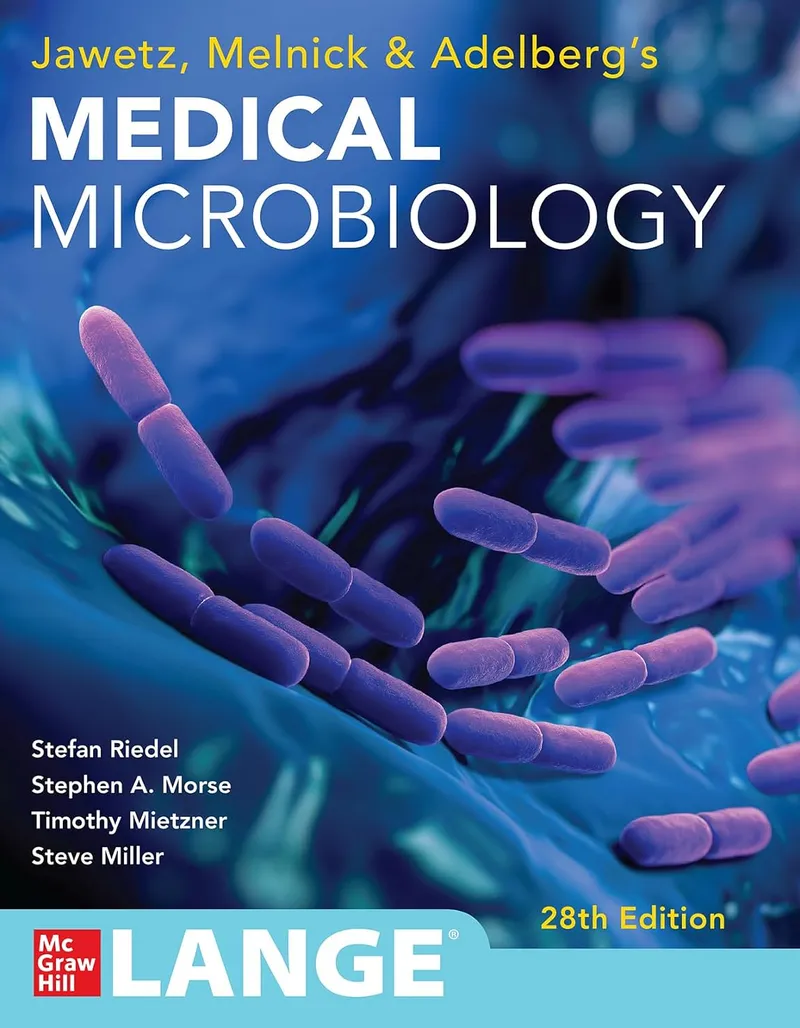

Jawetz, Melnick & Adelberg’s Medical Microbiology, 28th Edition
Jawetz, Melnick & Adelberg’s Medical Microbiology, 28th Edition is a widely recognized medical microbiology textbook that provides a comprehensive introduction to the microorganisms responsible for human disease and the principles used to understand, diagnose, prevent, and treat infectious diseases. Published by McGraw Hill Medical, the 28th edition brings together fundamental microbiology with clinically relevant information, making it a valuable resource for students and healthcare professionals.
Medical microbiology requires an understanding of microorganisms at several levels. Students need to learn microbial structure and physiology while also understanding how pathogens interact with humans, cause disease, evade immune defenses, and respond to antimicrobial treatment. Jawetz, Melnick & Adelberg’s Medical Microbiology brings these subjects together in a clinically oriented format.
With 880 pages, this edition provides substantial coverage of bacteriology, virology, mycology, parasitology, immunology, microbial genetics, infectious diseases, and antimicrobial therapy.
About Jawetz, Melnick & Adelberg’s Medical Microbiology
The Jawetz, Melnick & Adelberg’s Medical Microbiology series has long been used as a reference and study resource in medical microbiology. Its focus is on microorganisms of medical importance and the biological principles that explain their role in human disease.
The book begins with fundamental concepts before progressing into the major groups of medically important microorganisms. This allows students to establish a foundation in microbiology before examining individual pathogens and the diseases associated with them.
The clinical emphasis also helps readers connect microbiological concepts with diagnosis, prevention, and treatment.
Fundamental Principles of Medical Microbiology
A solid understanding of medical microbiology begins with the biology of microorganisms.
The book introduces concepts involving microbial structure, growth, metabolism, genetics, and the factors that influence microbial survival. These principles provide the foundation for understanding why different microorganisms behave differently and why certain pathogens are capable of causing particular diseases.
Microbial genetics is especially important because genetic variation can influence virulence, adaptation, and antimicrobial resistance.
Bacteriology
Bacteria are responsible for a large proportion of clinically important infectious diseases.
The book examines medically significant bacterial organisms and their characteristics, including their structures, growth requirements, mechanisms of pathogenicity, and relationships with human hosts.
Students can learn to distinguish bacterial groups based on characteristics such as morphology, Gram-stain reaction, biochemical properties, and other microbiological features.
The clinical significance of these organisms is considered alongside their basic biology, helping students connect laboratory characteristics with disease.
Bacterial Pathogenesis
Understanding why a microorganism causes disease is just as important as knowing its name.
Bacterial pathogens can produce disease through mechanisms involving colonization, invasion, toxins, tissue damage, immune evasion, and other interactions with the host.
Studying bacterial pathogenesis helps explain why some microorganisms cause severe disease while others are normally harmless or associated with disease only under particular circumstances.
Virology
Viruses represent a major area of medical microbiology.
Unlike bacteria and other cellular microorganisms, viruses depend on host cells for replication. Their distinctive biology requires specialized approaches to classification, diagnosis, prevention, and treatment.
The textbook introduces medically important viruses and examines their structures, replication, transmission, and relationships with human disease.
Understanding viral biology also provides a foundation for studying viral diagnostics, vaccines, and antiviral therapy.
Medical Mycology
Fungi can cause a wide range of human infections.
Some fungal diseases remain limited to superficial tissues, while others can become invasive and potentially serious, particularly in individuals with weakened immune defenses.
The book introduces medically important fungi and the principles used to recognize and diagnose fungal infections.
Medical Parasitology
Parasites are another major category of infectious agents.
Medical parasitology involves understanding organisms such as protozoa and helminths, their life cycles, transmission routes, geographic distribution, and associated diseases.
The textbook provides students with the microbiological and clinical background needed to recognize important parasitic infections and understand their diagnosis and prevention.
Immunology and Host Defense
The relationship between microorganisms and the immune system is central to medical microbiology.
The book introduces the mechanisms through which the human body recognizes and responds to microorganisms, including both innate and adaptive immune responses.
Understanding immunity helps explain why some individuals are more susceptible to particular infections and how vaccines and other preventive measures can provide protection.
Microorganisms and Human Disease
Infectious disease results from an interaction between a microorganism and its host.
The outcome can depend on microbial virulence, the route of infection, the host’s immune status, environmental conditions, and other factors.
This perspective helps students understand why the presence of a microorganism does not necessarily mean that disease will occur. Some organisms are part of the normal microbiota, while others become pathogenic only when they reach particular tissues or when host defenses are compromised.
Laboratory Diagnosis
Clinical microbiology laboratories play an important role in identifying infectious agents.
Depending on the suspected infection, diagnosis may involve:
- Microscopic examination
- Staining procedures
- Culture
- Biochemical testing
- Antigen detection
- Serological testing
- Molecular diagnostics
- Other specialized laboratory methods
Understanding the principles behind these approaches helps students appreciate how microbiological evidence is used in clinical decision-making.
Antimicrobial Therapy
The treatment of infectious diseases depends heavily on antimicrobial drugs.
The textbook introduces the major principles of antimicrobial therapy and explains how different agents affect microorganisms.
Understanding antimicrobial mechanisms also helps students recognize why particular drugs are effective against certain pathogens while having little or no activity against others.
Antimicrobial Resistance
Antimicrobial resistance is an important challenge in modern medicine.
Microorganisms can develop or acquire genetic characteristics that reduce their susceptibility to antimicrobial agents. These changes can spread through microbial populations and make infections increasingly difficult to treat.
Medical microbiology provides the foundation for understanding how resistance develops and why appropriate antimicrobial use and laboratory susceptibility testing are important.
Epidemiology and Prevention
Microbiology also plays an important role in public health.
Understanding how infectious agents are transmitted helps healthcare professionals develop strategies for preventing disease. Concepts such as reservoirs, routes of transmission, susceptible hosts, vaccination, sanitation, and infection-control measures are essential for understanding the spread of infectious diseases.
The relationship between microbiology and epidemiology is particularly important when dealing with outbreaks and emerging infectious diseases.
A Clinically Focused Resource
One of the strengths of Jawetz, Melnick & Adelberg’s Medical Microbiology is its ability to connect basic microbiological principles with clinical medicine.
Students can move from understanding a microorganism’s structure and physiology to examining how it causes disease, how the infection can be diagnosed, and how it can be prevented or treated.
This makes the book useful not only for learning microbiology but also for understanding how microbiological knowledge contributes to patient care.
Who Is This Book For?
The 28th edition can be useful for:
- Medical students
- Dental students
- Nursing and allied-health students
- Pharmacy students
- Biomedical science students
- Microbiology students
- Students studying infectious diseases
- Healthcare professionals reviewing medical microbiology
- Students preparing for medical examinations
It can also serve as a reference for readers who need a broad overview of medically important microorganisms.
Why Study Jawetz Medical Microbiology?
Medical microbiology contains a considerable amount of information, and students often need to integrate concepts from microbiology, immunology, pathology, pharmacology, and clinical medicine.
Jawetz, Melnick & Adelberg’s Medical Microbiology provides a structured way to approach these subjects.
Instead of viewing microorganisms simply as names to memorize, students can consider their:
- Structure and physiology
- Mechanisms of infection
- Virulence factors
- Clinical manifestations
- Laboratory characteristics
- Diagnostic methods
- Antimicrobial susceptibility
- Treatment and prevention
This integrated approach can make the study of infectious diseases more meaningful and easier to apply to clinical situations.
Final Thoughts
Jawetz, Melnick & Adelberg’s Medical Microbiology, 28th Edition is a comprehensive resource for studying the microorganisms and biological principles involved in human infectious diseases.
The book covers the major areas of medical microbiology, including bacteriology, virology, mycology, parasitology, immunology, microbial genetics, pathogenesis, laboratory diagnosis, antimicrobial therapy, and disease prevention.
Its clinically oriented approach makes it particularly valuable for students who need to understand the connection between microorganisms and human disease. By bringing together fundamental microbiology and clinical applications, the book provides a strong foundation for further study in medicine, infectious diseases, laboratory science, and related healthcare disciplines.
For students looking for a substantial medical microbiology textbook, the 28th edition offers broad coverage of the subject and provides a useful reference for both academic study and clinical review.
Book Information
Title: Jawetz, Melnick & Adelberg’s Medical Microbiology
Edition: 28th Edition
Publisher: McGraw Hill Medical
Publication Date: August 30, 2019
Language: English
Print Length: 880 pages
ISBN-10: 1260012026
ISBN-13: 978-1260012026
Subject: Medical Microbiology / Infectious Diseases / Microbiology
Jawetz, Melnick & Adelberg’s Medical Microbiology, 28th Edition is a useful academic resource for students and healthcare professionals seeking a comprehensive understanding of microorganisms, infectious diseases, diagnosis, antimicrobial treatment, and disease prevention.
Support the Creators!
If you enjoy this book, please consider supporting the author and publisher by purchasing a physical or digital copy. Buying official copies ensures authors can keep writing great books.