
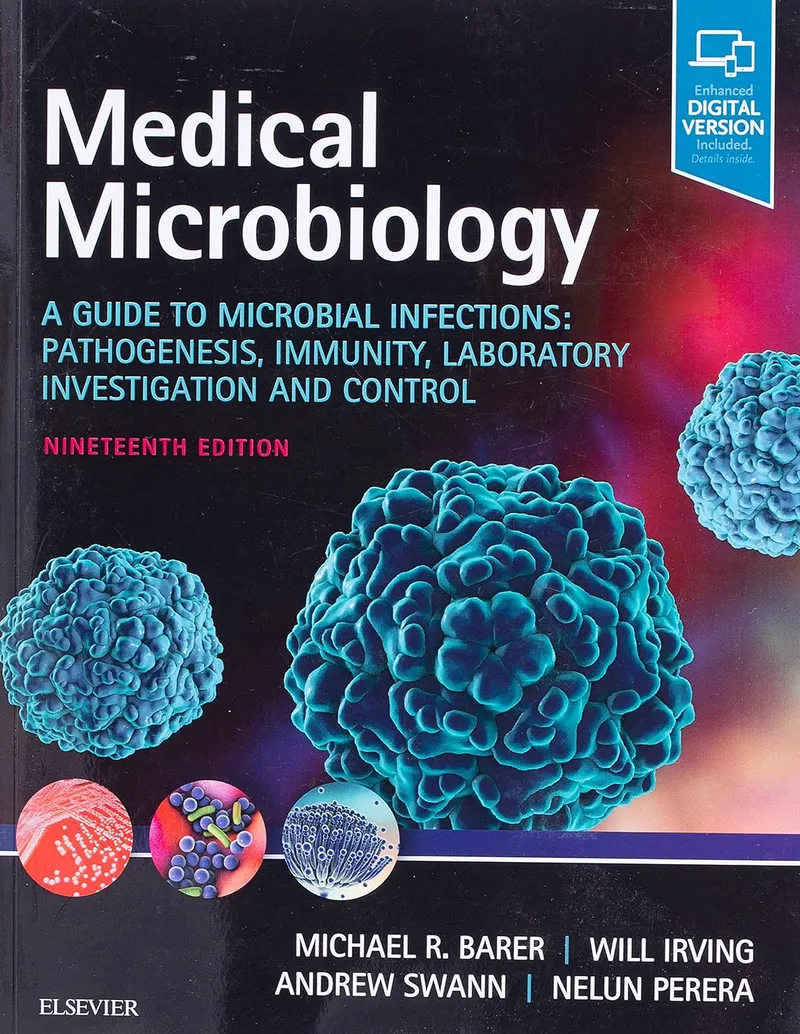

Medical Microbiology: A Guide to Microbial Infections — Pathogenesis, Immunity, Laboratory Investigation and Control, 19th Edition
Medical Microbiology: A Guide to Microbial Infections — Pathogenesis, Immunity, Laboratory Investigation and Control, 19th Edition is a comprehensive textbook covering the major principles of medical microbiology and their application to infectious diseases. Published by Elsevier, the book provides an integrated discussion of microorganisms, microbial pathogenesis, host immunity, laboratory diagnosis, antimicrobial treatment, and infection control.
With 760 pages, the 19th edition is designed to give students a broad understanding of how microorganisms interact with humans and how infectious diseases can be investigated, diagnosed, prevented, and controlled. Its combination of fundamental microbiology and clinical applications makes it useful for students in medicine, biomedical sciences, healthcare, and related disciplines.
About Medical Microbiology
Medical microbiology is concerned with microorganisms that affect human health and with the biological processes underlying infection and disease.
Studying the subject requires more than simply learning the names of bacteria, viruses, fungi, and parasites. Students need to understand how microorganisms enter the body, interact with host tissues, evade immune defenses, produce disease, and spread between individuals.
The 19th edition approaches medical microbiology through these interconnected concepts, providing a framework that links microbial biology with clinical medicine and laboratory investigation.
Microbial Infections and Pathogenesis
A central theme of the book is microbial pathogenesis, or the mechanisms through which microorganisms cause disease.
Different pathogens use different strategies to establish infection. Some attach to host cells, some invade tissues, some produce toxins, and others interfere with immune responses.
Understanding these mechanisms helps students explain why particular microorganisms cause specific diseases and why infections can produce different clinical manifestations.
Bacteriology
Bacteria are among the most important causes of human infectious disease.
The book examines medically important bacteria and introduces their characteristics, biology, pathogenic mechanisms, and clinical significance. Students can learn how bacterial properties influence their ability to colonize, invade, and damage host tissues.
Understanding bacterial characteristics is also essential for laboratory identification and antimicrobial treatment.
Virology
Viruses have unique biological characteristics because they depend on host cells for replication.
The textbook introduces the major principles of medical virology, including viral structure, replication, transmission, host interactions, and disease.
These concepts provide a foundation for understanding viral diagnosis, prevention, vaccination, and antiviral treatment.
Fungi and Parasites
Medical microbiology also includes organisms such as fungi and parasites that can produce a wide range of human infections.
Fungal diseases can range from relatively superficial infections to severe invasive disease, particularly in susceptible patients. Parasitic infections may involve complex life cycles and transmission through food, water, insects, animals, or other routes.
Understanding these organisms requires attention to their biology as well as their clinical manifestations.
Immunity and Host Defense
The outcome of an infection depends not only on the microorganism but also on the response of the host.
The book examines the immune mechanisms that protect humans from infectious agents, including innate and adaptive immune responses.
Understanding immunity helps explain why some microorganisms are successfully eliminated while others establish persistent or recurrent infections.
It also provides the foundation for understanding vaccination and other approaches to preventing infectious disease.
Laboratory Investigation
Laboratory investigation is an essential component of modern medical microbiology.
Identifying the microorganism responsible for an infection can involve several complementary approaches, including:
- Microscopy and staining
- Microbial culture
- Biochemical identification
- Antigen detection
- Serological testing
- Molecular diagnostic techniques
- Antimicrobial susceptibility testing
The book connects these laboratory methods with the biological characteristics of microorganisms and the clinical conditions in which they are encountered.
This makes laboratory microbiology easier to understand as part of the broader process of diagnosing infectious disease.
Antimicrobial Treatment
The treatment of microbial infections depends on selecting appropriate antimicrobial agents.
Understanding antimicrobial therapy requires knowledge of how drugs affect microorganisms and why certain agents are effective against particular pathogens.
The subject also introduces the importance of antimicrobial susceptibility and the growing challenge of resistance.
Antimicrobial Resistance
Antimicrobial resistance is an important issue in modern healthcare.
Microorganisms can develop or acquire characteristics that allow them to survive antimicrobial exposure. Genetic variation, selection, and the spread of resistance mechanisms can all contribute to the emergence of resistant populations.
Understanding these principles is essential for appreciating why antimicrobial stewardship, laboratory testing, and appropriate treatment decisions are important in clinical practice.
Infection Control
Preventing infection is just as important as treating it.
Medical microbiology provides the scientific foundation for infection-control practices used in hospitals, laboratories, community settings, and other healthcare environments.
Understanding transmission routes, reservoirs, environmental survival, and susceptibility to microbial-control procedures helps healthcare professionals reduce the risk of infection.
Connecting Microbiology with Clinical Medicine
A major value of an integrated medical microbiology textbook is its ability to connect basic science with clinical practice.
A microorganism can be studied at the cellular and molecular level, but its importance becomes clearer when its biology is connected to the disease it causes.
For example, microbial virulence factors can be related to tissue damage, immune responses can be connected to clinical symptoms, and laboratory characteristics can be used to support diagnosis.
This approach helps students understand the reasoning behind clinical microbiology rather than simply memorizing isolated facts.
Who Is This Book For?
Medical Microbiology: A Guide to Microbial Infections can be useful for:
- Medical students
- Microbiology students
- Biomedical science students
- Medical laboratory science students
- Nursing and allied-health students
- Pharmacy students
- Students studying infectious diseases
- Healthcare professionals reviewing medical microbiology
- Students preparing for microbiology examinations
Its broad coverage also makes it useful as a reference when moving from introductory microbiology toward more specialized clinical subjects.
Why Study Medical Microbiology: A Guide to Microbial Infections?
Medical microbiology sits at the intersection of several scientific disciplines. Microbial genetics, cell biology, immunology, pathology, pharmacology, and epidemiology all contribute to our understanding of infectious disease.
This book brings many of these concepts together around a common theme: the interaction between microorganisms and their human hosts.
For students, this can provide a more coherent way of understanding topics that might otherwise appear unrelated.
Final Thoughts
Medical Microbiology: A Guide to Microbial Infections — Pathogenesis, Immunity, Laboratory Investigation and Control, 19th Edition provides a broad introduction to the science of infectious disease and the microorganisms responsible for it.
The book covers important areas including microbial pathogenesis, immunity, bacteriology, virology, mycology, parasitology, laboratory diagnosis, antimicrobial treatment, antimicrobial resistance, and infection control.
By bringing these subjects together, the textbook helps readers understand the complete picture of microbial infection—from the biology of the pathogen and the response of the host to laboratory investigation, treatment, and prevention.
For students and healthcare professionals seeking a substantial medical microbiology resource, the 19th edition provides a strong foundation for understanding how microorganisms cause disease and how modern medicine investigates and controls infectious infections.
Book Information
Title: Medical Microbiology: A Guide to Microbial Infections — Pathogenesis, Immunity, Laboratory Investigation and Control
Edition: 19th Edition
Publisher: Elsevier
Publication Date: March 27, 2018
Language: English
Print Length: 760 pages
ISBN-10: 0702072001
ISBN-13: 978-0702072000
Subject: Medical Microbiology / Infectious Diseases / Immunology / Laboratory Medicine
Medical Microbiology, 19th Edition is a valuable academic resource for understanding the relationship between microbial pathogens, human immunity, infectious disease, laboratory diagnosis, antimicrobial treatment, and infection control.
Support the Creators!
If you enjoy this book, please consider supporting the author and publisher by purchasing a physical or digital copy. Buying official copies ensures authors can keep writing great books.