

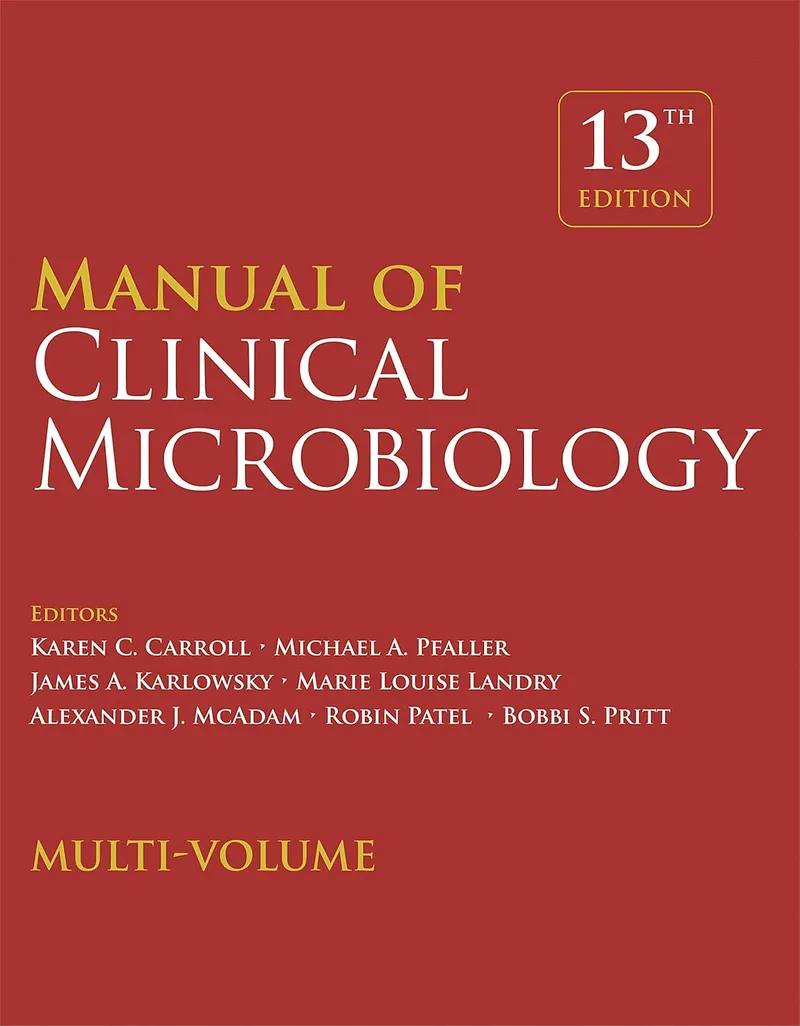

Manual of Clinical Microbiology, 4-Volume Set, 13th Edition
Manual of Clinical Microbiology, 13th Edition is an extensive reference work covering the science and practice of clinical microbiology. Published by ASM Press, this four-volume set provides comprehensive information on microorganisms, laboratory methods, diagnostic technologies, antimicrobial susceptibility testing, infectious diseases, and the role of the clinical microbiology laboratory in modern healthcare.
With 3,456 pages, the 13th edition is intended as a substantial reference rather than a short introductory textbook. It is particularly valuable for clinical microbiologists, laboratory professionals, researchers, physicians, and advanced students who require detailed information about the identification and investigation of infectious microorganisms.
About Manual of Clinical Microbiology
Clinical microbiology plays a central role in modern medicine. When an infectious disease is suspected, laboratory testing can help determine which microorganism is responsible and provide information that supports appropriate treatment.
This requires knowledge of microbial biology as well as sophisticated laboratory techniques. Modern clinical laboratories may use microscopy, culture, biochemical testing, immunological methods, molecular diagnostics, mass spectrometry, and antimicrobial susceptibility testing.
Manual of Clinical Microbiology brings these areas together in an extensive reference covering both established laboratory practices and modern approaches to microbial diagnosis.
Bacteriology
Bacteria represent a major focus of clinical microbiology because bacterial infections occur across virtually every area of medicine.
The manual provides extensive information relevant to the identification and characterization of clinically important bacteria. Understanding bacterial morphology, physiology, growth characteristics, biochemical properties, and pathogenicity is essential for accurate laboratory identification.
Clinical microbiologists can use this knowledge to distinguish between organisms that may produce similar clinical syndromes and determine which laboratory investigations are appropriate.
Virology
Clinical virology requires specialized approaches because viruses differ fundamentally from cellular microorganisms.
Modern viral diagnosis may involve molecular amplification, antigen detection, serological testing, and other laboratory methods. Understanding viral biology and the strengths and limitations of these techniques is important when investigating suspected viral infections.
The manual provides detailed coverage of clinical virology as part of its broader examination of diagnostic microbiology.
Mycology and Parasitology
Fungal and parasitic infections can present significant diagnostic challenges.
Many fungal organisms require specialized culture conditions or microscopic identification, while parasites may have complex life cycles and distinctive morphological characteristics.
Clinical laboratories therefore need appropriate methods for detecting and identifying these organisms. The manual provides reference material relevant to the investigation of medically important fungi and parasites.
Clinical Microbiology Laboratory Methods
Laboratory methodology is at the heart of clinical microbiology.
Depending on the suspected pathogen, investigations can include:
- Microscopic examination
- Staining techniques
- Culture and isolation
- Biochemical identification
- Antigen detection
- Serological methods
- Molecular diagnostics
- Mass spectrometry
- Antimicrobial susceptibility testing
Understanding how these methods work and when they should be applied is essential for producing reliable laboratory results.
Molecular Diagnostic Methods
Molecular biology has transformed clinical microbiology.
Techniques based on the detection and analysis of microbial nucleic acids can provide rapid and highly specific information about infectious agents. These methods are particularly useful when microorganisms are difficult or slow to grow in conventional culture.
The increasing role of molecular diagnostics also demonstrates how clinical microbiology continues to evolve alongside advances in genetics and biotechnology.
Antimicrobial Susceptibility Testing
Determining whether a microorganism is susceptible or resistant to antimicrobial agents is an important responsibility of the clinical microbiology laboratory.
Susceptibility testing can provide information that supports antimicrobial selection and helps clinicians manage infections caused by resistant organisms.
The subject also connects laboratory microbiology with the broader challenge of antimicrobial resistance and antimicrobial stewardship.
Antimicrobial Resistance
Antimicrobial resistance has become a major concern in healthcare.
Clinical laboratories contribute to the detection and surveillance of resistant microorganisms by identifying resistance patterns and providing susceptibility results.
Understanding resistance mechanisms and laboratory methods for detecting resistance is therefore an important part of modern clinical microbiology.
Infectious Disease Diagnosis
A clinical microbiology laboratory does more than identify microorganisms.
Laboratory findings must be interpreted in the context of the patient’s symptoms, specimen type, clinical history, and suspected infection.
The quality of the specimen, the timing of collection, transport conditions, laboratory methodology, and interpretation of results can all influence the diagnostic process.
This connection between laboratory science and clinical medicine is one of the defining features of clinical microbiology.
Specimen Collection and Laboratory Investigation
Accurate diagnosis begins before a specimen reaches the laboratory.
The selection of an appropriate specimen, proper collection technique, transport, storage, and processing can have a significant effect on the reliability of laboratory results.
Understanding these principles helps minimize contamination, preserve microorganisms or their biological material, and ensure that laboratory testing produces clinically meaningful information.
Infection Prevention and Public Health
Clinical microbiology also contributes to infection prevention and public health.
Laboratories can help identify outbreaks, monitor resistant organisms, investigate unusual infections, and support infection-control programs.
The information generated by clinical microbiology laboratories therefore extends beyond individual patients and can contribute to surveillance and disease-control efforts at the institutional and population levels.
Who Is This Book For?
The Manual of Clinical Microbiology, 13th Edition can be particularly useful for:
- Clinical microbiologists
- Medical laboratory scientists
- Microbiology researchers
- Infectious disease specialists
- Medical professionals
- Laboratory technologists
- Biomedical scientists
- Graduate students
- Advanced microbiology students
- Professionals involved in diagnostic microbiology
Because of its extensive coverage, it is especially suited to readers who need a detailed reference rather than a basic introductory textbook.
A Comprehensive Clinical Microbiology Reference
One of the defining characteristics of this edition is its scale.
At 3,456 pages across four volumes, the manual provides considerably more depth than a typical undergraduate microbiology textbook. It can be used to investigate specific organisms, laboratory techniques, diagnostic approaches, and clinical microbiology concepts in greater detail.
For students, it can serve as a supplementary reference alongside a more accessible textbook. For laboratory professionals and researchers, its breadth makes it suitable for consultation when more detailed information is required.
Final Thoughts
Manual of Clinical Microbiology, 13th Edition is a major reference for the study and practice of clinical microbiology. The four-volume set brings together fundamental microbiology, laboratory science, diagnostic technology, and clinical applications in a single comprehensive resource.
The book covers important areas including bacteriology, virology, mycology, parasitology, laboratory diagnosis, molecular microbiology, antimicrobial susceptibility testing, antimicrobial resistance, and infectious disease investigation.
With its extensive 3,456-page format, this edition is best suited to advanced students, laboratory professionals, researchers, clinicians, and others who require detailed information about clinical microbiology.
For anyone studying or working in diagnostic microbiology, the manual provides a broad reference for understanding how modern laboratories identify microorganisms, investigate infectious diseases, detect antimicrobial resistance, and contribute to patient care and public health.
Book Information
Title: Manual of Clinical Microbiology
Edition: 13th Edition
Format: 4-Volume Set
Publisher: ASM Press
Publication Date: September 13, 2023
Language: English
Print Length: 3,456 pages
ISBN-10: 1683674294
ISBN-13: 978-1683674290
Subject: Clinical Microbiology / Medical Microbiology / Laboratory Medicine / Infectious Diseases
Manual of Clinical Microbiology, 13th Edition is an extensive reference for understanding clinical microbiology, laboratory diagnosis, microbial identification, molecular testing, antimicrobial susceptibility, and the investigation of infectious diseases.
Support the Creators!
If you enjoy this book, please consider supporting the author and publisher by purchasing a physical or digital copy. Buying official copies ensures authors can keep writing great books.



A wonderful practical manual covering almost all aspects of Microbiology.
Hi there! Our storage provider suffered a major hardware failure and has temporarily shut down servers to safely restore data without losing any files. They estimate everything will be fixed and back online tomorrow, Wednesday (August 26th) at 11:00 CEST. Please try again after that time. Thank you so much for your patience! 🙏