
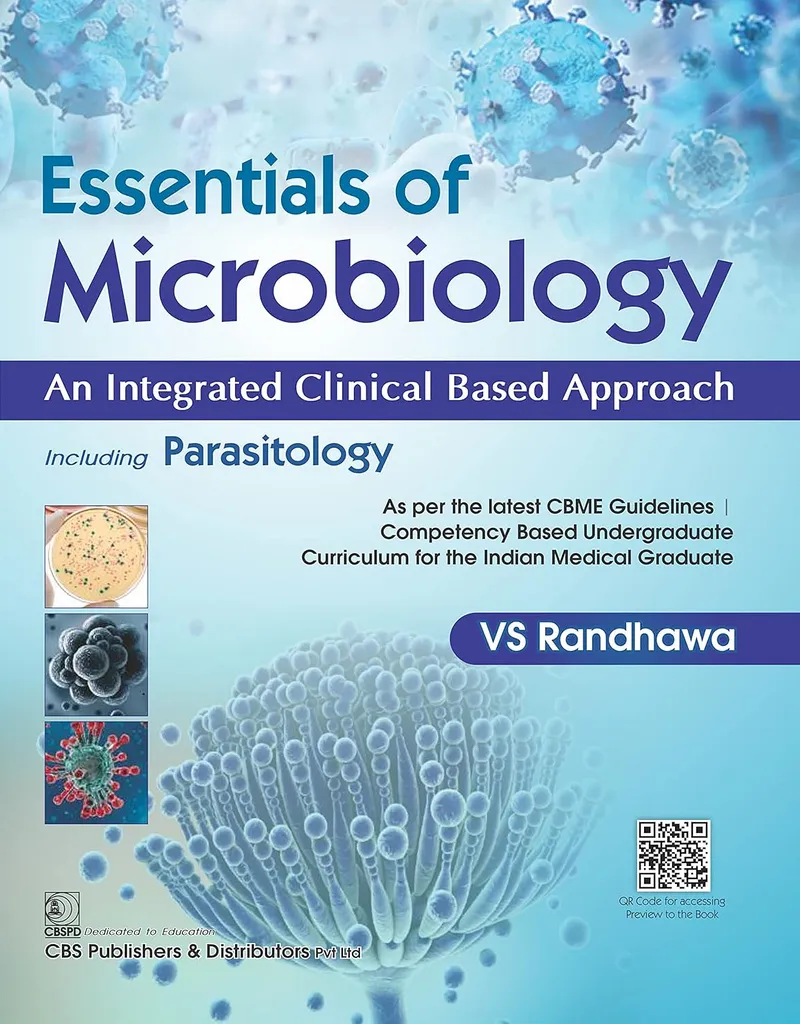

Essentials of Microbiology: An Integrated Clinical-Based Approach Including Parasitology
Essentials of Microbiology: An Integrated Clinical-Based Approach Including Parasitology is a practical medical microbiology resource that connects fundamental microbiological concepts with clinical applications and parasitology. Published by CBS Publishers and Distributors Pvt. Ltd., the book is designed to help students understand microorganisms and parasites in the context of human disease, diagnosis, prevention, and clinical practice.
By combining microbiology with parasitology, the book provides a broader foundation for students studying infectious diseases and healthcare sciences.
About Essentials of Microbiology
Microbiology is an important part of medical and health sciences because microorganisms are responsible for a wide range of human infections.
Understanding bacteria, viruses, fungi, and parasites requires more than memorizing individual organisms. Students also need to understand their characteristics, transmission, pathogenic mechanisms, laboratory diagnosis, and relationship with the human host.
An integrated clinical approach helps connect these concepts with real-world medical situations.
Clinical Microbiology
Clinical microbiology focuses on microorganisms that can cause human disease and the laboratory methods used to investigate infections.
Important areas include:
- Bacteriology
- Virology
- Mycology
- Parasitology
- Microbial pathogenesis
- Laboratory diagnosis
- Infection prevention
- Antimicrobial therapy
Studying these areas together helps students develop a more complete understanding of infectious diseases.
Parasitology
Parasites are another important group of organisms responsible for human disease.
Parasitology examines organisms such as protozoa and helminths, their life cycles, transmission, pathogenic effects, and methods of diagnosis.
Including parasitology alongside microbiology provides students with a broader understanding of the organisms responsible for infectious diseases.
Microorganisms and Human Disease
Pathogens can cause disease through different mechanisms.
Some organisms invade tissues, produce toxins, interfere with normal cellular functions, or evade host immune responses. The severity and characteristics of an infection depend on both the pathogen and the condition of the host.
Understanding these interactions helps students connect microbiological concepts with clinical manifestations.
Laboratory Diagnosis
Laboratory investigation is an essential component of clinical microbiology.
Depending on the suspected infection, diagnostic approaches may include:
- Microscopy
- Staining
- Culture
- Biochemical identification
- Serological testing
- Antigen detection
- Molecular methods
- Parasitological examination
- Antimicrobial susceptibility testing
Understanding these techniques helps students appreciate how laboratory findings contribute to the diagnosis of infectious diseases.
Infection Prevention and Control
Preventing the transmission of infectious organisms is an important part of healthcare.
Basic microbiological knowledge supports practices such as hand hygiene, sterilization, disinfection, appropriate use of protective equipment, safe handling of specimens, and prevention of cross-contamination.
These principles are relevant to healthcare professionals working in hospitals, clinics, laboratories, and community settings.
Antimicrobial Resistance
Antimicrobial resistance has become a major concern in modern medicine.
Microorganisms can develop mechanisms that reduce their susceptibility to antimicrobial drugs, making certain infections increasingly difficult to treat.
Understanding resistance and appropriate antimicrobial use is therefore an important part of contemporary clinical microbiology.
An Integrated Clinical Approach
A clinical approach to microbiology encourages students to connect scientific concepts with patient-related situations.
Instead of studying microorganisms as isolated facts, students can consider the relationship between the pathogen, route of transmission, clinical presentation, laboratory diagnosis, treatment, and prevention.
This approach can make microbiology more relevant to students preparing for healthcare careers.
Who Is This Book For?
Essentials of Microbiology: An Integrated Clinical-Based Approach Including Parasitology can be useful for:
- Medical students
- Nursing students
- Microbiology students
- Medical laboratory students
- Pharmacy students
- Allied health students
- Parasitology students
- Biomedical science students
- Healthcare professionals
- Students preparing for microbiology examinations
It can serve as a foundation for students who need to study both microbiology and parasitology within a clinical context.
Why Study Microbiology and Parasitology Together?
Many infectious diseases involve organisms that differ significantly in their biology, but the principles of transmission, host interaction, diagnosis, treatment, and prevention provide useful connections between microbiology and parasitology.
Studying these subjects together allows students to develop a broader understanding of infectious disease and the variety of organisms that can affect human health.
Final Thoughts
Essentials of Microbiology: An Integrated Clinical-Based Approach Including Parasitology provides a practical introduction to microbiology and parasitology with an emphasis on their clinical relevance.
The book brings together important concepts related to bacteria, viruses, fungi, parasites, microbial pathogenesis, laboratory diagnosis, infection control, antimicrobial resistance, and infectious diseases.
Published in 2022, it can be a useful study resource for students who want to connect microbiological theory with clinical applications.
For students in medicine, nursing, microbiology, medical laboratory science, pharmacy, parasitology, and allied health disciplines, this book offers a broad foundation for understanding the microorganisms and parasites involved in human disease.
Book Information
Title: Essentials of Microbiology: An Integrated Clinical-Based Approach Including Parasitology
Publisher: CBS Publishers and Distributors Pvt. Ltd.
Publication Date: July 19, 2022
Language: English
ISBN-13: 978-9354663123
ASIN: B0B71RL3W2
Subject: Microbiology / Medical Microbiology / Parasitology / Infectious Diseases / Clinical Microbiology
Essentials of Microbiology: An Integrated Clinical-Based Approach Including Parasitology provides an integrated foundation in clinical microbiology, bacteriology, virology, mycology, parasitology, laboratory diagnosis, infection control, and infectious diseases, making it a useful resource for students and healthcare learners.
Support the Creators!
If you enjoy this book, please consider supporting the author and publisher by purchasing a physical or digital copy. Buying official copies ensures authors can keep writing great books.