
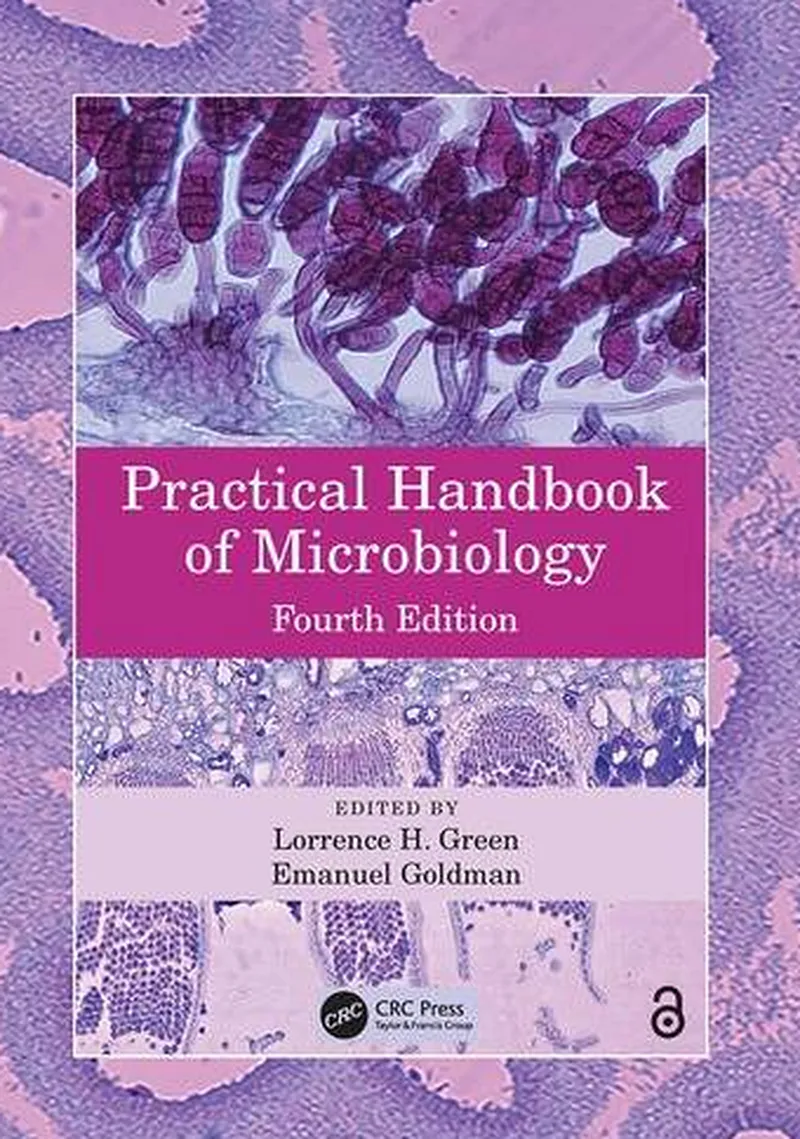

Practical Handbook of Microbiology, 4th Edition
Practical Handbook of Microbiology, 4th Edition is a comprehensive reference designed to support students, laboratory professionals, researchers, and other readers working with microbiological methods and applications. Published by CRC Press, this fourth edition brings together a broad range of practical microbiology topics, making it a useful reference for laboratory work, study, and research.
With 957 pages, the book provides extensive coverage of microbiological techniques and practical principles across different areas of the discipline.
About Practical Handbook of Microbiology
Microbiology relies heavily on laboratory techniques for observing, cultivating, identifying, and studying microorganisms.
From basic microscopy and staining to microbial culture, identification, molecular methods, and laboratory safety, practical skills are essential for understanding microorganisms and their biological properties.
This handbook provides a broad reference for readers who want to strengthen their knowledge of microbiology laboratory procedures and applications.
Microbiology Laboratory Techniques
Practical microbiology involves a wide range of methods for examining microorganisms.
Common techniques include:
- Microscopy
- Staining methods
- Aseptic technique
- Microbial culture
- Isolation of microorganisms
- Biochemical testing
- Microbial identification
- Enumeration of microorganisms
- Molecular techniques
- Antimicrobial susceptibility testing
Understanding these methods is essential for both academic microbiology and professional laboratory work.
Laboratory Safety and Good Practice
Safety is a fundamental part of microbiology laboratory work.
Proper handling of cultures, specimens, chemicals, equipment, and biological materials helps reduce risks to laboratory personnel and prevents unwanted contamination.
Good laboratory practices also improve the reliability and reproducibility of experimental results.
Cultivation and Identification of Microorganisms
Culturing microorganisms under controlled conditions allows researchers and students to examine their growth and characteristics.
Identification may involve combining microscopic observations, culture characteristics, biochemical reactions, and other laboratory methods.
These techniques are important in clinical, environmental, industrial, food, and research microbiology.
Molecular Microbiology
Modern microbiology increasingly uses molecular methods to study microorganisms at the genetic level.
Techniques involving nucleic acids can help researchers investigate microbial identity, genetic variation, pathogenicity, and other biological characteristics.
Molecular approaches have expanded the ability of microbiologists to study organisms that may be difficult to characterize using traditional methods alone.
Clinical and Applied Microbiology
Microbiological techniques have applications across many fields.
In clinical laboratories, microbiology helps identify infectious organisms and investigate antimicrobial susceptibility. In food and environmental microbiology, laboratory methods can be used to detect contamination and monitor microbial populations.
Microbiology also contributes to biotechnology, pharmaceutical research, agriculture, and industrial processes.
Antimicrobial Testing
Determining how microorganisms respond to antimicrobial substances is an important laboratory application.
Antimicrobial susceptibility testing can provide valuable information for studying microbial resistance and evaluating the effectiveness of antimicrobial agents.
This area has become increasingly important as antimicrobial resistance continues to challenge healthcare and public health.
A Comprehensive Laboratory Reference
One of the advantages of a large practical handbook is the ability to consult individual topics when needed.
Rather than serving only as a traditional textbook, a handbook can be used as a reference during laboratory courses, research projects, experimental work, and microbiological investigations.
Its broad coverage makes it suitable for readers with different levels of experience.
Who Is This Book For?
Practical Handbook of Microbiology can be useful for:
- Microbiology students
- Biology students
- Medical laboratory students
- Clinical microbiologists
- Laboratory technicians
- Biotechnology students
- Researchers
- Pharmaceutical researchers
- Food microbiologists
- Environmental microbiologists
- Laboratory professionals
It can also serve as a supplementary reference for students studying microbiology laboratory courses.
Why Use a Practical Microbiology Handbook?
Microbiology is a field where theoretical knowledge and laboratory practice are closely connected.
Understanding microbial physiology and taxonomy is important, but knowing how to safely culture, observe, identify, and analyze microorganisms is equally valuable.
A practical handbook provides a convenient way to review laboratory principles and techniques while supporting more detailed microbiological study.
Final Thoughts
Practical Handbook of Microbiology, 4th Edition provides an extensive reference for the practical study and application of microbiology.
The book covers areas related to microbiological laboratory techniques, microbial cultivation, identification, microscopy, staining, laboratory safety, molecular methods, antimicrobial testing, and applied microbiology.
With 957 pages, this fourth edition offers substantial material for students, researchers, and laboratory professionals who need a broad reference for microbiological methods.
For readers working in microbiology, clinical laboratory science, biotechnology, food microbiology, environmental microbiology, pharmaceutical research, and related fields, this handbook can be a valuable companion for both study and practical laboratory work.
Book Information
Title: Practical Handbook of Microbiology
Edition: 4th Edition
Publisher: CRC Press
Publication Date: May 31, 2023
Language: English
Print Length: 957 pages
ISBN-10: 0367567644
ISBN-13: 978-0367567644
Subject: Microbiology / Laboratory Techniques / Applied Microbiology / Microbial Identification / Biotechnology
Practical Handbook of Microbiology, 4th Edition offers a comprehensive reference covering microbiology laboratory techniques, microbial culture and identification, microscopy, molecular methods, laboratory safety, antimicrobial testing, and applied microbiology, making it a useful resource for students, researchers, and laboratory professionals.
Support the Creators!
If you enjoy this book, please consider supporting the author and publisher by purchasing a physical or digital copy. Buying official copies ensures authors can keep writing great books.