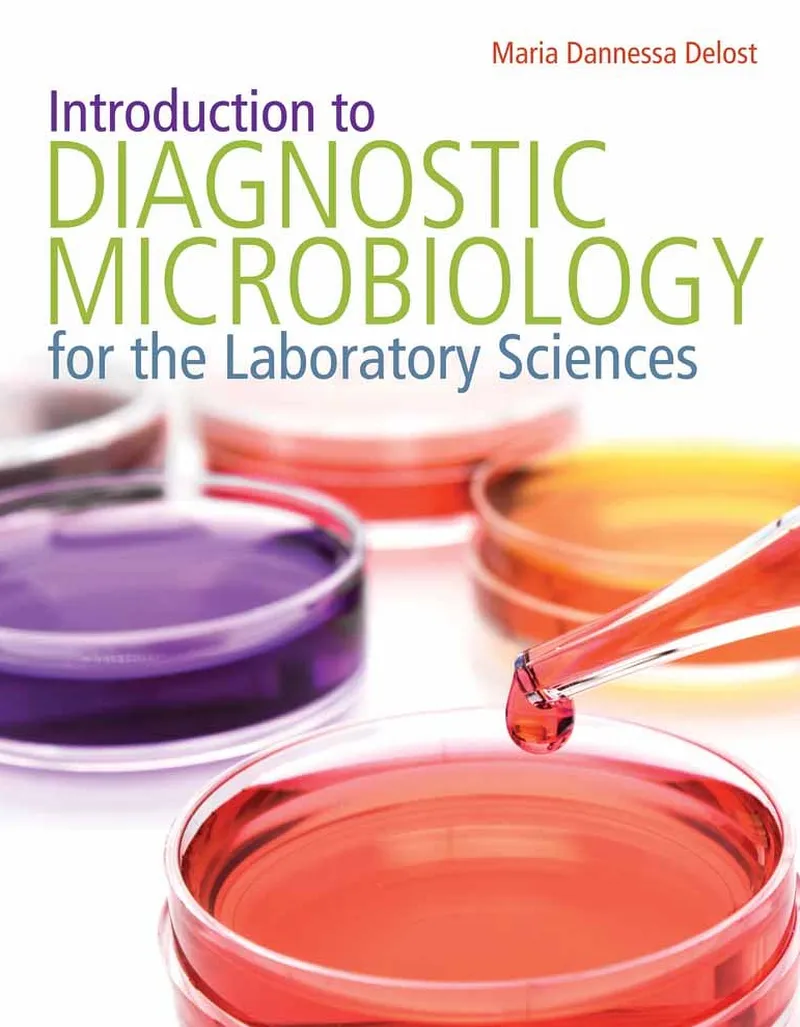

Introduction to Diagnostic Microbiology for the Laboratory Sciences, 1st Edition
Introduction to Diagnostic Microbiology for the Laboratory Sciences, 1st Edition by Maria Dannessa Delost is an introductory textbook designed to help students understand the principles and practices of diagnostic microbiology in clinical laboratory settings. Published by Jones & Bartlett Learning, the book connects fundamental microbiology with the laboratory techniques used to detect and identify infectious microorganisms.
About the Book
Diagnostic microbiology plays an important role in identifying the microorganisms responsible for infectious diseases.
The book introduces students to the principles behind specimen processing, microbial identification, laboratory testing, and interpretation of microbiological findings, providing a foundation for further study in clinical laboratory science.
Clinical Microbiology
Clinical microbiology focuses on microorganisms that are relevant to human health and disease.
Students can develop an understanding of how bacteria, viruses, fungi, and parasites are studied in the laboratory and how microbiological results contribute to clinical diagnosis.
Specimen Collection and Processing
Proper specimen handling is an essential part of diagnostic microbiology.
The book introduces fundamental concepts related to specimen collection, transport, processing, and preparation, helping students understand how laboratory procedures can affect diagnostic accuracy.
Microbial Identification
Identifying an infectious organism requires the systematic evaluation of its characteristics.
Students can learn about laboratory approaches involving microscopy, staining, culture, biochemical testing, and other identification methods used in clinical microbiology.
Laboratory Safety and Quality
Clinical laboratories require careful attention to safety and quality practices.
Understanding laboratory safety, contamination prevention, quality control, and proper handling of clinical specimens is essential for producing reliable microbiological results.
Diagnostic Applications
The information presented can help students connect laboratory procedures with the diagnosis of infectious diseases.
By understanding how laboratory findings relate to specific microorganisms, students can develop a stronger foundation in clinical microbiology and diagnostic reasoning.
Who Is This Book For?
Introduction to Diagnostic Microbiology for the Laboratory Sciences, 1st Edition can be useful for:
- Medical laboratory science students
- Clinical laboratory students
- Microbiology students
- Biomedical science students
- Medical laboratory technology students
- Healthcare science students
- Students beginning clinical microbiology
It can also serve as a supplementary resource for laboratory-focused microbiology courses.
Final Thoughts
Introduction to Diagnostic Microbiology for the Laboratory Sciences, 1st Edition provides an introduction to the principles and practices used in diagnostic microbiology.
By connecting microbiology fundamentals, specimen processing, laboratory safety, microbial identification, and diagnostic testing, the book helps students understand how clinical laboratories contribute to the diagnosis of infectious diseases.
Its laboratory-oriented approach makes it particularly suitable for students beginning their education in medical laboratory science and clinical microbiology.
Book Information
Title: Introduction to Diagnostic Microbiology for the Laboratory Sciences
Edition: 1st Edition
Author: Maria Dannessa Delost
Publisher: Jones & Bartlett Learning
Publication Date: March 11, 2014
Language: English
ISBN-13: 978-1284058635
ASIN: B00JKPGNE8
Subject: Diagnostic Microbiology / Clinical Microbiology / Medical Laboratory Science / Laboratory Diagnosis
Introduction to Diagnostic Microbiology for the Laboratory Sciences, 1st Edition introduces the fundamentals of clinical microbiology, specimen processing, laboratory safety, microbial identification, and diagnostic testing, making it a useful starting point for students in medical laboratory science and related disciplines.
Support the Creators!
If you enjoy this book, please consider supporting the author and publisher by purchasing a physical or digital copy. Buying official copies ensures authors can keep writing great books.