
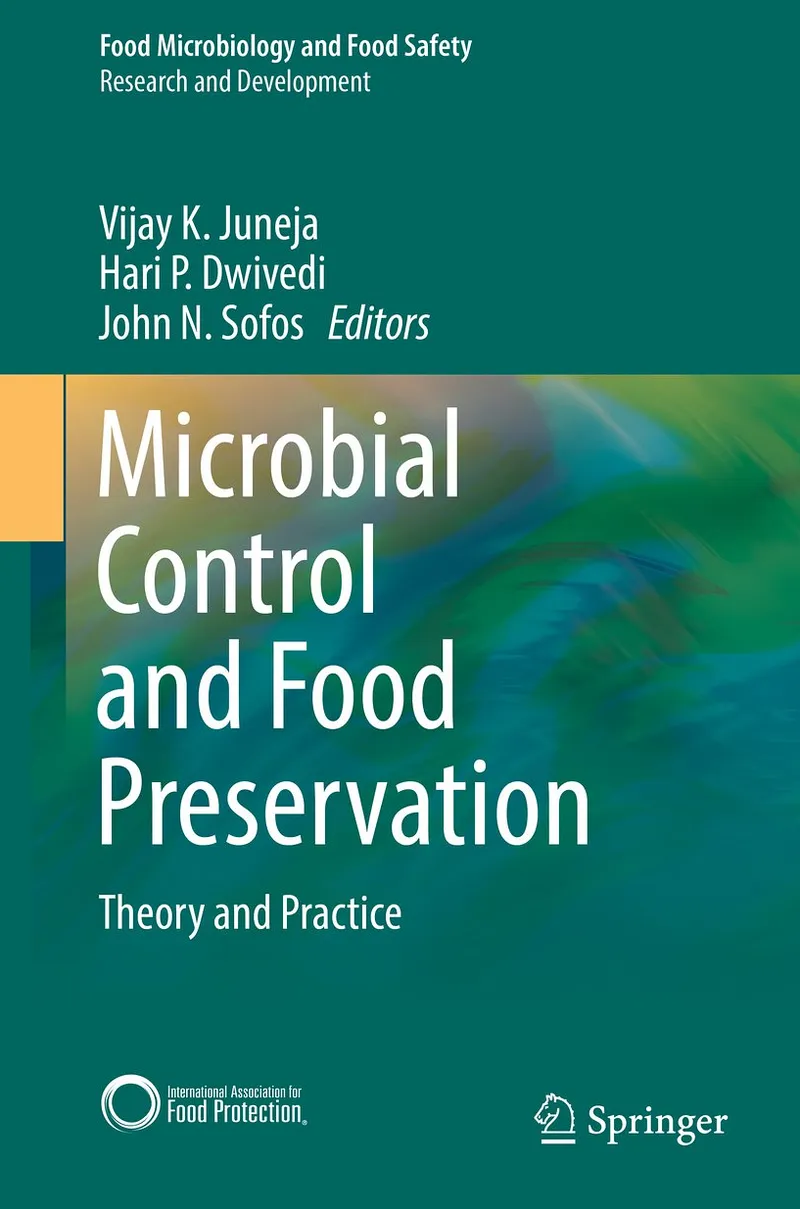

Microbial Control and Food Preservation: Theory and Practice
Microbial Control and Food Preservation: Theory and Practice is a specialized reference in the Food Microbiology and Food Safety series, published by Springer. The book examines the principles and practical methods used to control microorganisms in foods and extend their shelf life while maintaining safety and quality.
With 442 pages, it provides a detailed foundation for understanding the relationship between microbial growth, food preservation, processing, and food safety.
About the Book
Microbial growth is one of the major causes of food spoilage and can also create serious food safety concerns. Food preservation therefore relies on methods that inhibit, destroy, or control microorganisms without unnecessarily compromising food quality.
This book explores the scientific principles behind these approaches and their practical applications in food processing.
Microbial Growth in Foods
The growth of microorganisms in food depends on factors such as temperature, moisture availability, pH, nutrients, oxygen, and storage conditions.
Understanding these factors is essential for predicting microbial behavior and selecting appropriate preservation strategies.
Microbial Control
Food preservation can involve several approaches to controlling microorganisms.
The book provides a foundation for understanding methods involving heat treatment, refrigeration, freezing, drying, chemical preservation, and other microbial control strategies used in food systems.
Food Preservation Technologies
Different foods require different preservation approaches.
The book examines preservation principles that can be applied to maintain the microbiological safety, stability, and shelf life of food products under appropriate processing and storage conditions.
Food Safety
Controlling microorganisms is central to preventing foodborne disease.
The book addresses the importance of managing microorganisms that may cause foodborne infections, intoxications, contamination, and spoilage, linking preservation practices with broader food safety objectives.
Spoilage and Shelf Life
Microbial spoilage can result in undesirable changes in taste, odor, texture, appearance, and nutritional quality.
Understanding microbial growth and control helps food scientists develop preservation systems capable of extending shelf life while maintaining acceptable product quality.
Practical Applications
The principles of microbial control have applications throughout the food industry.
The book is relevant to food processing, quality control, food safety management, product development, and preservation research, making it useful for both academic and industrial applications.
Who Is This Book For?
Microbial Control and Food Preservation: Theory and Practice can be useful for:
- Food microbiology students
- Food science students
- Food technology students
- Microbiology students
- Food safety professionals
- Quality-control specialists
- Food processing professionals
- Biotechnology students
- Food preservation researchers
Final Thoughts
Microbial Control and Food Preservation: Theory and Practice provides a detailed examination of how microorganisms can be controlled to improve food safety, quality, and shelf life.
By connecting microbiological principles with preservation technologies and food-processing applications, the book offers a useful resource for understanding the scientific basis of modern food preservation.
With 442 pages, it is well suited to students, researchers, and professionals seeking a focused reference on food microbiology, microbial control, and preservation technology.
Book Information
Title: Microbial Control and Food Preservation: Theory and Practice
Series: Food Microbiology and Food Safety
Edition: 1st ed. 2017
Publisher: Springer
Publication Date: January 24, 2018
Language: English
Print Length: 442 pages
ISBN-10: 1493975544
ISBN-13: 978-1493975549
Subject: Food Microbiology / Food Safety / Food Preservation / Microbial Control / Food Technology
Microbial Control and Food Preservation: Theory and Practice explores the principles and applications of microbial growth control, food preservation, spoilage prevention, food safety, and shelf-life extension, making it a valuable reference for students and professionals in food microbiology and food science.
Support the Creators!
If you enjoy this book, please consider supporting the author and publisher by purchasing a physical or digital copy. Buying official copies ensures authors can keep writing great books.