
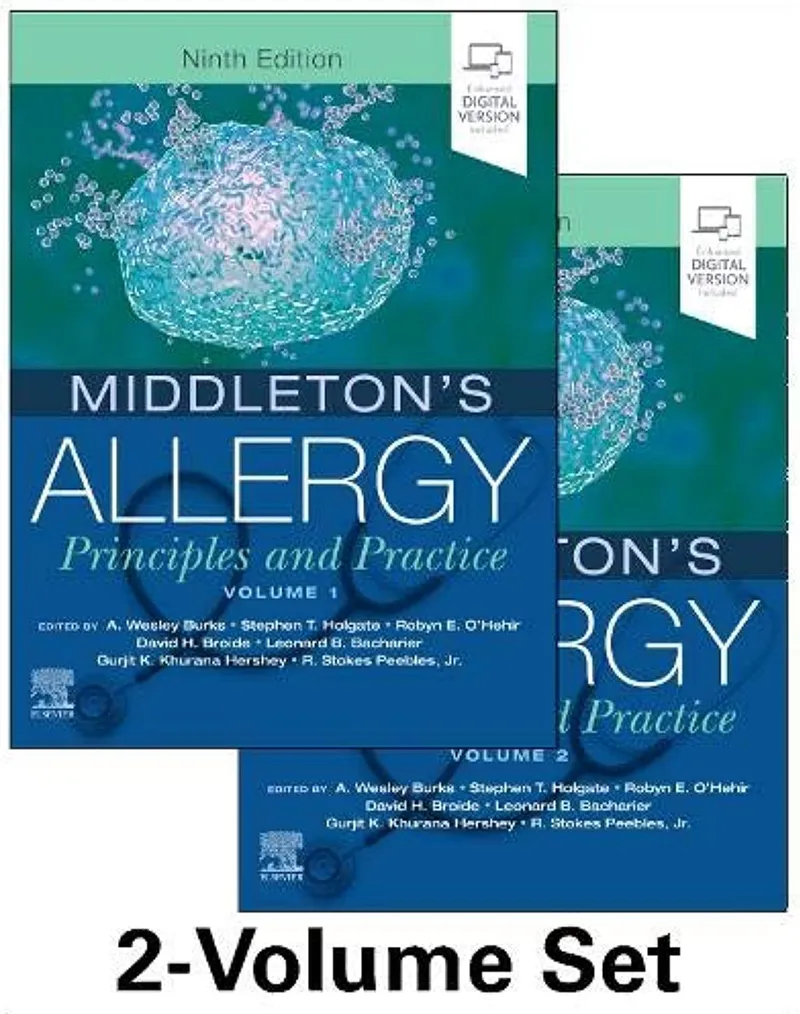

Middleton’s Allergy: Principles and Practice, 9th Edition
Middleton’s Allergy: Principles and Practice, 9th Edition is a comprehensive two-volume reference covering the science, diagnosis, and clinical management of allergic and immunologic diseases. Published by Elsevier, this extensive edition brings together fundamental immunology, allergy mechanisms, diagnostic approaches, and evidence-based clinical practice.
With 1,840 pages, it is designed as an in-depth reference for specialists, clinicians, researchers, and advanced students working in allergy, immunology, pulmonology, dermatology, and related medical fields.
About the Book
Allergic diseases result from complex interactions between the immune system, environmental exposures, genetics, and individual susceptibility.
Middleton’s Allergy: Principles and Practice provides a broad foundation for understanding these mechanisms while connecting them with the clinical evaluation, diagnosis, and management of allergic disorders.
Immunologic Foundations
Understanding allergy begins with understanding the immune mechanisms responsible for hypersensitivity reactions.
The book examines important concepts involving immune responses, antigens, antibodies, immune cells, inflammatory mediators, and mechanisms of allergic disease.
Allergy Pathophysiology
Allergic reactions involve coordinated cellular and molecular processes.
The text explores mechanisms underlying IgE-mediated reactions, inflammation, mast-cell activation, eosinophilic responses, and other pathways involved in allergic disease.
Allergic Diseases
The two-volume set provides extensive coverage of major allergic conditions affecting different organ systems.
Topics include disorders involving the respiratory tract, skin, gastrointestinal system, and other tissues, providing a broad clinical perspective on allergy.
Asthma and Respiratory Allergy
Respiratory allergic diseases represent a major area of clinical allergy.
The book discusses the relationship between allergic inflammation, asthma, airway disease, environmental allergens, and respiratory symptoms, together with approaches to clinical evaluation and management.
Food Allergy
Food allergies can produce reactions ranging from mild symptoms to severe systemic responses.
The text examines food allergens, mechanisms of food allergy, clinical manifestations, diagnostic approaches, and management strategies.
Drug Allergy
Medications can trigger a variety of immune-mediated reactions.
The book addresses the evaluation of drug hypersensitivity and drug allergy, including clinical assessment and approaches to diagnosis and management.
Skin Allergy
Allergic and immune-mediated skin disorders are another important area of clinical practice.
The text covers conditions involving urticaria, atopic dermatitis, contact reactions, and other allergic or immunologic skin diseases.
Anaphylaxis
Severe systemic allergic reactions require rapid recognition and appropriate treatment.
The book provides detailed discussion of anaphylaxis, its underlying mechanisms, clinical presentation, diagnosis, prevention, and management.
Allergy Diagnosis
Accurate diagnosis requires combining clinical history with appropriate laboratory and diagnostic testing.
The book discusses methods including skin testing, allergen-specific antibody testing, challenge procedures, and other diagnostic approaches used in allergy practice.
Immunotherapy
Allergen immunotherapy can modify the immune response to specific allergens.
The text examines principles and clinical applications of allergen immunotherapy, including its role in the management of selected allergic diseases.
Environmental Allergens
Patients may react to allergens encountered in their homes, workplaces, or surrounding environments.
The book addresses important indoor and outdoor allergens, their clinical relevance, and approaches to reducing exposure.
Pediatric Allergy
Allergic diseases frequently begin during childhood.
The text provides information relevant to the evaluation and management of allergic and immunologic conditions in pediatric patients.
Who Is This Book For?
Middleton’s Allergy: Principles and Practice, 9th Edition can be useful for:
- Allergists and immunologists
- Allergy and immunology fellows
- Physicians
- Medical students
- Researchers
- Pulmonologists
- Dermatologists
- Pediatricians
- Clinical immunologists
- Graduate students
- Healthcare professionals
It is particularly suited to readers seeking a comprehensive reference on allergy, clinical immunology, diagnosis, and treatment.
Final Thoughts
Middleton’s Allergy: Principles and Practice, 9th Edition provides extensive coverage of the biological mechanisms and clinical manifestations of allergic disease.
Its discussion of immunology, allergic inflammation, asthma, food allergy, drug allergy, skin disorders, anaphylaxis, diagnostic testing, environmental allergens, and immunotherapy makes it an important reference for clinicians, researchers, and advanced students in allergy and immunology.
Book Information
Title: Middleton’s Allergy: Principles and Practice
Edition: 9th Edition
Format: 2-Volume Set
Publisher: Elsevier
Publication Date: December 25, 2019
Language: English
Print Length: 1,840 pages
ISBN-10: 032354424X
ISBN-13: 978-0323544245
Subject: Allergy / Clinical Immunology / Immunology / Asthma / Allergic Diseases
Middleton’s Allergy: Principles and Practice, 9th Edition is a comprehensive two-volume reference covering allergy and immunology, allergic inflammation, asthma, food and drug allergy, skin disorders, anaphylaxis, diagnostic testing, environmental allergens, and allergen immunotherapy, making it a valuable resource for clinicians, researchers, and advanced students.
Support the Creators!
If you enjoy this book, please consider supporting the author and publisher by purchasing a physical or digital copy. Buying official copies ensures authors can keep writing great books.