
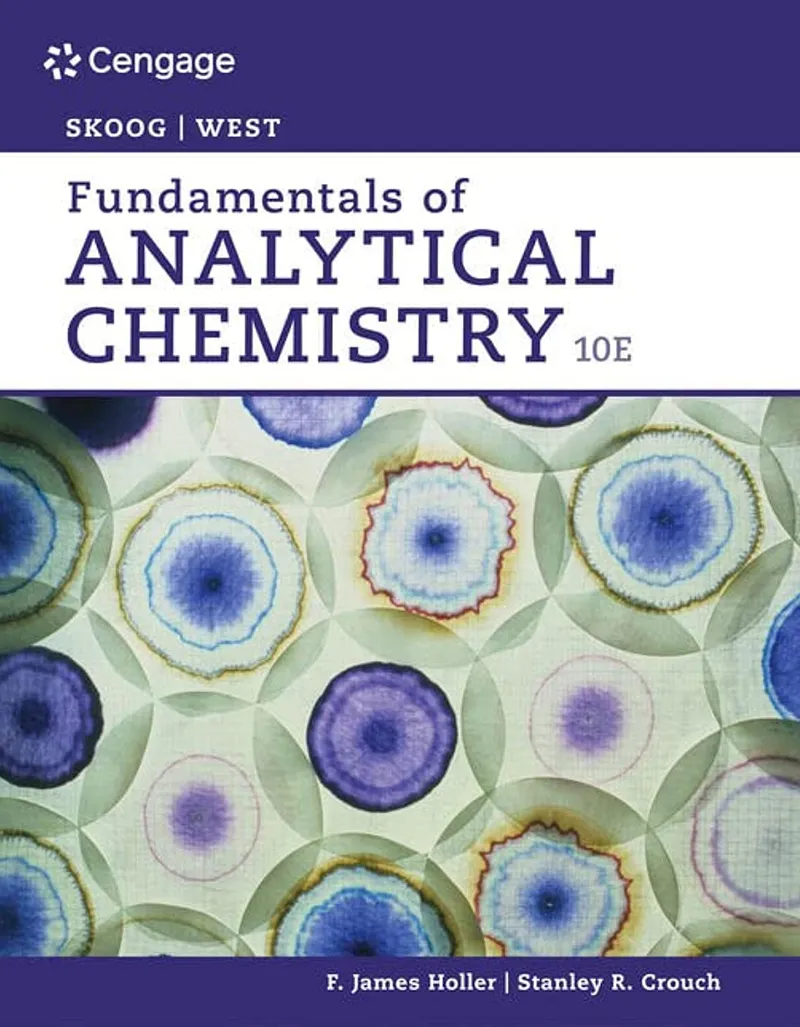

Fundamentals of Analytical Chemistry, 10th Edition
Fundamentals of Analytical Chemistry, 10th Edition is a comprehensive textbook that introduces the principles and techniques used to identify, measure, and analyze chemical substances. Published by Cengage Learning, this edition provides a strong foundation in analytical chemistry while connecting theoretical concepts with practical laboratory applications.
With 1,072 pages, the book offers extensive coverage of chemical analysis, quantitative methods, equilibrium chemistry, instrumental analysis, and laboratory techniques, making it a valuable resource for students studying chemistry, biochemistry, pharmaceutical sciences, and related disciplines.
About the Book
Analytical chemistry focuses on determining what substances are present in a sample and how much of each substance is present. These principles are fundamental to scientific research, medicine, environmental science, pharmaceuticals, food analysis, and industrial quality control.
Fundamentals of Analytical Chemistry develops these concepts systematically, helping students understand the relationship between chemical principles, analytical measurements, experimental methods, and interpretation of results.
Chemical Measurements and Data Analysis
Reliable analytical chemistry depends on accurate measurements and appropriate interpretation of experimental data.
The book introduces important concepts involving measurement uncertainty, significant figures, precision, accuracy, errors, statistical analysis, and evaluation of analytical results.
Chemical Equilibrium
Chemical equilibrium provides the foundation for many analytical methods.
The text examines acid–base equilibria, complex formation, precipitation reactions, and oxidation–reduction equilibria, showing how equilibrium principles can be applied to chemical analysis.
Acid–Base Chemistry
Acid–base reactions are central to numerous analytical procedures.
The book explores pH, buffers, acid–base equilibria, titrations, and calculations involving weak and strong acids and bases.
Gravimetric and Volumetric Analysis
Classical analytical methods remain important for understanding quantitative chemical analysis.
The text covers gravimetric analysis and titrimetric methods, explaining the principles behind precipitation, neutralization, complexation, and redox titrations.
Electrochemistry
Electrochemical techniques provide important approaches for chemical measurement.
The book introduces concepts involving electrochemical cells, electrode potentials, potentiometry, and related analytical methods.
Spectroscopic Methods
Instrumental analysis allows scientists to identify and quantify substances with high sensitivity.
The text introduces important spectroscopic techniques and explains their applications in qualitative and quantitative chemical analysis.
Chromatography
Chromatographic methods are widely used to separate and analyze complex mixtures.
The book discusses fundamental principles of chromatographic separation and analytical applications, providing a foundation for understanding modern separation techniques.
Instrumental Analysis
Modern laboratories rely heavily on analytical instruments.
The text introduces the principles behind various instrumental analytical techniques, explaining how instruments generate measurements and how analytical results can be interpreted.
Sample Preparation
The quality of an analytical result depends partly on how a sample is collected and prepared.
The book discusses important aspects of sampling, sample preparation, separation, and treatment of analytical specimens.
Quantitative Chemical Analysis
Quantitative analysis determines the amount or concentration of a chemical component in a sample.
The text develops the mathematical and chemical principles needed for quantitative calculations, calibration, standardization, and analytical measurements.
Applications of Analytical Chemistry
Analytical chemistry has applications across many scientific fields.
The principles discussed in the book can be applied to environmental analysis, pharmaceutical analysis, clinical chemistry, food science, materials science, forensic science, and industrial quality control.
Who Is This Book For?
Fundamentals of Analytical Chemistry, 10th Edition can be useful for:
- Chemistry students
- Analytical chemistry students
- Biochemistry students
- Pharmaceutical science students
- Medical laboratory science students
- Environmental science students
- Chemical engineering students
- Biology students
- Undergraduate students
- Laboratory professionals
- Graduate students
It is particularly suitable for learners who need a strong foundation in both classical and instrumental analytical chemistry.
Final Thoughts
Fundamentals of Analytical Chemistry, 10th Edition provides an extensive introduction to the principles used to perform and interpret chemical analysis.
Its coverage of chemical measurements, data analysis, equilibrium chemistry, acid–base reactions, titrations, gravimetric analysis, electrochemistry, spectroscopy, chromatography, instrumental methods, and quantitative analysis makes it a valuable study and reference resource for students and professionals working with chemical measurements.
Book Information
Title: Fundamentals of Analytical Chemistry
Edition: 10th Edition
Publisher: Cengage Learning
Publication Date: August 4, 2021
Language: English
Print Length: 1,072 pages
ISBN-10: 0357450396
ISBN-13: 978-0357450390
Subject: Analytical Chemistry / Chemistry / Chemical Analysis / Instrumental Analysis / Laboratory Science
Fundamentals of Analytical Chemistry, 10th Edition provides comprehensive coverage of chemical measurements, analytical data, equilibrium chemistry, acid–base reactions, titrations, gravimetric analysis, electrochemistry, spectroscopy, chromatography, instrumental analysis, and quantitative chemical methods, making it a valuable resource for students studying analytical chemistry and related laboratory sciences.
Support the Creators!
If you enjoy this book, please consider supporting the author and publisher by purchasing a physical or digital copy. Buying official copies ensures authors can keep writing great books.