
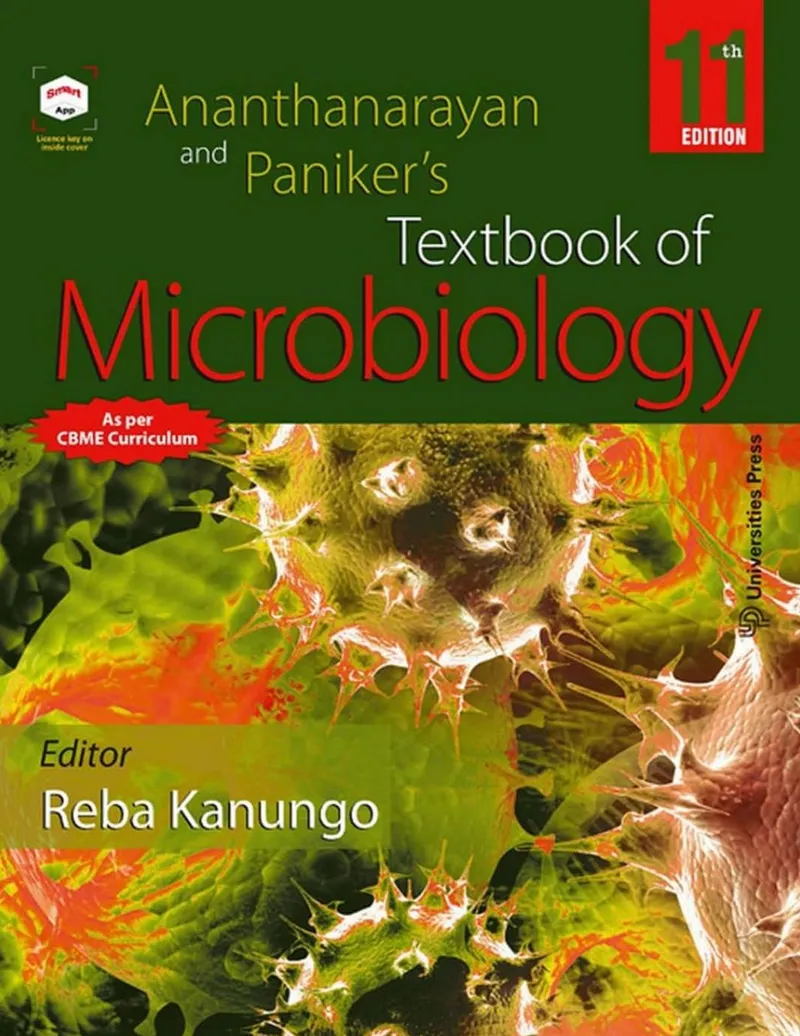

Ananthanarayan and Paniker’s Textbook of Microbiology, 11th Edition
Ananthanarayan and Paniker’s Textbook of Microbiology, 11th Edition is a comprehensive medical microbiology textbook covering the fundamental principles of microorganisms, infectious diseases, laboratory diagnosis, and the relationship between microbes and human health. Published by Orient Blackswan Pvt Ltd, this edition is designed to support students and healthcare professionals studying microbiology in a medical context.
With 680 pages, the book provides broad coverage of bacteriology, virology, mycology, parasitology, immunology, microbial pathogenesis, and diagnostic microbiology, making it a useful resource for medical and allied health science education.
About the Book
Microbiology is fundamental to understanding infectious diseases and their diagnosis, prevention, and treatment. Ananthanarayan and Paniker’s Textbook of Microbiology presents microbiological concepts in a structured format, connecting the biology of microorganisms with their clinical significance and laboratory diagnosis.
General Microbiology
The book introduces the basic principles needed to understand microorganisms, including their structure, physiology, growth, metabolism, genetics, and mechanisms of microbial variation.
These foundations help readers understand how microorganisms survive, reproduce, interact with their hosts, and cause disease.
Bacteriology
Bacteria are responsible for numerous human infections.
The text examines medically important bacteria, including their morphology, classification, virulence factors, pathogenic mechanisms, clinical manifestations, and laboratory identification.
Virology
Viruses require host cells for replication and can cause a wide variety of human diseases.
The book introduces viral structure, replication, classification, pathogenesis, clinical manifestations, laboratory diagnosis, and prevention of important viral infections.
Mycology
Fungi can cause superficial, opportunistic, and systemic infections.
The text covers medically important fungi and discusses their biology, pathogenicity, clinical presentations, and laboratory diagnosis.
Parasitology
Parasitic organisms represent important causes of infectious disease worldwide.
The book provides an introduction to medically significant protozoa and helminths, including their life cycles, transmission, clinical manifestations, and diagnostic approaches.
Immunology
The immune system plays a central role in protection against microorganisms.
The text introduces innate and adaptive immunity, immune cells, antibodies, antigen recognition, complement, hypersensitivity, autoimmunity, and immune responses to infection.
Microbial Pathogenesis
Understanding how microorganisms produce disease is an important component of medical microbiology.
The book explores mechanisms involving colonization, invasion, toxins, virulence factors, host–microbe interactions, and tissue damage.
Clinical Microbiology
Laboratory microbiology is essential for identifying infectious agents.
The text introduces diagnostic principles involving specimen collection, microscopy, culture, microbial identification, and antimicrobial susceptibility testing.
Antimicrobial Agents
Antimicrobial therapy is an important part of infectious disease management.
The book discusses the principles of antibacterial, antiviral, antifungal, and antiparasitic therapy, together with the importance of antimicrobial susceptibility and resistance.
Infection Prevention and Control
Preventing the transmission of infectious organisms is essential in healthcare.
The text covers principles related to sterilization, disinfection, asepsis, healthcare-associated infections, and infection-control practices.
Epidemiology of Infectious Diseases
Microbial diseases are influenced by environmental, geographical, and population factors.
The book introduces principles of epidemiology, modes of transmission, reservoirs, vectors, and prevention of infectious diseases.
Laboratory Diagnosis
Laboratory investigations provide essential evidence for diagnosing infections.
The text explains the role of microscopy, culture, biochemical testing, serology, antigen detection, molecular methods, and antimicrobial susceptibility testing in clinical microbiology.
Who Is This Book For?
Ananthanarayan and Paniker’s Textbook of Microbiology, 11th Edition can be useful for:
- Medical students
- Microbiology students
- Dental students
- Nursing students
- Medical laboratory science students
- Biomedical science students
- Pharmacy students
- Allied health students
- Healthcare professionals
- Postgraduate students
It is particularly useful for students seeking a broad foundation in medical microbiology and infectious diseases.
Final Thoughts
Ananthanarayan and Paniker’s Textbook of Microbiology, 11th Edition provides broad coverage of medical microbiology, linking fundamental microbiological concepts with clinical disease and laboratory diagnosis.
Its treatment of general microbiology, bacteriology, virology, mycology, parasitology, immunology, microbial pathogenesis, antimicrobial therapy, infection control, epidemiology, and diagnostic microbiology makes it a valuable study resource for students in medicine, microbiology, and allied health sciences.
Book Information
Title: Ananthanarayan and Paniker’s Textbook of Microbiology
Edition: 11th Edition
Publisher: Orient Blackswan Pvt Ltd
Publication Date: May 4, 2020
Language: English
Print Length: 680 pages
ISBN-10: 9389211433
ISBN-13: 978-9389211436
Subject: Medical Microbiology / Bacteriology / Virology / Mycology / Parasitology / Immunology
Ananthanarayan and Paniker’s Textbook of Microbiology, 11th Edition provides comprehensive coverage of general microbiology, bacteriology, virology, mycology, parasitology, immunology, microbial pathogenesis, clinical microbiology, antimicrobial therapy, infection control, epidemiology, and laboratory diagnosis, making it a valuable resource for students and healthcare professionals studying medical microbiology.
Support the Creators!
If you enjoy this book, please consider supporting the author and publisher by purchasing a physical or digital copy. Buying official copies ensures authors can keep writing great books.