
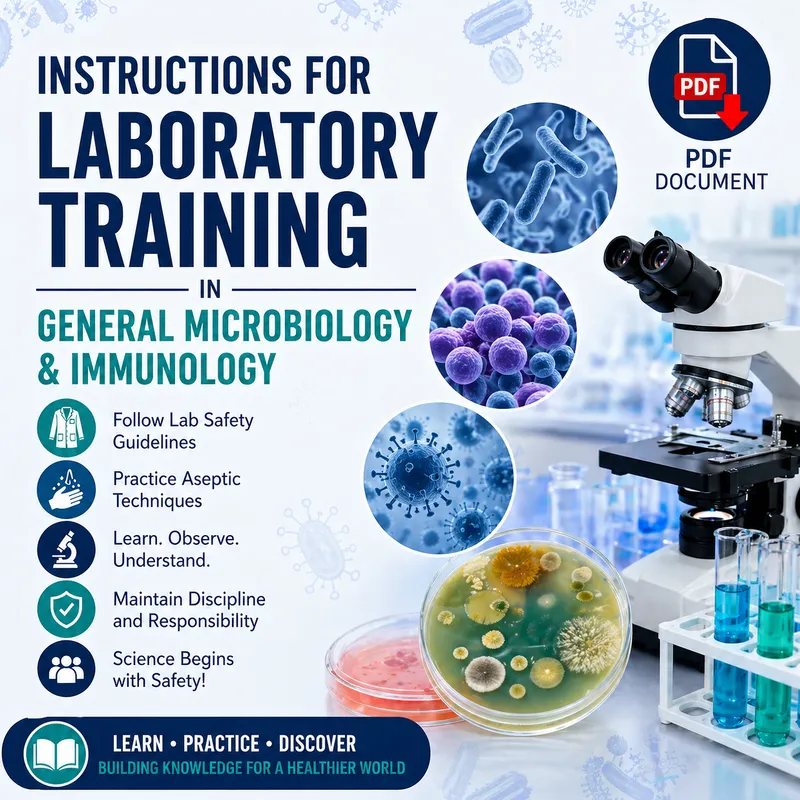

Instructions for Laboratory Training in General Microbiology & Immunology
Instructions for Laboratory Training in General Microbiology and Immunology for Students of the Faculty of General Medicine is a practical laboratory workbook prepared for medical students at higher educational institutions. Published by VSMU Press in 2023, the manual follows the basic educational plan and program approved by the Ministry of Health Care of the Republic of Belarus.
The workbook combines general microbiology, medical microbiology, laboratory techniques, immunology, and practical diagnostic methods into a structured sequence of laboratory classes. It is designed to help medical students develop essential practical skills while reinforcing the theoretical principles of microorganisms, microbial physiology, genetics, infection, immunity, and laboratory diagnosis.
About the Book
This laboratory training manual is organized around a series of practical classes covering the major foundations of general microbiology and medical immunology.
The microbiology section introduces students to laboratory safety, microbial morphology, bacterial physiology, genetics, sanitation, antimicrobial agents, and antibiotic susceptibility testing. The immunology section then progresses through the immune system, antigens and antibodies, innate and adaptive immunity, serological methods, immunopathology, immunodiagnostics, immunoprophylaxis, and immunotherapy.
The workbook also incorporates practical examination exercises, including the isolation and identification of pure bacterial cultures.
Microbiology Laboratory Safety
The first laboratory class introduces students to the microbiological laboratory and the principles of working safely with potentially pathogenic microorganisms.
Topics include biological safety, laboratory organization, safety rules, and responsible handling of microbial agents.
Microbial Systematics and Nomenclature
Students are introduced to the systematics and nomenclature of microorganisms, establishing a foundation for the classification and identification of medically important microbes.
Bacterial Morphology and Staining
Several laboratory classes focus on the microscopic examination of microorganisms.
Students study bacterial morphology, cellular structure, ultrastructure, and methods for examining microorganisms using simple and differential staining techniques.
The workbook also covers the morphology of spirochetes, rickettsiae, chlamydiae, mycoplasmas, and actinomycetes, together with the structure and morphology of fungi.
Isolation of Pure Bacterial Cultures
Practical training includes the staged isolation of a pure culture of aerobic bacteria.
Students follow the examination process across multiple laboratory sessions, providing practical experience with microbial cultivation and laboratory identification.
Bacterial Nutrition and Growth
The manual introduces the nutritional requirements of bacteria and the mechanisms through which nutrients enter bacterial cells.
Topics include bacterial nutrition, nutrient media, transport mechanisms, microbial growth and reproduction, and bacterial pigments.
Microbial Physiology and Biochemical Activity
Students examine the biochemical activities of microorganisms and the processes through which bacteria obtain energy.
The workbook covers bacterial enzymes, biological oxidation, fermentation, respiration, and methods for testing microbial biochemical activity.
Anaerobic Bacteria
The practical microbiology section also introduces methods for cultivating microorganisms that grow in the absence of oxygen.
Students learn fundamental approaches to the culturing of anaerobic bacteria.
Microbial Genetics and Molecular Analysis
A dedicated laboratory class addresses microbial genetics and molecular genetic analysis.
This provides students with an introduction to genetic mechanisms in microorganisms and laboratory approaches used to investigate microbial genetic characteristics.
Sanitary Microbiology and Infection Control
The workbook covers important principles of sanitary microbiology and microbial control.
Students study sterilization, antisepsis, disinfection, and asepsis, as well as the normal microflora of the human body and its biological significance.
Antibiotics and Chemotherapy
Antimicrobial therapy is introduced through a dedicated laboratory class covering chemotherapy, antibiotics, and antibiotic susceptibility testing.
These topics help students understand the laboratory basis for evaluating microbial sensitivity to antimicrobial agents.
Medical Immunology
The second major section of the workbook focuses on immunology and introduces the structure and functions of the immune system.
Students study types of immunity, fundamental immunological terminology, cytokines, interleukins, and the development and differentiation of T and B lymphocytes.
Antigens and Antibodies
The workbook introduces the basic principles of antigen–antibody interactions.
Topics include antigens, antibodies, serological testing, precipitation reactions, and toxin-neutralization reactions.
Innate Immunity
Students examine the mechanisms of innate immune defense, including both humoral and cellular responses.
The course covers Toll-like receptors, phagocytes, phagocytosis, granulocytes, natural killer cells, and the complement system.
Serological Testing
A significant part of the immunology training is dedicated to laboratory serology.
Students are introduced to methods including:
- Agglutination tests
- Indirect hemagglutination
- Coombs’ test
- Enzyme-linked immunosorbent assay (ELISA)
- Radioimmunoassay
- Immunofluorescence assays
- Immunoblotting and Western blotting
- Precipitation reactions
- Toxin-neutralization reactions
These methods provide a practical foundation for understanding how antigen–antibody reactions are used in laboratory medicine.
Immune Response
The manual examines the dynamics of the immune response and the genetic control of immune reactions.
This provides students with a foundation for understanding how immune responses develop and how genetic factors influence immune function.
Immunopathology
The workbook introduces major disorders associated with abnormal immune responses.
Topics include allergy, autoimmune diseases, and primary and secondary immunodeficiencies.
Immunodiagnostics and Immune Status
Students are introduced to the principles of immunodiagnostics and evaluation of immune status.
These concepts help connect immunological mechanisms with laboratory assessment and clinical medicine.
Immunoprophylaxis and Immunotherapy
The final immunology topics introduce the principles of preventing and treating disease through manipulation of the immune system.
The workbook covers immunoprophylaxis and immunotherapy as components of modern medical immunology.
Infection and the Infectious Process
The later section introduces the fundamental concepts of infection and infectious disease.
Topics include the infectious process, epidemic process, pathogenicity, and virulence, providing a foundation for understanding how infectious agents interact with hosts and contribute to disease.
Laboratory Training and Practical Skills
Unlike a purely theoretical microbiology textbook, this workbook is structured around laboratory classes and practical training.
The sequence includes dedicated sessions for microbiological laboratory techniques, bacterial examination, culture isolation, biochemical testing, microbial genetics, antimicrobial susceptibility testing, immunological testing, and final assessments.
Who Is This Book For?
Instructions for Laboratory Training in General Microbiology and Immunology is particularly useful for:
- Medical students
- General medicine students
- Microbiology students
- Immunology students
- Biomedical science students
- Medical laboratory students
- Healthcare students
- Laboratory trainees
- Students studying infectious diseases
It is especially relevant for students who need to develop practical laboratory skills alongside their theoretical knowledge of microbiology and immunology.
Final Thoughts
Instructions for Laboratory Training in General Microbiology and Immunology provides a structured practical introduction to the laboratory aspects of general microbiology and medical immunology.
Its contents progress from laboratory safety, bacterial morphology, staining, microbial cultivation, nutrition, physiology, genetics, sanitation, antibiotics, and susceptibility testing to immune-system structure, antigens and antibodies, innate immunity, serological testing, immunopathology, immunodiagnostics, immunoprophylaxis, and immunotherapy.
The combination of laboratory exercises, theoretical principles, practical examination procedures, and final controls makes this workbook a useful educational resource for medical students developing foundational microbiology and immunology laboratory skills.
Book Information
Title: Instructions for Laboratory Training in General Microbiology & Immunology
Publisher: VSMU Press
Publication Year: 2023
Language: English
Edition: Laboratory Training Workbook
Authors: I. I. Generalov, A. V. Frolova, N. V. Zheleznyak
Subject: General Microbiology / Medical Microbiology / Immunology / Laboratory Training / Medical Education
Instructions for Laboratory Training in General Microbiology and Immunology covers essential practical topics in bacterial morphology and staining, microbial cultivation, bacterial physiology, microbial genetics, sanitary microbiology, antibiotics, antimicrobial susceptibility testing, immunology, serological testing, innate immunity, immunopathology, immunodiagnostics, and infectious processes, making it a practical laboratory resource for medical students.