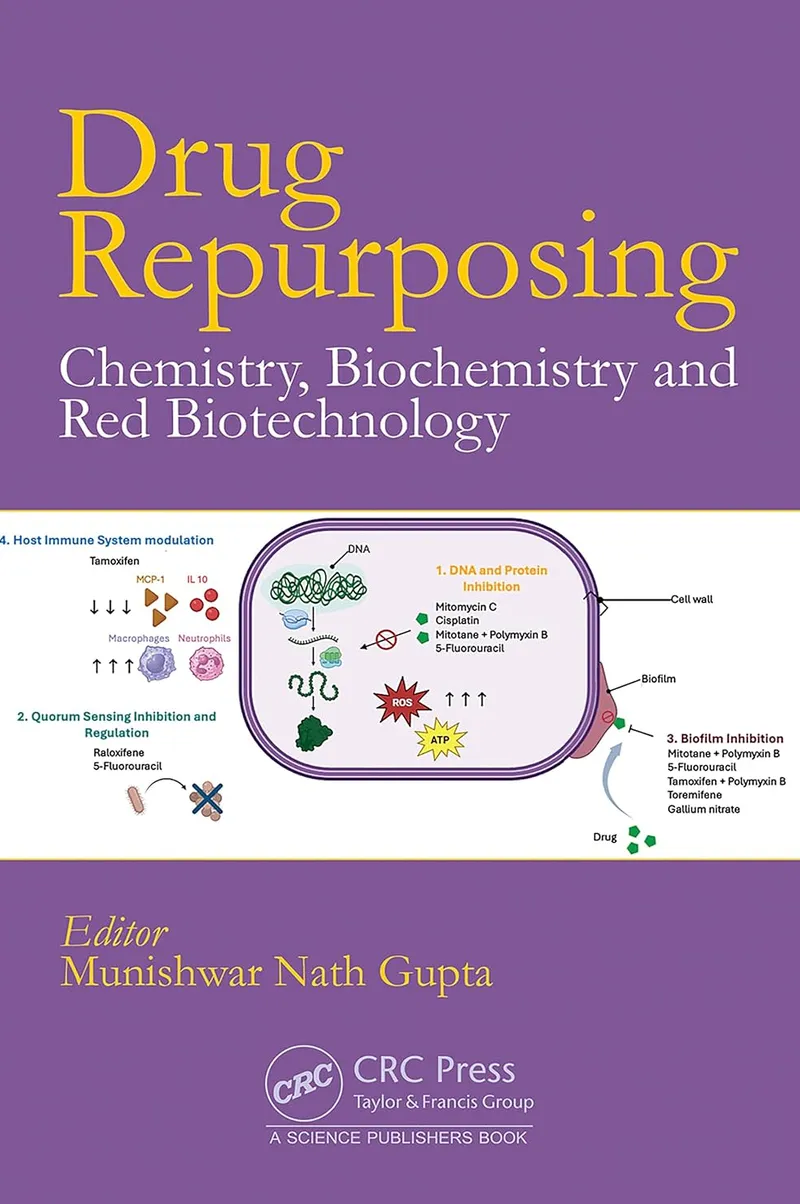

Drug Repurposing: Chemistry, Biochemistry & Red Biotechnology
Drug Repurposing: Chemistry, Biochemistry & Red Biotechnology is a focused scientific volume from CRC Press that explores the growing field of drug repurposing and its applications across modern medicine and biotechnology. Published in 2025, the book examines how existing drugs can be investigated for new therapeutic uses and evaluates both the successes and limitations of this approach.
Drug repurposing has attracted considerable attention because it can provide alternative pathways for discovering treatments while making use of compounds whose biological properties are already partly understood. This book brings together perspectives from chemistry, biochemistry, pharmacology, biotechnology, infectious diseases, oncology, neuroscience, and drug development, providing a balanced discussion of the opportunities and challenges associated with repurposing medicines.
About the Book
This first edition provides an overview of how drug repurposing works and examines the extent to which the initial expectations surrounding this strategy have been realized. Rather than presenting drug repurposing only as a collection of success stories, the book also provides a reality check on the current state of the field and discusses the scientific and practical challenges that remain.
An important theme introduced early in the book is the relationship between drug repurposing and polypharmacology. The discussion challenges the traditional “magic bullet” concept of drug action by emphasizing that both drugs and their biological targets can interact with multiple partners. This perspective helps explain why existing medicines may have therapeutic effects beyond their original indications.
Drug Repurposing in Major Diseases
The book examines the use of drug repurposing strategies across a range of important diseases and therapeutic areas, including:
- Neurodegenerative diseases – exploring efforts to identify existing medicines that may have new applications in disorders affecting the nervous system.
- Psychiatric disorders – considering the potential of established drugs for new therapeutic indications.
- Cancer – examining drug repurposing as an additional strategy in cancer research and treatment development.
- Parasitic worm diseases – discussing efforts to identify existing compounds with activity against parasitic infections.
- Bacterial infections – reviewing areas where repurposed drugs have shown potential against bacterial disease.
- Tuberculosis (TB) – considering drug repurposing in the context of antimicrobial resistance and the continuing challenge of developing effective treatments.
These examples illustrate both the potential of repurposing and the need for careful evaluation of its actual clinical and scientific impact.
Drug Repurposing and Antimicrobial Resistance
Multi-drug resistance represents one of the major challenges facing modern drug development, particularly in the treatment of bacterial infections. The book discusses how drug repurposing could contribute to efforts to identify alternative therapeutic approaches.
The treatment of tuberculosis provides an important example of this challenge. By investigating existing drugs and their biological activities from new perspectives, researchers may identify candidates that could contribute to strategies against resistant infections.
This area of drug repurposing is particularly relevant to researchers interested in antimicrobial drug discovery, infectious diseases, bacterial resistance, and tuberculosis research.
Nanomaterials and Drug Repurposing
Another important aspect covered in the book is the role of nanomaterials in drug formulation. Nanotechnology has become increasingly relevant to pharmaceutical research, including the development and delivery of repurposed therapeutic compounds.
The application of nanomaterials can provide new approaches to formulation and drug delivery, potentially expanding the usefulness of existing compounds and supporting the development of new therapeutic strategies.
Vaccine Repurposing
The book concludes by examining the emerging concept of vaccine repurposing. Increasing amounts of scientific data have created a strong basis for considering vaccines beyond their traditional applications and investigating their potential in new contexts.
This topic extends the concept of repurposing beyond conventional small-molecule medicines and highlights how existing biomedical technologies may provide opportunities for new therapeutic or preventive applications.
Chemistry, Biochemistry and Red Biotechnology
The multidisciplinary nature of Drug Repurposing: Chemistry, Biochemistry & Red Biotechnology makes it relevant to several areas of biomedical research.
The book connects:
- Chemistry – understanding drug structures, compounds, and their potential alternative applications.
- Biochemistry – examining drug-target interactions and biological mechanisms.
- Pharmacology and drug discovery – evaluating existing compounds for new therapeutic purposes.
- Red biotechnology – applying biotechnology to medicine, healthcare, and therapeutic development.
- Nanotechnology – exploring nanomaterials in pharmaceutical formulation.
- Infectious disease research – considering repurposing strategies for bacterial and parasitic diseases.
- Cancer and neuroscience research – investigating alternative uses for established drugs.
This combination provides readers with a broader understanding of drug repurposing as a multidisciplinary research strategy.
Successes, Limitations and Future Challenges
One of the strengths of this volume is its balanced approach. Drug repurposing has generated considerable enthusiasm, but not every proposed application results in an effective therapy. The book therefore combines successful examples, critical evaluation, and discussion of future challenges.
This approach makes the volume useful for understanding not only why drug repurposing is attractive, but also the scientific evidence, limitations, and practical considerations that influence whether a repurposing strategy can ultimately succeed.
Who Should Use This Book?
This book may be useful for:
- Researchers in drug discovery and development
- Pharmaceutical and medicinal chemistry students
- Biochemistry and biotechnology students
- Pharmacology researchers
- Pharmaceutical scientists
- Biomedical researchers
- Microbiology and infectious disease researchers
- Cancer researchers
- Neuroscience and neurodegenerative disease researchers
- Researchers studying antimicrobial resistance
- Biotechnology and pharmaceutical professionals
- Graduate and postgraduate students in biomedical sciences
Final Thoughts
Drug Repurposing: Chemistry, Biochemistry & Red Biotechnology provides a multidisciplinary examination of one of the increasingly important strategies in modern drug discovery. It explores applications ranging from neurodegenerative and psychiatric diseases to cancer, parasitic infections, bacterial diseases, tuberculosis, nanotechnology, and vaccine repurposing.
By combining examples of successful repurposing with a realistic assessment of limitations and future challenges, the book offers a useful perspective on where the field stands and where it may develop next. It can serve as a valuable reference for students, researchers, and professionals interested in the intersection of drug discovery, biochemistry, biotechnology, pharmacology, and modern medicine.
Book Information
Title: Drug Repurposing: Chemistry, Biochemistry & Red Biotechnology
Publisher: CRC Press
Publication Date: September 16, 2025
Edition: 1st
Language: English
Print Length: 200 pages
ISBN-13: 978-1040451496
ASIN: B0FHC3L39N
Subjects: Drug Repurposing / Drug Discovery / Medicinal Chemistry / Biochemistry / Red Biotechnology / Pharmacology / Pharmaceutical Sciences / Biotechnology / Antimicrobial Resistance / Cancer Research / Infectious Diseases / Nanotechnology / Vaccine Repurposing
Drug Repurposing: Chemistry, Biochemistry & Red Biotechnology is a multidisciplinary resource examining the science, applications, successes, limitations, and future challenges of repurposing existing drugs for new therapeutic uses.
Support the Creators!
If you enjoy this book, please consider supporting the author and publisher by purchasing a physical or digital copy. Buying official copies ensures authors can keep writing great books.