
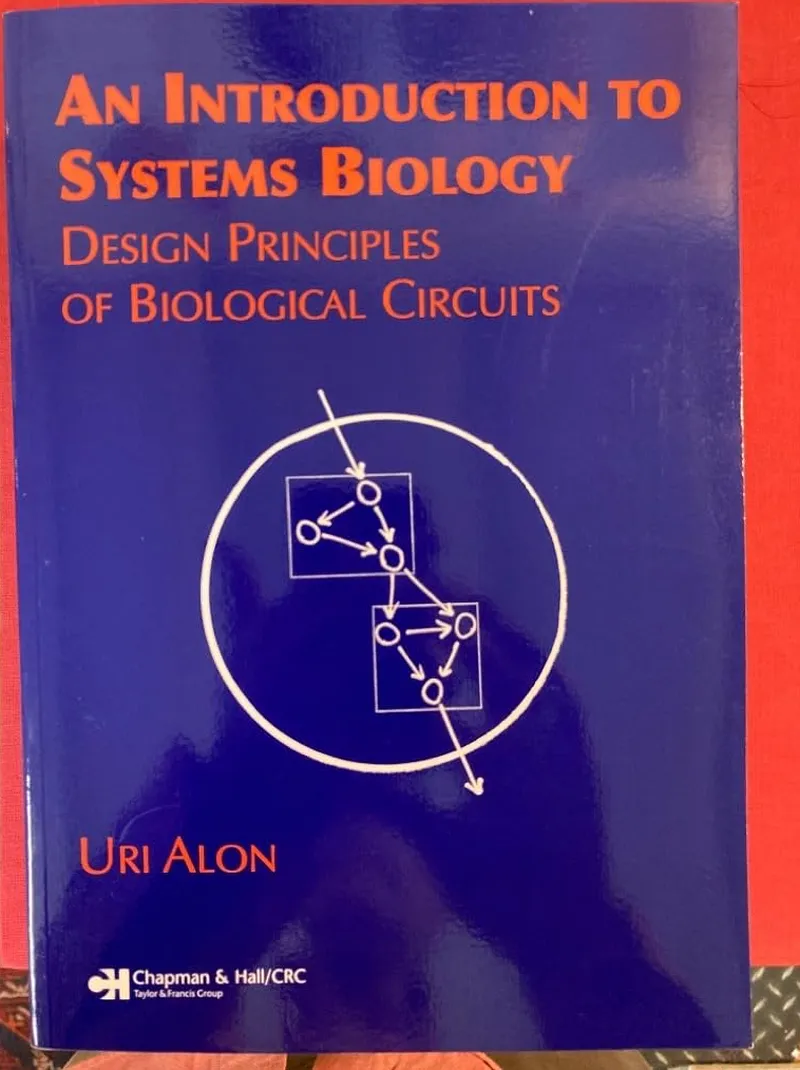

An Introduction to Systems Biology: Design Principles of Biological Circuits
An Introduction to Systems Biology: Design Principles of Biological Circuits is a clear and accessible introduction to the principles behind biological systems and the networks that control their behavior. Published by Chapman and Hall/CRC, this first edition provides readers with a practical way to understand how biological components interact to form functional circuits.
Rather than relying heavily on specialized terminology, the book introduces systems biology through well-studied biological examples and simple mathematical models. It focuses on a fundamental question in biology: Why is a biological system designed the way it is? By examining recurring circuit structures and their functions, readers can develop an intuitive understanding of how biological networks operate.
About the Book
Systems biology brings together biology, mathematics, and computational thinking to study biological systems as interconnected networks rather than as isolated components. This book develops that perspective by examining common design principles found in biological circuits.
A central feature of the book is its use of simplified mathematical frameworks. These models allow readers to explore the behavior of biological systems without requiring an extensive background in advanced mathematics. The approach makes the subject suitable for students and researchers who want to understand the logic underlying biological regulation and network behavior.
Design Principles of Biological Systems
The book highlights recurring circuit elements that appear across different biological networks. Understanding these structures helps explain how cells and organisms can respond to changes, regulate processes, and maintain functional behavior.
Topics include:
- Recurring circuit elements in biological networks
- Design principles underlying biological systems
- Interactions between biological components
- Network behavior and system-level organization
- Functional roles of different circuit structures
- Using simplified models to explain biological behavior
Mathematical Models in Systems Biology
Mathematical modeling provides a useful bridge between biological observations and system-level understanding. The book introduces a relatively simple mathematical framework that can be used to describe and analyze biological circuits.
Instead of presenting mathematics as an isolated subject, the text connects models directly to biological questions. This allows readers to see how mathematical representations can help explain why particular network structures produce particular behaviors.
Understanding Biological Networks
A major goal of the book is to move beyond simply describing biological components. Readers are encouraged to investigate how components work together and why biological networks are organized in particular ways.
Well-studied biological systems are used as examples to demonstrate broader principles. These examples make it easier to recognize patterns that can also occur in other biological networks.
An Accessible Introduction to Systems Biology
The book is designed to provide a strong conceptual foundation without overwhelming readers with specialist terminology. Its accessible approach makes it useful for those encountering systems biology for the first time, while the mathematical perspective also provides a foundation for more advanced study.
By combining biological examples with simplified models, the book encourages readers to develop an intuitive understanding of biological circuits and their underlying design principles.
Who Should Use This Book?
An Introduction to Systems Biology: Design Principles of Biological Circuits can be useful for:
- Biology and life science students
- Students studying systems biology and computational biology
- Biochemistry and molecular biology students
- Researchers interested in biological networks
- Students with an interest in mathematical biology
- Computational biology and bioinformatics learners
- Readers looking for an accessible introduction to biological modeling
- Researchers interested in the design and organization of biological circuits
Final Thoughts
An Introduction to Systems Biology: Design Principles of Biological Circuits offers a practical introduction to the logic and organization of biological networks. Its emphasis on recurring circuit elements, simple mathematical models, and well-established biological examples makes complex systems biology concepts easier to approach.
For students and researchers interested in understanding how biological circuits work and why they are organized in particular ways, this book provides a solid conceptual starting point for exploring systems biology, mathematical modeling, and biological network analysis.
Book Information
Title: An Introduction to Systems Biology: Design Principles of Biological Circuits
Publisher: Chapman and Hall/CRC
Publication Date: July 9, 2006
Edition: 1st Edition
Language: English
Print Length: 320 pages
ISBN-10: 1584886420
ISBN-13: 978-1584886426
Subjects: Systems Biology, Biological Circuits, Biological Networks, Mathematical Biology, Computational Biology, Systems Modeling
An Introduction to Systems Biology: Design Principles of Biological Circuits provides an accessible foundation for understanding biological networks through design principles, recurring circuit structures, and simple mathematical models.
Support the Creators!
If you enjoy this book, please consider supporting the author and publisher by purchasing a physical or digital copy. Buying official copies ensures authors can keep writing great books.