
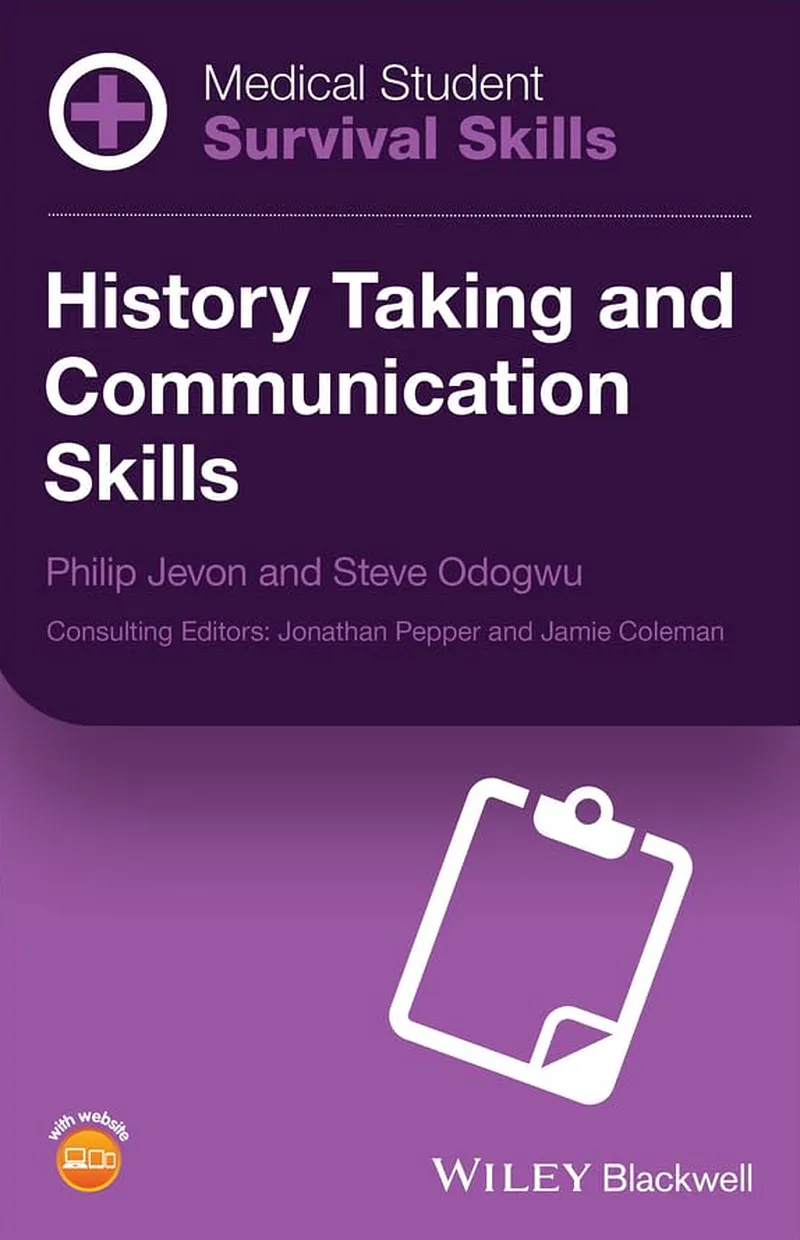

Medical Student Survival Skills: History Taking and Communication Skills
Medical Student Survival Skills: History Taking and Communication Skills is a concise clinical guide designed to help medical students develop two essential skills used throughout medical education and clinical practice: taking an accurate medical history and communicating effectively with patients. Published by Wiley-Blackwell, the book provides a practical reference that can be especially useful during OSCE preparation and hospital placements.
Medical students must learn how to translate theoretical knowledge into effective patient encounters. A structured approach to history taking helps students gather relevant clinical information, while strong communication skills help establish rapport, encourage patients to share important information, and support effective clinical interactions. This book brings these skills together in a compact and accessible format.
About the Book
A Practical Guide to History Taking
The first part of the book focuses on the process of obtaining and recording a medical history. It guides students through the interaction from the initial introduction with the patient to identifying and exploring symptoms, helping develop a systematic approach to clinical interviews.
A structured history is an important foundation for clinical assessment. Students can use the guidance to become more confident in gathering information while maintaining a clear and organized consultation.
Exploring Common Clinical Presentations
The book addresses a range of symptoms and situations that medical students may encounter during clinical training. Topics include:
- Abdominal pain
- Chest pain
- Dizziness and vertigo
- Shortness of breath
- Sexual history
- Confusion and loss of memory
These examples help students understand how history-taking techniques can be adapted according to the patient’s presenting complaint.
Recording Medical Histories
Obtaining information is only part of effective history taking. Students must also learn how to organize and record the information clearly. The book therefore provides guidance relevant to documenting medical histories in a structured clinical context.
Essential Communication Skills
The second section concentrates on patient communication skills and strategies. Effective communication is essential for building positive patient interactions and can be particularly important when conversations involve sensitive, emotional, or difficult subjects.
The book introduces approaches for communicating in a variety of challenging clinical situations, helping students develop greater confidence when interacting with different types of patients.
Managing Challenging Patient Interactions
Clinical encounters do not always proceed smoothly. The guide addresses situations involving angry patients, providing students with strategies for approaching difficult interactions professionally and constructively.
Learning how to remain calm, listen effectively, and communicate appropriately can be an important part of developing clinical professionalism.
Sensitive Clinical Conversations
Some patient interactions require particular care and sensitivity. The book covers communication in situations involving drug and alcohol abuse, as well as sexual history taking and other potentially sensitive topics.
These discussions can help students appreciate the importance of respectful, non-judgmental communication when gathering information from patients.
Counselling and Breaking Bad News
The guide also covers diabetes counselling and breaking bad news, two situations that require careful communication and an appropriate clinical approach. These topics expose students to conversations in which the way information is delivered can be as important as the information itself.
OSCE and Hospital Placement Preparation
As part of the Medical Student Survival Skills series, the book is designed as a short reference guide for OSCE preparation and hospital placements. Its compact format makes it suitable for reviewing important clinical skills before practical assessments or while preparing for patient encounters.
Who Should Use This Book?
- Medical students developing clinical history-taking skills
- Students preparing for OSCEs
- Medical students beginning hospital placements
- Students learning structured patient interviewing
- Those seeking to improve patient communication skills
- Students preparing for challenging clinical conversations
- Medical learners looking for a concise clinical reference guide
Final Thoughts
Medical Student Survival Skills: History Taking and Communication Skills provides a focused introduction to the practical communication abilities that medical students need when moving from classroom learning into clinical environments. Its combination of history taking, symptom exploration, documentation, and patient communication makes it a useful companion for students developing their clinical skills.
With coverage ranging from common presenting symptoms to challenging conversations such as angry patients, substance abuse, counselling, and breaking bad news, the book gives students a practical framework for approaching a variety of patient interactions. Its concise format also makes it well suited to OSCE revision and hospital placement preparation.
Book Information
Title: Medical Student Survival Skills: History Taking and Communication Skills
Publisher: Wiley-Blackwell
Publication Date: April 19, 2019
Edition: 1st Edition
Language: English
Print Length: 272 pages
ISBN-10: 1118862686
ISBN-13: 978-1118862681
Subjects: Medical History Taking, Clinical Communication, Patient Interaction, Clinical Skills, OSCE Preparation, Medical Student Skills, Hospital Placements, Patient Interviewing, Clinical Training
Medical Student Survival Skills: History Taking and Communication Skills is a concise practical guide to medical history taking and effective patient communication, making it a useful companion for OSCE preparation and clinical placements.
Support the Creators!
If you enjoy this book, please consider supporting the author and publisher by purchasing a physical or digital copy. Buying official copies ensures authors can keep writing great books.