
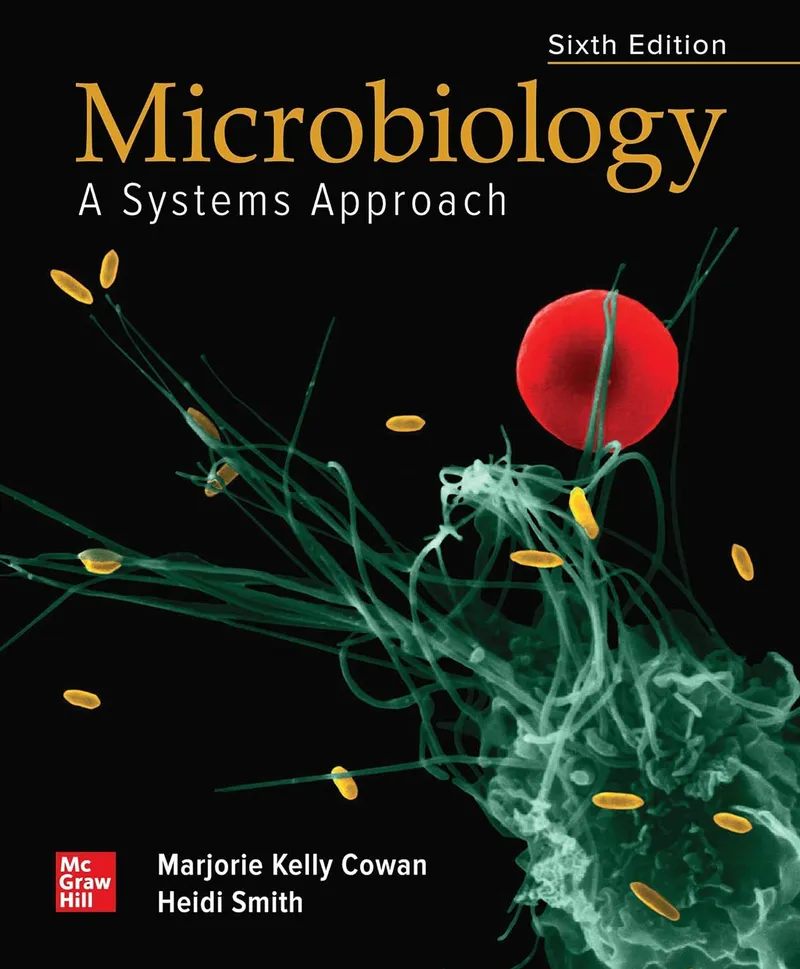

Microbiology: A Systems Approach, 6th Edition
Microbiology: A Systems Approach, 6th Edition by Marjorie Kelly Cowan is a comprehensive introductory microbiology textbook that presents the study of microorganisms through an integrated, systems-based perspective. Published by McGraw Hill, the sixth edition is designed to help students understand not only individual microbiological concepts but also how those concepts interact across cellular biology, genetics, metabolism, microbial ecology, immunology, infectious disease, and biotechnology.
Microbiology encompasses an enormous range of scientific subjects. A student may need to understand chemistry and cell structure before moving into microbial metabolism, genetics, evolution, disease, and immune responses. Microbiology: A Systems Approach addresses this complexity by encouraging students to see relationships between these areas rather than treating them as completely separate topics.
The result is a textbook that can serve as a strong foundation for students beginning their study of microbiology and for readers who want a broad understanding of microbial life and its importance to humans and the environment.
About Microbiology: A Systems Approach
Microorganisms are among the most diverse and influential forms of life on Earth. They inhabit virtually every environment and participate in processes ranging from nutrient cycling and decomposition to fermentation, biotechnology, and infectious disease.
Understanding microorganisms requires an appreciation of their structures, metabolism, genetics, evolution, ecological relationships, and interactions with other organisms.
A systems approach provides a useful way to bring these subjects together. Instead of studying microbial physiology, genetics, ecology, and disease as isolated topics, students can examine how changes in one part of a biological system affect other components.
For example, microbial genes influence proteins and cellular processes; cellular metabolism influences growth; environmental conditions influence microbial populations; and microbial characteristics can influence interactions with human hosts.
This integrated perspective is central to the educational approach of Microbiology: A Systems Approach.
Building a Foundation in Microbiology
The book begins with the fundamental principles students need before they can explore more advanced microbiological topics.
These foundations include the nature of microorganisms, basic chemistry, cell structure, microscopy, laboratory methods, and the principles used to classify and identify microbial life.
Establishing this background is important because later subjects such as metabolism, genetics, microbial control, and infectious disease depend on a clear understanding of microbial structure and function.
The Microbial World
One of the fascinating aspects of microbiology is the extraordinary diversity of microorganisms.
Students encounter bacteria, archaea, fungi, protozoa, algae, viruses, and other microscopic biological entities. Although these organisms can be extremely different from one another, they share fundamental biological principles that allow scientists to study them within a common framework.
Understanding microbial diversity also demonstrates that microorganisms are not simply disease-causing agents. Most microorganisms occupy ecological niches and perform functions that are essential to ecosystems and, in many cases, to human health.
Microscopy and the Study of Microorganisms
Microorganisms are generally too small to observe without specialized equipment.
Microscopy therefore plays a central role in microbiology. Students learn how microscopic techniques allow researchers to observe microbial morphology, cellular structures, and other characteristics.
The study of microscopy also introduces an important principle of scientific investigation: observations provide evidence that can be combined with other laboratory findings to identify and characterize microorganisms.
Microbial Cell Structure
Understanding microbial cells is essential for understanding how microorganisms survive and reproduce.
The textbook examines cellular structures and the functions they perform. Students can compare the organization of prokaryotic and eukaryotic cells and explore how differences in cellular architecture affect microbial physiology.
Cell structure also has practical importance. Many antimicrobial drugs work by targeting structures or processes that are essential to microbial cells.
Microbial Nutrition and Growth
Like all living organisms, microorganisms require resources to grow and reproduce.
However, microorganisms display an extraordinary range of nutritional strategies. Some can use organic compounds as sources of energy and carbon, while others obtain energy through processes that allow them to survive in environments where more familiar organisms could not.
Understanding microbial nutrition helps explain microbial ecology, biotechnology, food production, and the growth of microorganisms in laboratory and clinical settings.
Microbial Metabolism
Metabolism is one of the central themes of microbiology.
Microorganisms use metabolic pathways to obtain energy, synthesize cellular components, and maintain their biological functions. Their metabolic diversity allows microorganisms to inhabit environments ranging from deep sediments and oceans to soil, food, and the human body.
Students studying microbial metabolism can therefore gain insight into both the internal operation of microbial cells and the ecological roles microorganisms play in the world around them.
Microbial Growth and Environmental Factors
Microbial populations respond strongly to their surroundings.
Factors such as temperature, pH, oxygen availability, moisture, nutrient availability, and osmotic conditions can influence microbial growth.
Understanding these relationships has practical importance in many areas. Food preservation, infection control, laboratory cultivation, industrial microbiology, and environmental biotechnology all depend on controlling or understanding the conditions under which microorganisms grow.
Microbial Genetics
Genetics provides the information needed to understand how microorganisms inherit characteristics and adapt to changing conditions.
The textbook introduces the organization and expression of genetic information and explains how genetic variation can arise.
Students can then connect genetic mechanisms with microbial evolution, biotechnology, pathogenicity, and antimicrobial resistance.
Gene Expression and Regulation
Microorganisms must regulate their genes in response to their environments.
Gene regulation allows cells to produce particular proteins when they are needed and conserve resources when they are not.
This subject demonstrates the relationship between genetic information and cellular behavior and provides an important foundation for understanding microbial adaptation.
Microbial Genetic Exchange
Microorganisms can acquire genetic information through mechanisms that differ from the simple inheritance patterns commonly associated with multicellular organisms.
The exchange of genetic material between microorganisms can contribute to rapid changes in microbial populations.
This is particularly important in understanding the spread of characteristics such as antimicrobial resistance and other traits that can influence microbial survival.
Viruses and Other Acellular Agents
Viruses differ fundamentally from cellular microorganisms.
The book introduces viral structure, replication, diversity, and interactions with host cells. Understanding viruses requires students to reconsider some of the concepts used to define cellular life.
Viral biology is also highly relevant to human health because viruses are responsible for numerous infectious diseases.
Microbial Evolution
Evolution provides a framework for understanding microbial diversity and adaptation.
Microorganisms can respond rapidly to environmental changes because of their short generation times and large population sizes. Mutation, selection, genetic exchange, and other processes can contribute to changes within microbial populations.
Studying microbial evolution therefore helps explain both the extraordinary diversity of microorganisms and challenges such as antimicrobial resistance.
Controlling Microbial Growth
Controlling microorganisms is essential in medicine, food production, laboratory science, and public health.
The textbook examines approaches for controlling microbial growth and explains how physical and chemical conditions can be used to inhibit or destroy microorganisms.
These principles provide the scientific basis for sterilization, disinfection, sanitation, preservation, and other microbial-control procedures.
Antimicrobial Drugs
Antimicrobial chemotherapy represents one of the most important practical applications of microbiology.
Students learn how antimicrobial agents affect microorganisms and why different drugs target different cellular processes or structures.
Understanding these mechanisms helps explain why antimicrobial drugs can selectively affect microorganisms while having different effects on host cells.
Antimicrobial Resistance
Antimicrobial resistance is an important modern microbiological challenge.
Microorganisms can acquire genetic changes that allow them to survive exposure to antimicrobial agents. The spread of resistance can make infections more difficult to treat and increases the importance of appropriate antimicrobial use.
Studying resistance from a systems perspective allows students to connect microbial genetics, evolution, cellular physiology, antimicrobial mechanisms, and public health.
Microbial Ecology
Microorganisms are essential components of ecosystems.
They contribute to decomposition, nutrient cycling, energy flow, and interactions between organisms. Some microorganisms live in symbiotic relationships with plants and animals, while others perform important chemical transformations in soil and aquatic environments.
Microbial ecology therefore expands microbiology beyond the laboratory and clinic and demonstrates how microorganisms contribute to the functioning of the planet.
Microorganisms and the Human Body
Humans live in continuous association with microorganisms.
The human body contains diverse microbial communities that interact with tissues, nutrients, the immune system, and one another. Some microorganisms can cause disease, while others are harmless or beneficial.
Understanding these relationships helps students develop a more accurate view of microorganisms and recognize that the microbial world is not synonymous with infection.
Host–Microbe Interactions
When microorganisms encounter a human host, the outcome depends on many factors.
Microbial characteristics, host defenses, environmental conditions, and the nature of the interaction all contribute to whether colonization, infection, or disease occurs.
Studying host–microbe interactions therefore brings together microbial physiology, genetics, immunology, and human biology.
Innate and Adaptive Immunity
The immune system provides multiple layers of protection against microorganisms.
The textbook introduces innate defenses as well as adaptive immune responses, allowing students to understand how the body recognizes and responds to microbial threats.
Adaptive immunity also provides the basis for immunological memory, which is important for understanding vaccination and long-term protection against infectious diseases.
Infectious Disease
Microbiology provides the foundation for understanding infectious disease.
The book explores the mechanisms by which microorganisms establish infections, damage host tissues, evade immune defenses, and spread between hosts.
Studying disease from a microbiological perspective allows students to connect microbial structure and physiology with real clinical outcomes.
Epidemiology
Infectious diseases occur within populations rather than only within individual patients.
Epidemiology examines patterns of disease and the factors influencing transmission. Understanding these principles helps students appreciate how microorganisms move through populations and why public-health interventions can reduce the spread of infection.
Diagnostic Microbiology
Identifying microorganisms is an essential component of clinical microbiology.
Diagnostic approaches may include microscopy, culture, biochemical testing, immunological techniques, molecular methods, and other laboratory procedures.
Students can learn how microbiologists combine different types of evidence to determine the identity and significance of a microorganism.
Biotechnology and Applied Microbiology
Microorganisms are valuable biological tools.
Their metabolic diversity, rapid growth, and genetic flexibility make them useful in biotechnology, pharmaceutical production, food processing, environmental applications, and scientific research.
Understanding these applications demonstrates that microbiology is not limited to the study of infectious disease.
Microorganisms can also be used to produce useful compounds, transform materials, support industrial processes, and contribute to environmental technologies.
Food and Industrial Microbiology
Microorganisms have played important roles in food production for thousands of years.
Fermentation processes involving microorganisms are used to produce a variety of foods and beverages. At the same time, microbial contamination can cause spoilage and foodborne illness.
Industrial microbiology similarly takes advantage of microbial metabolism to produce useful products and carry out biological processes on a large scale.
Environmental Microbiology
Microorganisms are essential to the natural environment.
They contribute to carbon, nitrogen, sulfur, and other biogeochemical cycles and help break down organic materials.
Environmental microbiology also examines how microorganisms can be used to address environmental problems, including waste treatment and bioremediation.
These applications illustrate how microbial processes can be harnessed to support environmental sustainability.
Why a Systems Approach Matters
The major advantage of a systems-based perspective is that it encourages students to think about relationships.
A microorganism’s genes influence its proteins. Those proteins influence cellular processes. Cellular processes influence growth and survival. Environmental conditions affect those processes, while interactions with other organisms influence the microorganism’s ecological role.
The same interconnected reasoning can be applied to infectious disease.
A pathogen’s genetic characteristics can influence its virulence. Its cellular structures can affect how it interacts with host tissues. The host’s immune response can determine the outcome of infection. Antimicrobial treatment can create selection pressure that favors resistant organisms.
Seeing these relationships can make microbiology more understandable and scientifically meaningful.
Who Is Microbiology: A Systems Approach For?
Microbiology: A Systems Approach, 6th Edition can be useful for a broad range of students studying microbiology and related biological sciences.
It may be particularly appropriate for:
- Undergraduate microbiology students
- Biology students
- Pre-medical students
- Nursing and allied-health students
- Health-science students
- Biotechnology students
- Students studying molecular biology
- Environmental science students
- Students taking introductory microbiology
- Independent learners interested in microorganisms
The broad coverage also makes the textbook useful as a reference when students encounter microbiological concepts in more specialized courses.
Why Study from Microbiology: A Systems Approach?
Microbiology is sometimes presented as a subject dominated by memorization. Students may be expected to remember large numbers of microbial species, diseases, laboratory tests, and biological terms.
A systems approach offers a different way to learn.
Instead of simply memorizing facts, students can ask how microbial structures, genes, metabolism, environmental conditions, host defenses, and ecological relationships influence one another.
This approach can help transform individual facts into a connected framework of knowledge.
A Foundation for Further Study
A strong understanding of microbiology can prepare students for more advanced study in many disciplines.
Knowledge gained from this textbook can provide a foundation for subjects such as:
- Medical microbiology
- Clinical microbiology
- Immunology
- Molecular biology
- Genetics
- Biotechnology
- Epidemiology
- Infectious disease
- Environmental microbiology
- Food microbiology
- Public health
- Pharmaceutical science
The broad nature of the book makes it particularly useful as an introductory resource before students move into specialized areas.
Final Thoughts
Microbiology: A Systems Approach, 6th Edition by Marjorie Kelly Cowan provides a broad introduction to the microbial world while encouraging students to understand the relationships connecting different areas of microbiology.
The book moves from fundamental concepts such as microbial structure, chemistry, microscopy, nutrition, and growth toward genetics, metabolism, evolution, microbial control, antimicrobial drugs, ecology, immunology, infectious disease, diagnostics, and biotechnology.
Its systems-oriented perspective is particularly useful for understanding that microorganisms cannot always be studied effectively as isolated subjects. Their biology is shaped by interactions between genes, cells, environments, hosts, populations, and ecosystems.
For students beginning an undergraduate microbiology course, the textbook offers a comprehensive foundation for exploring microorganisms and their importance in medicine, biotechnology, environmental science, public health, and everyday life.
Book Information
Title: Microbiology: A Systems Approach
Edition: 6th Edition
Author: Marjorie Kelly Cowan
Publisher: McGraw Hill
Publication Date: January 7, 2020
Edition: 6th Edition
Language: English
Print Length: 864 pages
ISBN-10: 1260258998
ISBN-13: 9781260258998
Subject: Microbiology / Biological Sciences
Microbiology: A Systems Approach, 6th Edition is a useful academic resource for students who want to develop a connected understanding of microbial biology, from the molecular level through individual organisms, human health, microbial communities, and the environment.
Support the Creators!
If you enjoy this book, please consider supporting the author and publisher by purchasing a physical or digital copy. Buying official copies ensures authors can keep writing great books.