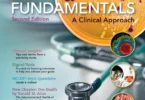

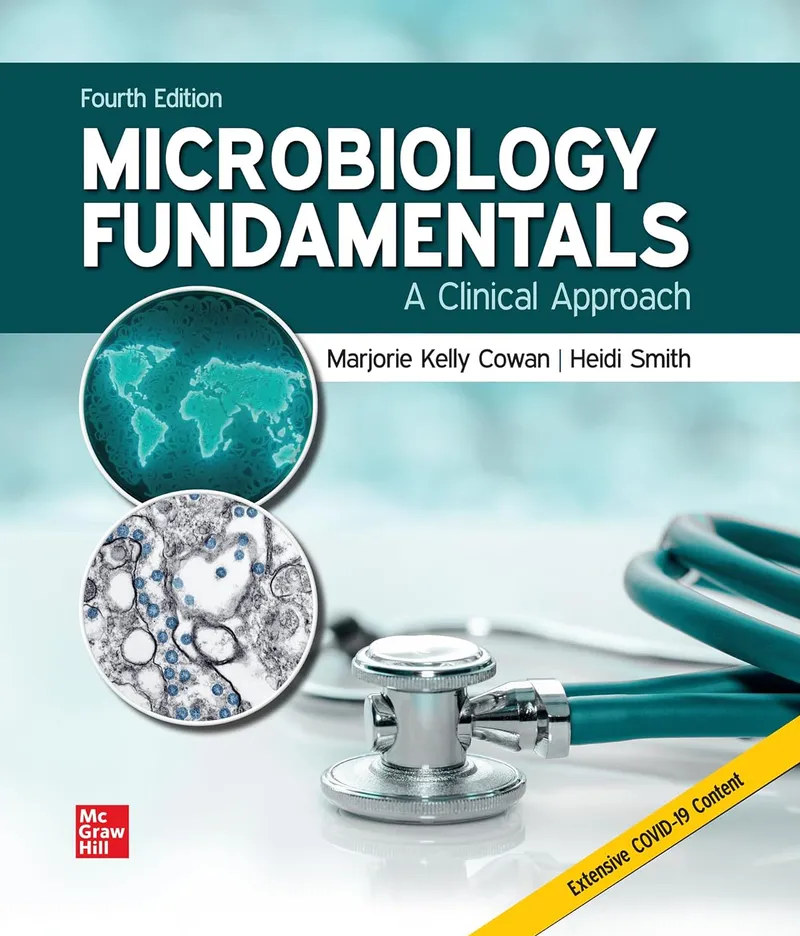

Microbiology Fundamentals: A Clinical Approach, 4th Edition
Microbiology Fundamentals: A Clinical Approach, 4th Edition by Marjorie Kelly Cowan, Heidi Smith, and Jennifer Lusk is a comprehensive introductory microbiology textbook published by McGraw Hill. Designed around the connection between fundamental microbiological science and human health, the book provides students with a structured introduction to microorganisms, microbial processes, infectious diseases, immunity, antimicrobial treatment, diagnostic methods, and the relationship between humans, animals, and the environment.
The fourth edition contains 768 pages and was published by McGraw Hill in 2021. It is identified by ISBN-10 126070243X and ISBN-13 9781260702439.
What makes this textbook particularly useful is its clinical orientation. Instead of studying microorganisms only as biological entities, students are encouraged to understand how microbiological principles relate to disease, diagnosis, treatment, prevention, and human health. The author team also includes Jennifer Lusk, a practicing registered nurse, helping connect microbiological concepts with situations relevant to healthcare and future professional practice.
About Microbiology Fundamentals: A Clinical Approach
Microbiology is a broad discipline that ranges from the chemistry of individual molecules to the behavior of microbial populations and the interactions between microorganisms and humans. For students encountering the subject for the first time, this range can make microbiology seem complicated.
Microbiology Fundamentals: A Clinical Approach approaches the subject progressively. It begins with the basic building blocks of microorganisms and the laboratory techniques used to study them, then moves through microbial structure, growth, metabolism, genetics, microbial control, antimicrobial treatment, immunity, diagnosis, and infectious diseases.
This progression gives students the opportunity to develop the necessary scientific foundation before moving into more clinically oriented topics.
The fourth edition contains 22 chapters, beginning with the fundamentals of microorganisms and ending with the broader concept of One Health, which considers the interconnected health of humans, animals, and the environment.
Introduction to Microbes and Their Building Blocks
The book begins by introducing microorganisms and the biological and chemical components that make microbial life possible.
Students are introduced to the characteristics of microorganisms and the fundamental molecules and structures that form the basis of microbial cells. These concepts provide the groundwork for understanding how microorganisms obtain energy, reproduce, interact with their environments, and cause or prevent disease.
Starting with these fundamentals is important because many later microbiological concepts depend on an understanding of cellular structures and biological chemistry.
Tools of the Microbiology Laboratory
Microbiology is an experimental science, and laboratory methods are an essential part of studying microorganisms.
The book introduces methods used for the culturing and microscopic analysis of microorganisms, helping students understand how microorganisms can be grown, observed, and investigated under controlled conditions.
Laboratory techniques provide the practical foundation for later topics such as microbial identification and diagnosis. Students can therefore see how observations made in the laboratory can contribute to understanding microorganisms and infectious diseases.
Bacteria and Archaea
Bacteria and archaea represent two major groups of prokaryotic microorganisms.
The book examines their characteristics and helps students understand the diversity of microbial life. Learning about prokaryotic cellular structures also provides a foundation for understanding microbial growth, metabolism, genetics, antimicrobial treatment, and microbial evolution.
Because bacteria are responsible for many important human infections while also performing essential ecological functions, understanding their biology is central to microbiology.
Eukaryotic Cells and Microorganisms
Not all microorganisms are prokaryotic. The textbook also introduces eukaryotic cells and microorganisms, allowing students to compare their structures and functions with those of bacteria and archaea.
This comparison is especially useful when studying medically important fungi and other eukaryotic microorganisms, since their cellular organization can influence their biology and susceptibility to antimicrobial agents.
Viruses and Prions
Viruses and prions differ fundamentally from cellular microorganisms.
The book introduces their distinctive characteristics and explains why they require different approaches to study and control. Viral infections are particularly important in clinical microbiology, making an understanding of viral structure, replication, transmission, and diagnosis an essential part of an introductory microbiology course.
Microbial Nutrition and Growth
Microorganisms require appropriate nutrients and environmental conditions to survive and reproduce.
The book examines microbial nutrition and growth and explains how environmental factors influence microbial populations. These principles are important in clinical microbiology, food microbiology, environmental microbiology, and biotechnology.
Understanding microbial growth also helps explain why controlling environmental conditions can be an effective way of preventing or reducing microbial contamination.
Microbial Metabolism
Microbial metabolism examines the chemical processes through which microorganisms acquire energy and produce the materials required for cellular growth.
Microorganisms display an impressive range of metabolic strategies. Understanding these processes helps students appreciate how microbes can survive in environments that differ greatly in nutrient availability, oxygen concentration, temperature, and other conditions.
Metabolism also provides an important foundation for understanding biochemical identification tests used in clinical microbiology.
Microbial Genetics and Genetic Engineering
Genetics is central to modern microbiology.
The textbook introduces microbial genetics and genetic engineering, allowing students to understand how genetic information is maintained, expressed, altered, and transferred.
These concepts are important for understanding microbial variation, adaptation, biotechnology, pathogenicity, and antimicrobial resistance.
Genetic engineering also demonstrates how microorganisms and their genetic systems can be used as tools in modern biotechnology and scientific research.
Physical and Chemical Control of Microbes
Controlling microbial populations is essential in healthcare, laboratories, food production, and public health.
The textbook examines physical and chemical approaches for controlling microorganisms and introduces the principles behind methods used to reduce or eliminate microbial contamination.
This material helps students understand why different control methods are appropriate under different circumstances and how microbial characteristics influence susceptibility to environmental and chemical treatments.
Antimicrobial Treatment
Antimicrobial treatment connects microbiological principles directly with healthcare.
Students learn how antimicrobial agents are used against microorganisms and why the effectiveness of a treatment depends on the characteristics of both the microorganism and the antimicrobial agent.
This topic also provides an introduction to one of the most important challenges in modern medicine: antimicrobial resistance.
Understanding why microorganisms can become resistant requires knowledge of microbial genetics, mutation, selection, antimicrobial mechanisms, and microbial evolution.
Interactions Between Microbes and Humans
Humans constantly interact with microorganisms.
Some microorganisms are beneficial or harmless, while others can cause disease. The book examines the relationship between microorganisms and their human hosts and explores the conditions under which microbial interactions can lead to infection.
This perspective is especially important for students entering health-related fields because exposure to microorganisms does not automatically mean that disease will occur.
The outcome depends on factors involving the microorganism, the host, the environment, and the interaction between them.
Host Defenses and Innate Immunity
The human body has multiple mechanisms for protecting itself from microorganisms.
The textbook introduces the body’s innate defenses and explains how these mechanisms provide an initial response to potential pathogens.
Understanding innate immunity gives students the foundation needed to study more specialized immune responses and the ways microorganisms attempt to overcome host defenses.
Adaptive Immunity and Immunization
The book then progresses to adaptive immunity, in which the immune system develops highly specific responses to foreign substances.
Students learn how adaptive immune responses differ from innate defenses and how immunological memory contributes to protection against subsequent exposure.
Immunization can then be understood as an application of these biological principles rather than simply as a medical procedure.
Disorders in Immunity
Although immune responses are essential for protection, abnormalities in the immune system can produce disease.
The textbook examines disorders involving immunity and helps students understand how inappropriate, excessive, or inadequate immune responses can affect human health.
This provides an important connection between microbiology and immunology.
Diagnosing Infections
The diagnosis of infectious diseases depends heavily on microbiological laboratory methods.
The book introduces the principles involved in diagnosing infections and helps students understand how laboratory evidence can be used to identify microorganisms associated with disease.
Diagnostic microbiology may involve microscopy, culture, biochemical testing, immunological methods, molecular techniques, and other approaches depending on the suspected pathogen and clinical specimen.
This chapter therefore brings together many of the laboratory concepts introduced earlier in the book.
Infectious Diseases and the Human Body
The clinical portion of the book is organized around infectious diseases affecting different parts of the human body. This makes the material easier to connect with anatomy, physiology, symptoms, and clinical conditions.
The fourth edition includes chapters covering infectious diseases affecting the:
- Skin and eyes
- Nervous system
- Cardiovascular and lymphatic systems
- Respiratory system
- Gastrointestinal tract
- Genitourinary system
This organization allows students to study microorganisms in the context of the diseases and body systems with which they are associated.
Skin and Eye Infections
The skin and eyes provide important barriers against microbial invasion, but they can also become sites of infection.
Students examine microorganisms associated with infections affecting these areas and learn how microbial characteristics and host defenses influence disease.
Nervous System Infections
Infections involving the nervous system can be particularly serious because of the sensitivity of nervous tissue.
The book introduces microorganisms and infectious conditions associated with the nervous system while connecting disease manifestations with microbial and host factors.
Cardiovascular and Lymphatic Infections
The cardiovascular and lymphatic systems can become involved in serious infections.
Understanding these infections requires students to consider how microorganisms can enter the bloodstream, spread through the body, and interact with host tissues and immune defenses.
Respiratory Infections
Respiratory infections are among the most common infectious diseases encountered in human populations.
The textbook examines microorganisms associated with respiratory disease and provides the microbiological background needed to understand transmission, infection, diagnosis, and prevention.
Gastrointestinal Infections
The gastrointestinal tract contains an enormous microbial community and represents an important site of interaction between microorganisms and humans.
Students explore infectious diseases affecting the gastrointestinal system and learn how microbial contamination, transmission, toxins, and host responses can contribute to illness.
Genitourinary Infections
The book also covers infections involving the genitourinary system, providing students with an understanding of the microorganisms and biological factors associated with these diseases.
One Health
One of the particularly interesting aspects of the fourth edition is its final chapter on One Health: The Interconnected Health of the Environment, Humans, and Other Animals.
The One Health perspective recognizes that human health cannot always be separated from animal health and environmental conditions.
Microorganisms move between humans, animals, and environments, while changes in ecosystems, animal populations, food systems, and human behavior can influence infectious disease patterns.
Introducing this concept at the end of a microbiology textbook provides students with a broader perspective on the role microorganisms play beyond the individual patient.
A Clinical Approach to Learning Microbiology
The clinical orientation of the book is particularly useful for students who are studying microbiology as part of a healthcare or allied-health program.
The authors connect fundamental microbiological concepts with questions that students may encounter in clinical settings:
What microorganism is involved? How does it cause disease? How can it be detected? How does the body respond? How can the infection be treated or prevented?
Thinking about microbiology through these questions can make the subject more coherent and meaningful.
Instead of studying microbial structure, genetics, immunity, and infectious disease as completely separate topics, students can begin to see how they interact during an actual infection.
Who Is This Book For?
Microbiology Fundamentals: A Clinical Approach, 4th Edition can be useful for students studying microbiology as part of a biological or health-science curriculum.
It may be particularly suitable for:
- Undergraduate microbiology students
- Nursing students
- Allied-health students
- Health-science students
- Medical laboratory science students
- Pre-health and pre-medical students
- Students studying infectious diseases
- Students taking introductory microbiology
- Students preparing for healthcare-related careers
- Independent learners interested in microbiology
The clinical emphasis makes it especially relevant to students who want to understand how fundamental microbiology connects with human health and disease.
Why Study from Microbiology Fundamentals: A Clinical Approach?
One of the difficulties of introductory microbiology is that the subject requires students to combine knowledge from several scientific disciplines.
Chemistry explains microbial molecules and metabolism. Cell biology explains microbial structure. Genetics explains inheritance and variation. Immunology explains host defenses. Epidemiology helps explain disease transmission. Clinical microbiology connects these concepts to diagnosis.
A textbook that brings these subjects together can help students develop a more integrated understanding of microbiology.
Microbiology Fundamentals: A Clinical Approach follows this progression from basic principles toward clinical applications, making it possible for students to build their knowledge step by step.
Connecting Microbiology with Healthcare
For students preparing for healthcare careers, microbiology is not simply a theoretical subject.
Understanding microorganisms helps explain why infections develop, how pathogens spread, why antimicrobial drugs work, how resistance emerges, how vaccines provide protection, and how laboratory tests contribute to diagnosis.
The clinical approach of this textbook gives these concepts a practical context.
Students can therefore study microbiology while keeping sight of the larger question: How does knowledge of microorganisms help us understand and protect human health?
Final Thoughts
Microbiology Fundamentals: A Clinical Approach, 4th Edition by Marjorie Kelly Cowan, Heidi Smith, and Jennifer Lusk provides a broad and structured introduction to microbiology with a clear emphasis on clinical relevance.
The book progresses from the basic building blocks of microbial life and laboratory methods through microbial diversity, growth, metabolism, genetics, microbial control, antimicrobial treatment, host defenses, immunization, diagnostic microbiology, and infectious diseases.
Its body-system approach to infectious diseases makes it particularly useful for students who need to connect microorganisms with the human conditions they can cause. The final discussion of One Health further expands the perspective by showing how human health is connected with animals and the environment.
For students beginning their study of microbiology, particularly those in nursing, allied health, health sciences, medical laboratory science, and related programs, this fourth edition provides a comprehensive foundation for understanding microorganisms and their importance in human health.
Book Information
Title: Microbiology Fundamentals: A Clinical Approach
Edition: 4th Edition
Authors: Marjorie Kelly Cowan, Heidi Smith, Jennifer Lusk
Publisher: McGraw Hill
Publication Date: January 20, 2021
Language: English
Print Length: 768 pages
ISBN-10: 126070243X
ISBN-13: 9781260702439
Subject: Microbiology / Clinical Microbiology / Health Sciences
Support the Creators!
If you enjoy this book, please consider supporting the author and publisher by purchasing a physical or digital copy. Buying official copies ensures authors can keep writing great books.