
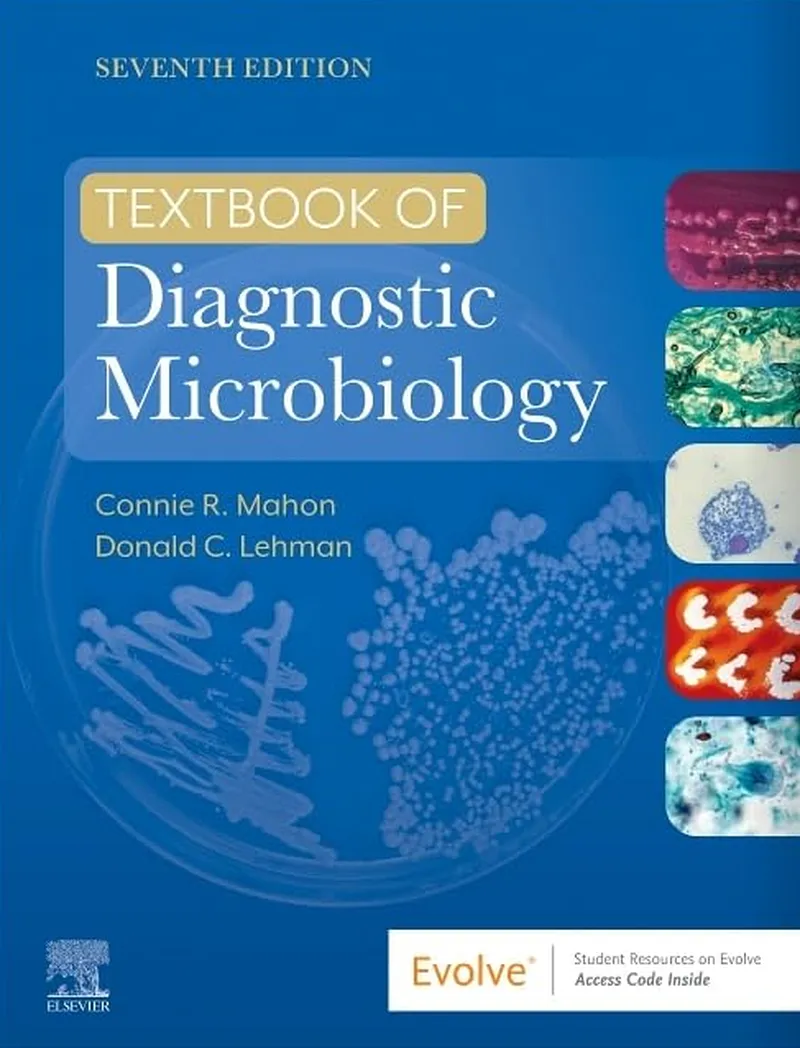

Textbook of Diagnostic Microbiology, 7th Edition
Textbook of Diagnostic Microbiology, 7th Edition by Connie R. Mahon, Donald C. Lehman, and George Manuselis is a comprehensive resource for students and professionals studying clinical and diagnostic microbiology. Published by Elsevier, the textbook focuses on the practical application of microbiological principles in the clinical laboratory, with particular attention to the detection, identification, and characterization of microorganisms associated with human disease.
Diagnostic microbiology plays a critical role in modern healthcare. When a patient is suspected of having an infectious disease, laboratory professionals must determine whether a microorganism is present, identify the causative organism when possible, and provide information that can help guide clinical management. This process requires much more than simply recognizing microorganisms. It involves appropriate specimen collection, transport, processing, culture, microscopy, biochemical testing, molecular methods, antimicrobial susceptibility testing, and careful interpretation of laboratory findings.
Textbook of Diagnostic Microbiology, 7th Edition brings these components together in a comprehensive resource designed to help students understand both the scientific principles and practical procedures behind clinical microbiological diagnosis.
About Textbook of Diagnostic Microbiology
Clinical microbiology is one of the most applied branches of microbiology. While general microbiology introduces students to microorganisms and their biology, diagnostic microbiology focuses on a different question: How can the laboratory determine whether a microorganism is responsible for a patient’s illness?
Answering that question requires an organized diagnostic process.
A specimen must first be collected correctly and transported under appropriate conditions. The laboratory then evaluates the specimen, performs appropriate microscopic and culture-based examinations, identifies potential pathogens, and may carry out additional biochemical, immunological, molecular, or susceptibility testing.
The 7th Edition provides students with a framework for understanding this process and the reasoning behind the laboratory methods used in diagnostic microbiology.
The Role of the Clinical Microbiology Laboratory
The clinical microbiology laboratory serves as an important link between scientific investigation and patient care.
Laboratory professionals examine specimens from patients and generate information that can help clinicians understand infectious diseases. Depending on the suspected infection, specimens may include blood, urine, respiratory samples, stool, wound material, cerebrospinal fluid, genital specimens, and other clinical materials.
The quality of the final laboratory result depends heavily on what happens before the specimen reaches the laboratory. Proper specimen selection, collection, labeling, transport, and processing are therefore fundamental parts of diagnostic microbiology.
Understanding this complete workflow helps students appreciate why laboratory quality and proper technique are just as important as the individual tests themselves.
Specimen Collection and Processing
An accurate diagnosis begins with an appropriate clinical specimen.
Different microorganisms are associated with different anatomical sites and disease processes, and the type and quality of the specimen can have a major effect on the usefulness of laboratory testing.
Students studying diagnostic microbiology need to understand concepts such as:
- Selecting the appropriate specimen
- Proper specimen collection
- Avoiding contamination
- Specimen transport
- Specimen storage
- Initial specimen examination
- Appropriate culture and testing procedures
These principles are particularly important in clinical laboratories, where an improperly collected specimen can produce misleading results even when technically sophisticated testing methods are subsequently used.
Microscopy in Diagnostic Microbiology
Microscopy remains an important component of microbiological diagnosis.
Direct examination of clinical specimens can provide valuable preliminary information about the presence, morphology, and characteristics of microorganisms. Microscopic findings may help guide subsequent laboratory procedures and provide an early indication of the possible cause of an infection.
Staining procedures can make microorganisms easier to visualize and can reveal characteristics useful for classification and identification.
Gram Staining
The Gram stain is one of the most important techniques in diagnostic bacteriology.
By separating many bacteria into Gram-positive and Gram-negative groups, Gram staining provides an initial classification that can influence the selection of subsequent tests.
The procedure can also provide information about bacterial morphology and arrangement, helping laboratory professionals develop an initial picture of the microorganisms present in a specimen.
Other Microscopic Methods
Diagnostic microbiology also uses specialized microscopic approaches for particular organisms and clinical specimens.
The choice of method depends on the suspected pathogen and the characteristics of the specimen. Learning when and why different microscopic techniques are used is an important part of clinical laboratory training.
Culture and Isolation of Microorganisms
Culturing microorganisms allows laboratory professionals to isolate organisms from clinical specimens and obtain material for further identification.
Culture media can be designed to support the growth of particular microorganisms or to distinguish organisms based on specific biological characteristics.
Students therefore need to understand the differences between various types of culture media and the reasons a laboratory may select one medium rather than another.
Selective and Differential Media
Selective media favor the growth of certain microorganisms while inhibiting others. Differential media allow microorganisms to be distinguished based on visible or biochemical characteristics.
These approaches are particularly useful when a clinical specimen contains multiple microorganisms or when a laboratory needs to distinguish potential pathogens from normal microbiota.
Colony Morphology
Once microorganisms grow on culture media, their colonies may provide useful preliminary information.
Characteristics such as colony size, shape, color, texture, elevation, and hemolysis can help guide the identification process.
However, colony morphology is generally interpreted alongside other laboratory findings rather than being used as the sole basis for identification.
Identification of Bacterial Pathogens
One of the central activities of diagnostic microbiology is identifying clinically significant bacteria.
Identification may involve a combination of:
- Microscopic morphology
- Gram-stain characteristics
- Colony morphology
- Growth requirements
- Biochemical reactions
- Metabolic characteristics
- Antigen detection
- Molecular testing
- Other specialized laboratory methods
The identification process is essentially a form of scientific reasoning. Each test provides additional evidence that helps narrow the possibilities until the laboratory can reach an appropriate identification.
Biochemical Identification
Bacteria possess different metabolic capabilities, and these differences can be used for identification.
Biochemical tests can reveal characteristics such as enzyme activity, carbohydrate utilization, metabolic pathways, and other physiological properties.
Students learning diagnostic microbiology therefore need to understand not only how to perform biochemical tests but also how to interpret their results as part of a larger identification scheme.
This approach encourages laboratory reasoning rather than simple memorization.
Anaerobic Bacteria
Some clinically important microorganisms require environments with little or no oxygen.
The recovery and identification of anaerobic bacteria require specialized collection, transportation, culture, and incubation procedures. Understanding these requirements is important because inappropriate handling can prevent the recovery of clinically significant organisms.
The study of anaerobic microbiology also demonstrates how strongly microbial physiology influences laboratory diagnosis.
Mycology and Diagnostic Mycology
Fungi can cause a wide range of human infections, from superficial conditions to serious systemic diseases.
Diagnostic mycology requires laboratory professionals to recognize fungal structures, understand appropriate culture conditions, and interpret microscopic and macroscopic characteristics.
The study of medically important fungi therefore combines morphology, culture techniques, identification methods, and knowledge of the clinical conditions associated with different organisms.
Parasitology and Diagnostic Parasitology
Parasites represent another important category of organisms encountered in clinical microbiology.
Diagnostic parasitology involves the examination of specimens for parasites or their developmental stages. Depending on the organism, diagnosis may involve microscopic examination, concentration procedures, antigen detection, molecular testing, or other specialized methods.
Students must learn to distinguish clinically significant organisms from artifacts and understand the relationship between the laboratory findings and the patient’s clinical presentation.
Virology and Viral Diagnosis
Viruses differ fundamentally from cellular microorganisms and therefore require specialized diagnostic approaches.
Traditional viral culture may be used in selected situations, but modern viral diagnostics can also involve antigen detection, serological methods, nucleic acid amplification, and other molecular technologies.
The development of rapid molecular diagnostics has significantly expanded the ability of clinical laboratories to detect viral pathogens.
Understanding these methods provides students with an important foundation in modern diagnostic virology.
Molecular Diagnostics
Molecular biology has transformed diagnostic microbiology.
Methods based on the detection and amplification of microbial nucleic acids can provide highly specific approaches to identifying infectious agents. These methods can be particularly valuable when organisms are difficult to culture, present in low numbers, or require rapid identification.
Molecular diagnostic techniques also demonstrate the growing relationship between traditional microbiology and modern molecular biology.
Students studying diagnostic microbiology therefore benefit from understanding both conventional culture-based approaches and newer molecular methods.
Immunological and Serological Methods
The immune response can also provide useful diagnostic information.
Laboratories may detect microbial antigens or antibodies produced by the patient in response to infection. These approaches can be particularly useful when direct detection of the microorganism is difficult or when the timing of infection makes other methods less appropriate.
Understanding the principles behind antigen and antibody detection helps students appreciate the relationship between microbiology and immunology.
Antimicrobial Susceptibility Testing
Identifying a microorganism is only one part of clinical microbiology. Once a bacterial pathogen has been identified, the laboratory may also determine how susceptible it is to particular antimicrobial agents.
Antimicrobial susceptibility testing (AST) provides information about whether an organism is likely to respond to specific antimicrobial drugs under standardized laboratory conditions.
This area has become increasingly important because antimicrobial resistance can make the treatment of infections more difficult.
Students studying diagnostic microbiology therefore need to understand both the laboratory principles behind susceptibility testing and the clinical importance of interpreting the resulting data appropriately.
Antimicrobial Resistance
Antimicrobial resistance is one of the major challenges facing modern healthcare.
Microorganisms can develop or acquire mechanisms that reduce their susceptibility to antimicrobial agents. These mechanisms can include changes in drug targets, enzymatic inactivation of antimicrobial compounds, altered permeability, and active transport systems.
The clinical microbiology laboratory plays an important role in detecting resistant organisms and generating susceptibility information.
Understanding antimicrobial resistance therefore requires students to connect microbiology, genetics, antimicrobial therapy, epidemiology, and laboratory diagnostics.
Diagnostic Microbiology and Infectious Disease
A clinical microbiology result cannot always be interpreted independently of the patient.
Laboratory findings must be considered alongside the specimen type, collection method, clinical symptoms, patient history, and other available information.
For example, recovery of a microorganism from a specimen does not automatically prove that it is the cause of disease. Some microorganisms may represent normal microbiota, colonization, contamination, or transient presence.
This is why diagnostic microbiology requires both technical competence and careful interpretation.
Quality and Safety in the Clinical Laboratory
Clinical laboratories must maintain high standards of quality and safety.
Laboratory personnel may handle specimens containing potentially pathogenic microorganisms, making appropriate biosafety procedures essential. Quality-control practices are also necessary to ensure that test systems, reagents, instruments, and procedures produce reliable results.
Students preparing for clinical laboratory careers therefore need to develop an appreciation for laboratory safety, quality assurance, documentation, and professional responsibility alongside their technical skills.
Who Is This Book For?
Textbook of Diagnostic Microbiology, 7th Edition can be particularly valuable for students and professionals studying clinical laboratory science and diagnostic microbiology.
Potential readers include:
- Medical laboratory science students
- Clinical laboratory science students
- Medical technology students
- Microbiology students
- Biomedical science students
- Healthcare students
- Graduate students in microbiology
- Laboratory professionals
- Students studying infectious diseases
- Readers interested in clinical microbiological diagnostics
It can serve as a core textbook or supplementary reference for courses involving bacteriology, clinical microbiology, diagnostic microbiology, infectious diseases, and laboratory medicine.
Why Study Diagnostic Microbiology?
Diagnostic microbiology brings together many areas of biological science.
A student may begin with basic microbiology and learn about microbial structure and physiology. Later, these principles become tools for identifying microorganisms. Genetics helps explain antimicrobial resistance and molecular diagnostics. Immunology contributes to serological testing. Epidemiology helps explain disease transmission. Clinical knowledge provides the context needed to interpret laboratory results.
This interconnected nature is what makes diagnostic microbiology both challenging and valuable.
A strong understanding of diagnostic microbiology can help students see how laboratory science contributes directly to healthcare and infectious-disease management.
Building Clinical Laboratory Skills
For students preparing to work in a clinical laboratory, mastering microbiological theory is only one part of professional development.
They also need to learn how to:
- Handle clinical specimens appropriately
- Perform microbiological tests accurately
- Maintain laboratory safety
- Recognize clinically significant microorganisms
- Select appropriate identification methods
- Interpret laboratory results
- Evaluate antimicrobial susceptibility
- Recognize possible contamination
- Understand quality-control procedures
- Communicate laboratory findings appropriately
These skills provide a foundation for more advanced clinical laboratory practice.
A Comprehensive Resource for Modern Diagnostic Microbiology
The field of diagnostic microbiology continues to evolve. Traditional culture and microscopy remain important, while molecular diagnostics, automated identification systems, advanced susceptibility testing, and other technologies continue to expand the capabilities of clinical laboratories.
A modern diagnostic microbiology textbook therefore needs to provide students with an understanding of both established laboratory principles and the broader technological direction of the field.
Textbook of Diagnostic Microbiology offers a comprehensive framework for studying this discipline and understanding how laboratory techniques contribute to the diagnosis of infectious diseases.
Final Thoughts
Textbook of Diagnostic Microbiology, 7th Edition by Connie R. Mahon and colleagues is a valuable resource for anyone seeking a detailed understanding of how microorganisms are detected, identified, and evaluated in the clinical laboratory.
The subject extends from the initial collection and processing of clinical specimens to microscopy, staining, culture, biochemical identification, molecular diagnostics, immunological testing, antimicrobial susceptibility testing, and interpretation of laboratory findings.
For students of medical laboratory science, clinical laboratory science, microbiology, and related health disciplines, the book provides an important connection between microbiological theory and practical diagnostic work.
Its focus on clinical applications makes it especially useful for understanding how laboratory evidence contributes to the diagnosis and management of infectious diseases. At the same time, its coverage of microbial identification, laboratory methodology, molecular testing, and antimicrobial resistance provides a strong foundation for further study in clinical microbiology and laboratory medicine.
Book Information
Title: Textbook of Diagnostic Microbiology
Edition: 7th Edition
Authors: Connie R. Mahon, Donald C. Lehman, George Manuselis
Publisher: Elsevier
Subject: Diagnostic Microbiology / Clinical Microbiology / Medical Laboratory Science
ISBN: 9780323834690
Publication: 2023
Textbook of Diagnostic Microbiology, 7th Edition is particularly suited to academic study in clinical microbiology, medical laboratory science, diagnostic microbiology, infectious disease, and laboratory medicine.
Support the Creators!
If you enjoy this book, please consider supporting the author and publisher by purchasing a physical or digital copy. Buying official copies ensures authors can keep writing great books.