
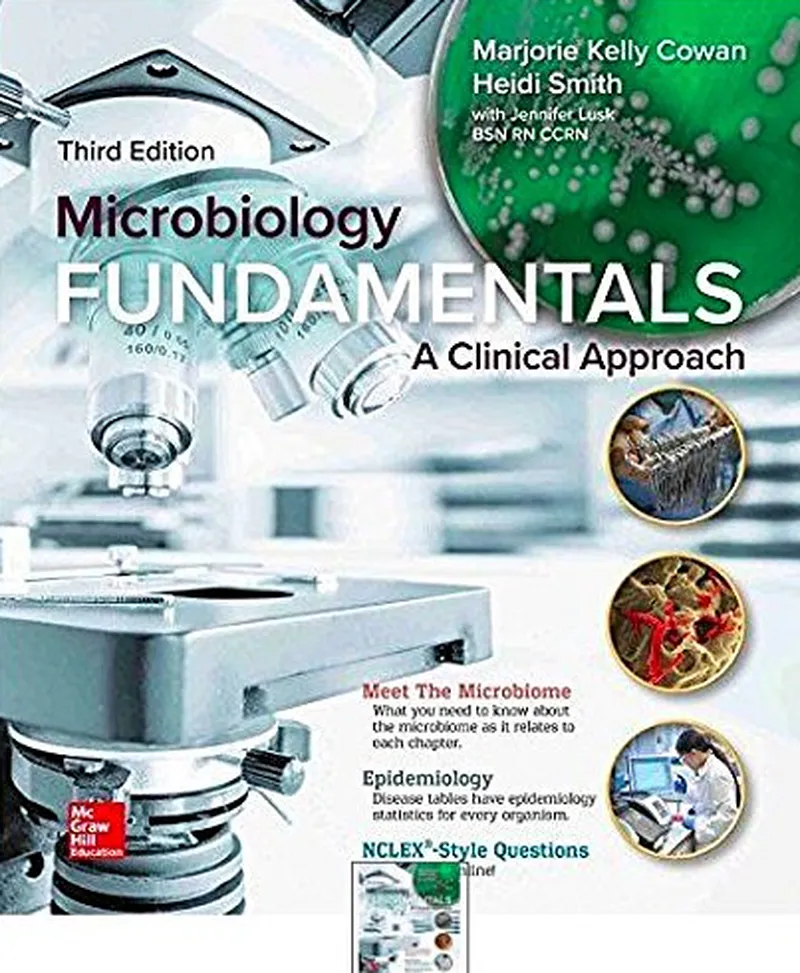

Microbiology Fundamentals: A Clinical Approach, 3rd Edition
Microbiology Fundamentals: A Clinical Approach, 3rd Edition by Marjorie Kelly Cowan is an introductory microbiology textbook designed to help students understand the fundamental principles of microbiology while connecting them to human health and clinical practice. Published by McGraw Hill, this edition provides a structured introduction to microorganisms, microbial structure and function, genetics, metabolism, immunity, infectious diseases, antimicrobial therapy, and diagnostic microbiology.
With its clinical emphasis, the book is particularly suitable for students who are studying microbiology as part of a healthcare, nursing, allied-health, or other health-science program. Rather than presenting microorganisms simply as organisms to memorize, the textbook encourages students to understand how microbial characteristics influence disease, how the human body responds to infection, and how laboratory and therapeutic approaches can be used to control infectious diseases.
About Microbiology Fundamentals: A Clinical Approach
Microbiology is closely connected to many areas of modern healthcare. Understanding bacteria, viruses, fungi, parasites, and other microorganisms helps explain how infections develop, spread, and can be prevented or treated.
Microbiology Fundamentals: A Clinical Approach introduces these concepts progressively, beginning with the basic principles required to understand microbial life and then moving toward more clinically relevant subjects. This makes it suitable for students who may be encountering microbiology for the first time.
The clinical orientation of the book provides an important connection between fundamental science and real-world healthcare. Concepts such as microbial growth, genetics, metabolism, immune responses, and antimicrobial drugs become easier to appreciate when they are considered in the context of infectious disease.
Understanding the Microbial World
The textbook introduces students to the major groups of microorganisms and the characteristics that distinguish them.
Topics involving bacteria, archaea, eukaryotic microorganisms, viruses, and other infectious agents provide students with a broad view of microbial diversity. The book also explores the structures and functions of microbial cells, helping readers understand how microorganisms survive, reproduce, and interact with their environments.
An understanding of microbial structure is especially important when studying antimicrobial drugs, since many treatments work by targeting particular microbial structures or cellular processes.
Microbial Growth and Metabolism
Microorganisms require nutrients and suitable environmental conditions to grow. The book examines microbial nutrition, growth, and metabolism and explains how microorganisms obtain energy and produce the materials necessary for cellular life.
These concepts have applications far beyond basic microbiology. They help explain microbial growth in laboratory cultures, food spoilage, environmental processes, and the development of infections.
Students also gain a foundation for understanding how biochemical characteristics can be used to distinguish and identify microorganisms in the clinical laboratory.
Microbial Genetics
Genetics is another important component of the textbook.
Students are introduced to DNA, gene expression, genetic variation, and the mechanisms through which microorganisms acquire and transmit genetic information. These concepts are essential for understanding microbial adaptation and evolution.
They are also particularly relevant to antimicrobial resistance, where genetic changes can allow microorganisms to survive exposure to drugs that would normally inhibit or destroy them.
The connection between genetics, evolution, and antimicrobial resistance illustrates the systems-oriented nature of modern microbiology.
Controlling Microorganisms
The ability to control microorganisms is essential in healthcare, laboratories, food production, and public health.
The book discusses methods used to control microbial growth and explains the principles behind sterilization, disinfection, sanitation, and other approaches to reducing microbial populations.
Students can also develop an understanding of how antimicrobial agents affect microorganisms and why different drugs are effective against particular types of pathogens.
Antimicrobial Therapy and Resistance
Antimicrobial therapy is one of the most important applications of microbiology.
The textbook introduces the principles behind antimicrobial treatment and explains how antimicrobial agents interact with microbial cells. This provides the background needed to understand why some drugs are effective against particular microorganisms while others are not.
The subject also leads naturally to the problem of antimicrobial resistance. Resistant microorganisms can emerge and spread through microbial populations, making infections more difficult to treat.
Understanding resistance requires students to combine concepts from genetics, microbial physiology, evolution, and antimicrobial therapy.
The Human Body and Microorganisms
Humans are constantly exposed to microorganisms, and many microorganisms live naturally on or within the human body.
The relationship between humans and microorganisms can be beneficial, neutral, or harmful depending on the organism and circumstances. The textbook examines these interactions and introduces the concepts needed to distinguish normal microbial colonization from infection and disease.
This provides an important foundation for understanding why exposure to a microorganism does not necessarily result in illness.
Immunity and Host Defenses
The human immune system provides multiple mechanisms for protecting the body from infectious microorganisms.
The book introduces innate and adaptive immunity, explaining how the body recognizes and responds to potential pathogens. Students can also develop an understanding of immunological memory and the principles underlying vaccination.
The discussion of host defenses connects microbiology with immunology and helps explain why the outcome of an infection depends on both microbial characteristics and the condition of the host.
Infectious Diseases
The clinical focus becomes particularly apparent in the sections dealing with infectious diseases.
Students learn how microorganisms can cause disease and how infections can affect different parts of the human body. The material connects microbial characteristics with disease processes, symptoms, transmission, diagnosis, prevention, and treatment.
This approach is particularly useful for healthcare students because it allows them to see how basic microbiology contributes to understanding real clinical conditions.
Diagnostic Microbiology
Laboratory diagnosis is an essential part of modern infectious-disease management.
The book introduces the basic principles used to detect and identify microorganisms, including methods involving microscopy, culture, staining, biochemical characteristics, and other diagnostic approaches.
Students learn that identifying a pathogen is generally a process of combining several observations rather than relying on a single characteristic.
This provides a useful introduction to the reasoning used in clinical microbiology laboratories.
Why the Clinical Approach Matters
One of the main strengths of Microbiology Fundamentals: A Clinical Approach is its effort to connect fundamental microbiology with human health.
A student studying bacterial cell structure, for example, can understand how those structures relate to antimicrobial drug targets. Microbial genetics can be connected to antibiotic resistance. Immunology can be connected to vaccination and host defense. Microbial growth can be connected to infection and laboratory culture.
These connections help turn microbiology from a collection of isolated facts into a coherent scientific subject.
Who Is This Book For?
The 3rd edition can be useful for:
- Undergraduate microbiology students
- Nursing students
- Allied-health students
- Health-science students
- Medical laboratory science students
- Pre-medical students
- Students studying infectious diseases
- Students taking introductory microbiology
- Students preparing for healthcare-related careers
It can also serve as a useful reference for anyone who wants a broad introduction to microbiology with a stronger emphasis on human health and clinical applications.
Why Study Microbiology Fundamentals: A Clinical Approach?
Microbiology provides the scientific foundation for understanding many common healthcare problems. Infections, antimicrobial resistance, vaccination, foodborne illness, hospital-acquired infections, and diagnostic laboratory testing all depend on microbiological principles.
This textbook provides students with the background needed to understand these subjects while gradually introducing more clinically relevant applications.
For students who find microbiology challenging because of the large amount of terminology involved, organizing the subject around fundamental principles and clinical examples can also make the material easier to follow.
Final Thoughts
Microbiology Fundamentals: A Clinical Approach, 3rd Edition by Marjorie Kelly Cowan offers a comprehensive introduction to microbiology with a clear connection to human health and clinical practice.
The book covers the essential foundations of microbial biology, including microbial structure, growth, metabolism, genetics, microbial control, antimicrobial therapy, immunity, infectious diseases, and diagnostic microbiology. By connecting these subjects with healthcare applications, it helps students understand not only what microorganisms are, but also why they matter.
For students in nursing, allied health, health sciences, medical laboratory science, and introductory microbiology courses, this edition can provide a useful foundation for further study in microbiology, immunology, infectious diseases, and clinical laboratory science.
Book Information
Title: Microbiology Fundamentals: A Clinical Approach
Edition: 3rd Edition
Author: Marjorie Kelly Cowan
Publisher: McGraw Hill
Publication Date: January 3, 2018
Language: English
Print Length: 752 pages
ISBN-10: 1259709221
ISBN-13: 978-1259709227
Subject: Microbiology / Clinical Microbiology / Health Sciences
Support the Creators!
If you enjoy this book, please consider supporting the author and publisher by purchasing a physical or digital copy. Buying official copies ensures authors can keep writing great books.