
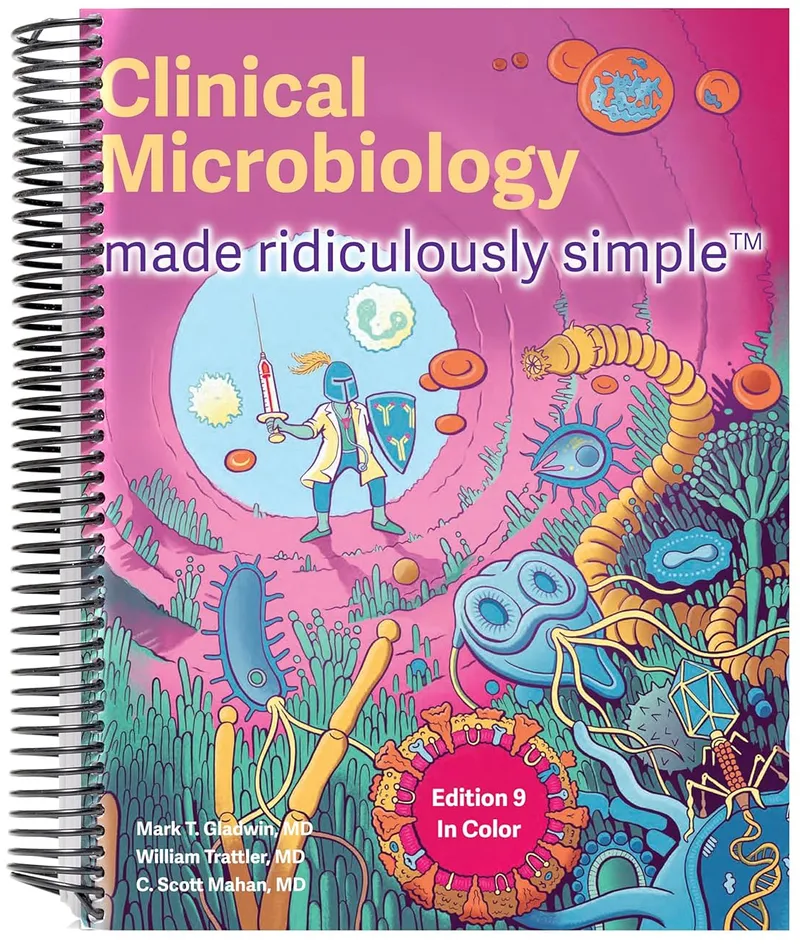

Clinical Microbiology Made Ridiculously Simple, 9th Edition
Clinical Microbiology Made Ridiculously Simple, 9th Edition is a concise and approachable guide to the principles of clinical microbiology and infectious diseases. Published by MedMaster, the ninth edition is designed to make a subject that can often seem complicated and heavily dependent on memorization easier to understand and remember.
Clinical microbiology brings together microbiology, immunology, pathology, pharmacology, and clinical medicine. Students are expected to recognize important microorganisms, understand how they cause disease, identify characteristic clinical presentations, and know the basic principles used to diagnose and treat infections. Clinical Microbiology Made Ridiculously Simple approaches these subjects in a straightforward and highly review-oriented format.
With its emphasis on simplified explanations, memorable associations, and clinically relevant information, the book can be particularly useful for medical students, healthcare students, laboratory students, and readers preparing for examinations in microbiology and infectious diseases.
About Clinical Microbiology Made Ridiculously Simple
Clinical microbiology can be challenging because there are hundreds of microorganisms, diseases, laboratory tests, and antimicrobial drugs to learn. Memorizing individual facts without understanding their relationships can make the subject even more difficult.
This book takes a different approach by organizing important microbiological concepts around clinical relevance and memorable learning techniques.
Rather than requiring readers to memorize every detail about every microorganism, the book focuses attention on the characteristics that are most useful for recognizing clinically important pathogens and understanding the infections they cause.
This makes it particularly useful as a review book and study companion alongside a more comprehensive microbiology textbook.
Understanding Clinically Important Microorganisms
A major part of clinical microbiology involves recognizing which microorganisms are associated with human disease and understanding their distinguishing characteristics.
The book introduces important groups of bacteria, viruses, fungi, and parasites, emphasizing information that can help students distinguish between clinically relevant organisms.
Understanding these organisms requires more than knowing their names. Students also need to associate pathogens with their typical infections, transmission routes, laboratory characteristics, and clinical significance.
Organizing this information around recognizable patterns can make the material easier to review.
Bacteriology and Bacterial Infections
Bacteria are responsible for a wide range of human infections, from relatively common illnesses to severe and potentially life-threatening diseases.
Clinical bacteriology examines bacterial structure, classification, pathogenic mechanisms, laboratory identification, and the diseases associated with important bacterial species.
The book provides a focused introduction to medically important bacteria and the infections they produce, helping students connect individual organisms with recognizable clinical patterns.
This is particularly valuable when preparing for examinations in which a question may provide a combination of symptoms, laboratory findings, and epidemiological information and ask the student to identify the most likely pathogen.
Virology and Viral Diseases
Viruses require a different approach to diagnosis and treatment because they are fundamentally different from cellular microorganisms.
Clinical virology involves understanding viral structure, replication, transmission, host interactions, and disease manifestations. Students also need to recognize the characteristics of important human viruses and understand the general approaches used to diagnose viral infections.
The book introduces clinically important viral infections while maintaining its emphasis on high-yield concepts and practical understanding.
Medical Mycology
Fungi can cause infections ranging from superficial conditions affecting the skin and nails to serious systemic infections.
Clinical mycology requires students to distinguish between different types of fungal infections and recognize the organisms commonly associated with them.
The book provides an introduction to medically important fungi and the clinical conditions associated with fungal infections, helping readers build a foundation in diagnostic and clinical mycology.
Parasitology
Parasitic infections represent another important area of clinical microbiology.
Parasites can be transmitted through food, water, insects, animals, or other routes, and their clinical manifestations can vary considerably.
Understanding medically important parasites requires knowledge of their life cycles, transmission, geographical distribution, and characteristic diseases. A concise review approach can help students organize this information into patterns that are easier to recall.
Host–Pathogen Interactions
Infectious disease is the result of an interaction between a microorganism and its host.
Whether exposure results in disease depends on characteristics of the pathogen, the host’s immune defenses, the route of infection, and environmental factors.
Understanding these interactions helps explain why some microorganisms are highly pathogenic while others are normally harmless or cause disease only under particular circumstances.
Clinical Presentation of Infectious Diseases
One of the most useful aspects of clinical microbiology is connecting microorganisms with the diseases they cause.
A patient’s symptoms, physical findings, exposure history, and laboratory results can provide clues about the likely infectious agent.
For students, learning these associations can be particularly important when preparing for clinical examinations. Recognizing patterns such as a particular type of infection combined with characteristic laboratory findings can help narrow the possible pathogens.
Laboratory Diagnosis
Clinical microbiology laboratories use a variety of techniques to detect and identify microorganisms.
These may include:
- Microscopic examination
- Staining procedures
- Culture
- Biochemical testing
- Antigen detection
- Serological testing
- Molecular diagnostic methods
- Antimicrobial susceptibility testing
The book introduces the principles behind clinical diagnosis and helps students understand how laboratory information contributes to the identification of infectious agents.
This connection between microbiology and diagnosis is particularly important for students entering medicine, nursing, medical laboratory science, and other healthcare professions.
Antimicrobial Therapy
The diagnosis of an infectious disease is closely connected with treatment.
Antimicrobial therapy involves selecting agents that are effective against the causative microorganism while minimizing harm to the patient. Understanding the basic mechanisms of antimicrobial drugs helps students appreciate why particular medications are used against particular groups of microorganisms.
The subject also requires an understanding of antimicrobial resistance and the factors that can reduce treatment effectiveness.
Antimicrobial Resistance
Antimicrobial resistance has become an increasingly important issue in clinical medicine.
Bacteria and other microorganisms can acquire characteristics that allow them to survive exposure to antimicrobial agents. Resistance can spread within microbial populations and can complicate the treatment of infectious diseases.
For students, understanding resistance requires connecting several concepts, including microbial genetics, mutation, selection, antimicrobial mechanisms, and clinical treatment.
Why Use a Simplified Clinical Microbiology Guide?
The main challenge with clinical microbiology is often not the lack of information but the large amount of information that students are expected to organize.
A simplified review guide can be useful because it allows students to focus on the relationships that matter most.
Instead of approaching every microorganism as a completely separate topic, students can compare organisms according to characteristics such as:
- Gram-stain reaction
- Cell morphology
- Transmission
- Virulence factors
- Typical infections
- Laboratory identification
- Important clinical associations
- Antimicrobial treatment
This type of organization can make revision more efficient and help students recognize recurring patterns.
Useful for Medical and Health-Science Students
Clinical Microbiology Made Ridiculously Simple can be particularly useful for students who need to review microbiology within a limited amount of time.
It may be helpful for:
- Medical students
- Nursing students
- Physician assistant students
- Allied-health students
- Medical laboratory science students
- Biomedical science students
- Pharmacy students
- Healthcare professionals reviewing microbiology
- Students preparing for microbiology examinations
It can also function as a supplementary resource alongside a full-length clinical or medical microbiology textbook.
A Review Resource Rather Than a Replacement for Detailed Textbooks
Because of its concise and simplified approach, the book is best viewed as a review and learning aid rather than a substitute for an extensive reference textbook.
Students who need detailed coverage of microbial physiology, molecular mechanisms, advanced diagnostic methods, or comprehensive clinical microbiology may still require a larger textbook.
However, when the goal is to organize major concepts, review clinically important organisms, and reinforce high-yield associations, a concise guide can be extremely useful.
Making Microbiology Easier to Remember
One of the recurring difficulties in microbiology is remembering large numbers of related facts.
Memory aids and associations can help students convert information into recognizable patterns. This can be especially useful for subjects such as bacterial classification, infectious diseases, laboratory characteristics, and antimicrobial drugs.
The simplified presentation of Clinical Microbiology Made Ridiculously Simple is intended to reduce the cognitive burden associated with these topics and make review more manageable.
Final Thoughts
Clinical Microbiology Made Ridiculously Simple, 9th Edition is a practical review resource for students who want a clearer and more approachable introduction to clinical microbiology and infectious diseases.
The book focuses on clinically important microorganisms and connects them with disease, diagnosis, laboratory findings, and antimicrobial treatment. Its concise presentation and emphasis on memorable concepts make it particularly suitable for reviewing large amounts of material before examinations.
For students in medicine, nursing, medical laboratory science, pharmacy, allied health, and related disciplines, the book can serve as a useful companion to a comprehensive microbiology textbook.
Rather than replacing detailed study, it can help students organize the essential concepts of clinical microbiology into a more manageable framework and reinforce the connections between microorganisms, infectious diseases, diagnosis, immunity, and treatment.
Book Information
Title: Clinical Microbiology Made Ridiculously Simple
Edition: 9th Edition
Publisher: MedMaster
Publication Date: October 15, 2022
Language: English
Print Length: 448 pages
ISBN-10: 1935660500
ISBN-13: 978-1935660507
Subject: Clinical Microbiology / Infectious Diseases / Medical Education
Support the Creators!
If you enjoy this book, please consider supporting the author and publisher by purchasing a physical or digital copy. Buying official copies ensures authors can keep writing great books.