
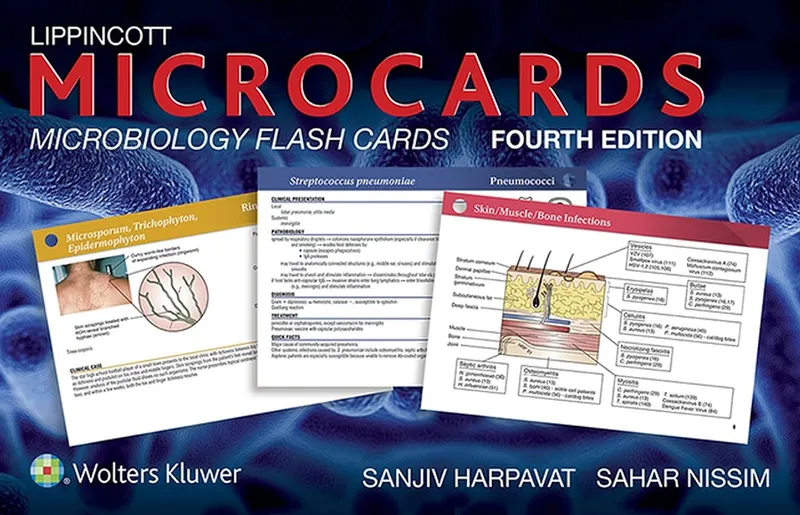

Lippincott Microcards: Microbiology Flash Cards, 4th Edition
Lippincott Microcards: Microbiology Flash Cards, 4th Edition by Sanjiv Harpavat and Sahar Nissim is a practical study and review resource designed to help students learn and recall important concepts in microbiology. Published by Wolters Kluwer Health, this fourth edition presents microbiological information in a flash-card format, making it particularly useful for quick revision, self-testing, and examination preparation.
Microbiology involves a large amount of information, including bacterial characteristics, infectious diseases, laboratory identification, microbial structures, viruses, fungi, parasites, and antimicrobial therapy. Remembering these details can be challenging when studying from a conventional textbook alone. A flash-card resource such as Lippincott Microcards provides a more focused way to review important facts and reinforce concepts through active recall.
The fourth edition contains 312 pages and was published on June 24, 2015.
About Lippincott Microcards: Microbiology Flash Cards
Flash cards are particularly useful for subjects that require students to recognize and recall a large number of related facts. Microbiology is an excellent example because students often need to remember the characteristics of microorganisms and associate them with specific diseases, laboratory findings, and clinical features.
Lippincott Microcards: Microbiology Flash Cards provides a compact study format that allows learners to review microbiology in short sessions. Instead of reading through lengthy chapters, students can concentrate on individual concepts and test their knowledge one item at a time.
This makes the resource suitable for both regular study and intensive revision before examinations.
Learning Microbiology Through Active Recall
One of the advantages of flash cards is that they encourage active recall.
Rather than simply reading information repeatedly, students attempt to retrieve the answer from memory before checking the corresponding explanation. This process can help identify areas that require additional study and reinforce information that has already been learned.
For microbiology students, active recall can be particularly useful for subjects such as microbial classification, bacterial characteristics, infectious diseases, and clinical associations.
Bacteriology
Bacteria represent one of the largest areas of study in microbiology.
Students often need to distinguish between bacterial groups based on characteristics such as Gram-stain reaction, morphology, biochemical properties, virulence factors, and the diseases they cause.
Flash cards provide a convenient way to review these relationships repeatedly until they become easier to recognize.
Important bacterial pathogens can be studied alongside their characteristic infections and clinical features, helping students develop associations rather than memorizing isolated facts.
Virology
Viruses have distinctive structures, replication strategies, and clinical characteristics.
A microbiology review resource needs to help students organize information about important viruses and the diseases associated with them.
Flash-card learning can be especially useful for reviewing viral characteristics, transmission patterns, clinical manifestations, and other high-yield information.
Medical Mycology
Fungi are responsible for a variety of human infections, ranging from superficial infections to more serious systemic diseases.
Students studying medical microbiology may need to remember important fungal organisms, their characteristic infections, and the clinical settings in which they are encountered.
The compact flash-card format provides an efficient way to repeatedly review these associations.
Parasitology
Parasites can be particularly difficult to study because many have complex life cycles and distinctive modes of transmission.
Reviewing parasitic organisms through short, focused questions and answers can help students reinforce important characteristics and distinguish between organisms that may initially appear similar.
This can be especially useful during examination preparation.
Infectious Diseases
Clinical microbiology requires students to connect microorganisms with the diseases they cause.
For example, knowing the name of a microorganism is only part of the learning process. Students may also need to recognize its typical site of infection, mode of transmission, clinical presentation, and important diagnostic characteristics.
Flash cards can help build these associations through repeated review.
Laboratory Diagnosis
Microbiology students also need to understand how microorganisms are identified in the laboratory.
Important diagnostic concepts can involve:
- Gram staining
- Microbial morphology
- Culture characteristics
- Biochemical testing
- Antigen and antibody detection
- Molecular diagnostic methods
- Laboratory identification procedures
A flash-card resource can complement laboratory and lecture courses by allowing students to review these concepts outside the classroom.
Antimicrobial Drugs
Antimicrobial therapy is another important part of microbiology education.
Students may need to understand the major classes of antimicrobial agents, their general mechanisms of action, and the microorganisms or infections for which they are relevant.
Reviewing these relationships repeatedly can help students organize pharmacological and microbiological information more effectively.
Useful for Examination Preparation
One of the most practical uses of Lippincott Microcards is examination preparation.
Students can use flash cards to identify subjects they already understand and areas where additional study is needed. Because individual concepts can be reviewed quickly, the cards can also be incorporated into a daily revision routine.
They can be used:
- Before microbiology examinations
- During short study sessions
- As a review after lectures
- Alongside a microbiology textbook
- During clinical science revision
- For self-testing
- For rapid review before examinations
A Supplement to a Microbiology Textbook
Lippincott Microcards is best used as a supplementary study resource rather than as a replacement for a comprehensive microbiology textbook.
A full textbook provides detailed explanations of microbial physiology, genetics, immunology, pathogenesis, and laboratory methods. Flash cards serve a different purpose: they help students review and recall the information they have already studied.
Using both resources together can create a more effective study strategy. Students can learn a topic from their textbook and then use flash cards to test how much of the material they can remember.
Who Is This Book For?
Lippincott Microcards: Microbiology Flash Cards, 4th Edition can be useful for a variety of students studying microbiology and related health sciences.
It may be particularly helpful for:
- Medical students
- Nursing students
- Allied-health students
- Biomedical science students
- Pharmacy students
- Medical laboratory science students
- Biology students
- Students studying infectious diseases
- Students preparing for microbiology examinations
- Healthcare students who need a compact microbiology review resource
Because the cards can be studied in short sessions, they may also be useful for learners who prefer an active and flexible approach to revision.
Why Use Microbiology Flash Cards?
Microbiology contains many details that students must be able to recall quickly. Simply rereading the same material does not always provide an effective way to determine whether the information has actually been learned.
Flash cards change the learning process by requiring the student to retrieve information.
This makes them particularly useful for questions such as:
- Which organism causes a particular infection?
- What characteristic distinguishes one bacterial group from another?
- Which microorganism is associated with a particular clinical condition?
- What laboratory finding is associated with an organism?
- Which antimicrobial class is relevant to a particular pathogen?
- What are the important characteristics of a particular virus, fungus, or parasite?
Repeatedly answering questions like these can strengthen the connections between microbiological concepts.
Final Thoughts
Lippincott Microcards: Microbiology Flash Cards, 4th Edition by Sanjiv Harpavat and Sahar Nissim is a convenient and focused resource for reviewing essential microbiology concepts.
Its flash-card format makes it particularly suitable for active recall, self-testing, quick revision, and examination preparation. The resource can help students reinforce their knowledge of bacteria, viruses, fungi, parasites, infectious diseases, laboratory diagnosis, and antimicrobial therapy.
For students who are already using a comprehensive microbiology textbook, Lippincott Microcards can provide a practical way to revisit important information without having to reread entire chapters.
Whether used during regular coursework or as part of an intensive examination review, the flash-card format offers a flexible approach to learning a subject that contains a large amount of terminology and clinically important information.
Book Information
Title: Lippincott Microcards: Microbiology Flash Cards
Edition: 4th Edition
Authors: Sanjiv Harpavat, Sahar Nissim
Publisher: Wolters Kluwer Health
Publication Date: June 24, 2015
Language: English
Print Length: 312 pages
ISBN-13: 978-1496322272
ASIN: B010C66CM6
Subject: Microbiology / Medical Microbiology / Medical Education
Support the Creators!
If you enjoy this book, please consider supporting the author and publisher by purchasing a physical or digital copy. Buying official copies ensures authors can keep writing great books.