
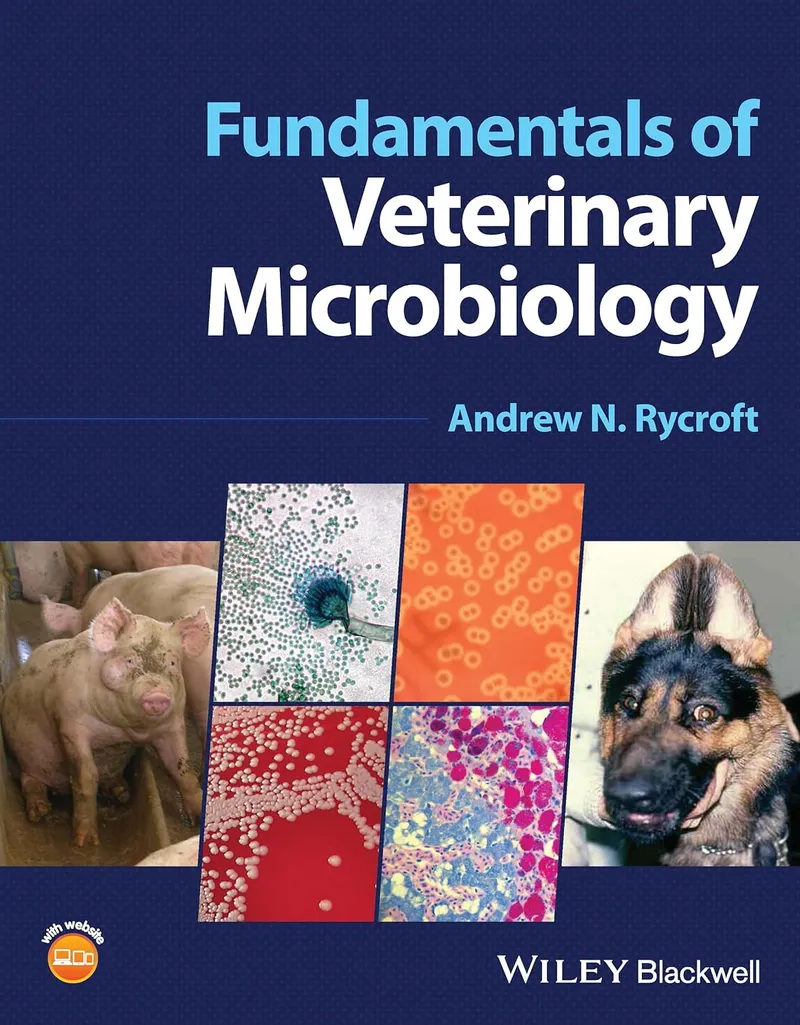

Fundamentals of Veterinary Microbiology
Fundamentals of Veterinary Microbiology by Andrew N. Rycroft is an introductory textbook focused on the microorganisms that affect animal health, veterinary medicine, and animal production. Published by Wiley-Blackwell, the book provides a foundation in veterinary microbiology while connecting fundamental microbial biology with the diagnosis, prevention, and control of infectious diseases in animals.
Published in 2023 and listed as a 2024 book, this first edition contains 240 pages and offers a relatively concise introduction to a field that sits at the intersection of microbiology, veterinary medicine, animal health, and infectious disease.
Veterinary microbiology is important not only for treating sick animals but also for protecting livestock, companion animals, wildlife, food production systems, and, in many cases, human health.
About Fundamentals of Veterinary Microbiology
Microorganisms are an essential part of the animal world. Many microorganisms live harmlessly on and within animals, while others can cause infectious diseases.
Veterinary microbiology focuses on understanding these microorganisms and the relationships they establish with animal hosts. Students need to learn how pathogens survive, enter the host, reproduce, cause disease, and interact with the animal immune system.
The subject also has an important public-health dimension because some infectious agents can move between animals and humans. Understanding animal infections can therefore contribute to disease prevention beyond veterinary practice.
The Microbial World in Veterinary Medicine
Veterinary microbiology covers a wide variety of microorganisms, including bacteria, viruses, fungi, and parasites.
Each group has its own biological characteristics and requires different approaches to diagnosis, treatment, and prevention.
Learning the fundamental characteristics of these microorganisms provides students with the background needed to understand why particular pathogens affect particular animal species and tissues.
Bacterial Infections in Animals
Bacteria are responsible for many important diseases affecting domestic animals, livestock, and other animal populations.
Understanding bacterial infections requires knowledge of bacterial structure, growth, metabolism, virulence, and transmission.
Veterinary microbiology also considers the differences between animal species. A microorganism that causes severe disease in one species may have a very different effect in another.
Recognizing these relationships is important for accurate diagnosis and effective disease management.
Veterinary Virology
Viruses are important causes of infectious disease in animals.
Because viruses depend on host cells for replication, their biology differs significantly from that of bacteria and other cellular microorganisms.
Veterinary virology examines viral characteristics, transmission, host interactions, disease mechanisms, diagnosis, prevention, and control. Understanding these principles is particularly important for managing infectious diseases that can spread rapidly through animal populations.
Fungal Infections
Fungi can affect animals in several different ways.
Some fungal infections involve the skin and other superficial tissues, while others can become systemic and potentially serious. Certain fungi can also be transmitted between animals and humans.
Understanding veterinary mycology therefore has relevance to both animal health and public health.
Microbial Pathogenesis
An important part of veterinary microbiology is understanding how microorganisms cause disease.
Pathogens may attach to host tissues, invade cells, produce toxins, damage tissues, or interfere with immune responses.
The severity and outcome of an infection depend on both the microorganism and the animal host. Factors such as age, species, immune status, nutrition, and environmental conditions can influence susceptibility to disease.
Host Immunity
Animals have complex immune systems that provide protection against infectious microorganisms.
Understanding innate and adaptive immune responses helps explain why some infections are successfully controlled while others develop into clinical disease.
The interaction between immunity and microbial pathogenesis is also important when considering vaccination and disease prevention programs.
Laboratory Diagnosis
Veterinary microbiology relies heavily on laboratory investigation.
Depending on the suspected infection, diagnostic procedures may involve:
- Microscopy
- Staining
- Culture
- Biochemical testing
- Antigen detection
- Serological testing
- Molecular methods
- Antimicrobial susceptibility testing
Laboratory diagnosis helps veterinarians identify infectious agents and distinguish between diseases that may produce similar clinical signs.
Antimicrobial Treatment
Antimicrobial therapy is an important component of veterinary medicine.
Understanding how antimicrobial agents affect microorganisms helps veterinary professionals select appropriate treatment strategies.
Veterinary antimicrobial use also requires consideration of antimicrobial resistance, animal health, food production, and the potential impact of resistant microorganisms on wider populations.
Antimicrobial Resistance in Veterinary Medicine
Antimicrobial resistance is not limited to human medicine.
The use of antimicrobial agents in veterinary settings can influence microbial populations and contribute to the emergence and spread of resistant organisms.
This makes antimicrobial stewardship an important part of modern veterinary practice. Understanding the microbiological basis of resistance helps students appreciate why antimicrobial drugs need to be used carefully and appropriately.
Zoonotic Diseases and One Health
Veterinary microbiology has an important connection with zoonotic diseases, which are infections that can be transmitted between animals and humans.
This relationship demonstrates why animal health and human health cannot always be considered separately.
Veterinarians, microbiologists, physicians, public-health professionals, and environmental scientists may all contribute to the surveillance and control of infectious diseases that cross species boundaries.
This broader perspective is often described through the One Health approach.
Microbiology and Animal Production
Infectious diseases can have significant consequences for livestock and animal production.
Disease outbreaks can affect animal welfare, productivity, food security, and agricultural economies. Veterinary microbiology provides the scientific knowledge needed to understand how pathogens spread through animal populations and how disease can be prevented.
Biosecurity, vaccination, sanitation, monitoring, and appropriate treatment all depend on an understanding of microbial transmission and survival.
Who Is This Book For?
Fundamentals of Veterinary Microbiology can be useful for:
- Veterinary medicine students
- Veterinary microbiology students
- Animal science students
- Biomedical science students
- Biology students
- Veterinary laboratory students
- Animal health professionals
- Researchers working with animal infectious diseases
- Students interested in zoonotic diseases and One Health
It can also serve as an introductory reference for readers who want to understand the microbiological foundations of animal disease.
Why Study Veterinary Microbiology?
Veterinary microbiology extends beyond identifying pathogens.
A strong understanding of the subject helps explain how infectious diseases emerge, how microorganisms move between animals, why some animals are more susceptible than others, and how disease can be prevented.
It also provides a foundation for understanding important areas such as veterinary pathology, immunology, epidemiology, infectious disease, antimicrobial therapy, public health, and animal production.
Final Thoughts
Fundamentals of Veterinary Microbiology by Andrew N. Rycroft provides an introduction to the microorganisms and biological processes that are important in veterinary medicine and animal health.
The book connects fundamental microbiology with subjects such as bacterial and viral infections, fungal disease, microbial pathogenesis, host immunity, laboratory diagnosis, antimicrobial treatment, antimicrobial resistance, zoonotic diseases, and One Health.
Its relatively concise format makes it a useful starting point for students who are beginning their study of veterinary microbiology and want to understand the fundamental principles before progressing to more specialized subjects.
For students of veterinary medicine, animal science, microbiology, and related biological disciplines, this textbook provides a foundation for understanding how microorganisms influence animal health and why veterinary microbiology is also important to public health and disease prevention.
Book Information
Title: Fundamentals of Veterinary Microbiology
Author: Andrew N. Rycroft
Edition: 1st Edition
Publisher: Wiley-Blackwell
Publication Date: November 14, 2023
Language: English
Print Length: 240 pages
ISBN-10: 0470659475
ISBN-13: 978-0470659472
Subject: Veterinary Microbiology / Animal Health / Infectious Diseases / Veterinary Medicine
Fundamentals of Veterinary Microbiology is a useful introductory resource for understanding the relationship between microorganisms, animal health, infectious disease, diagnosis, treatment, and disease prevention, while also highlighting the broader connection between veterinary and human health.
Support the Creators!
If you enjoy this book, please consider supporting the author and publisher by purchasing a physical or digital copy. Buying official copies ensures authors can keep writing great books.