
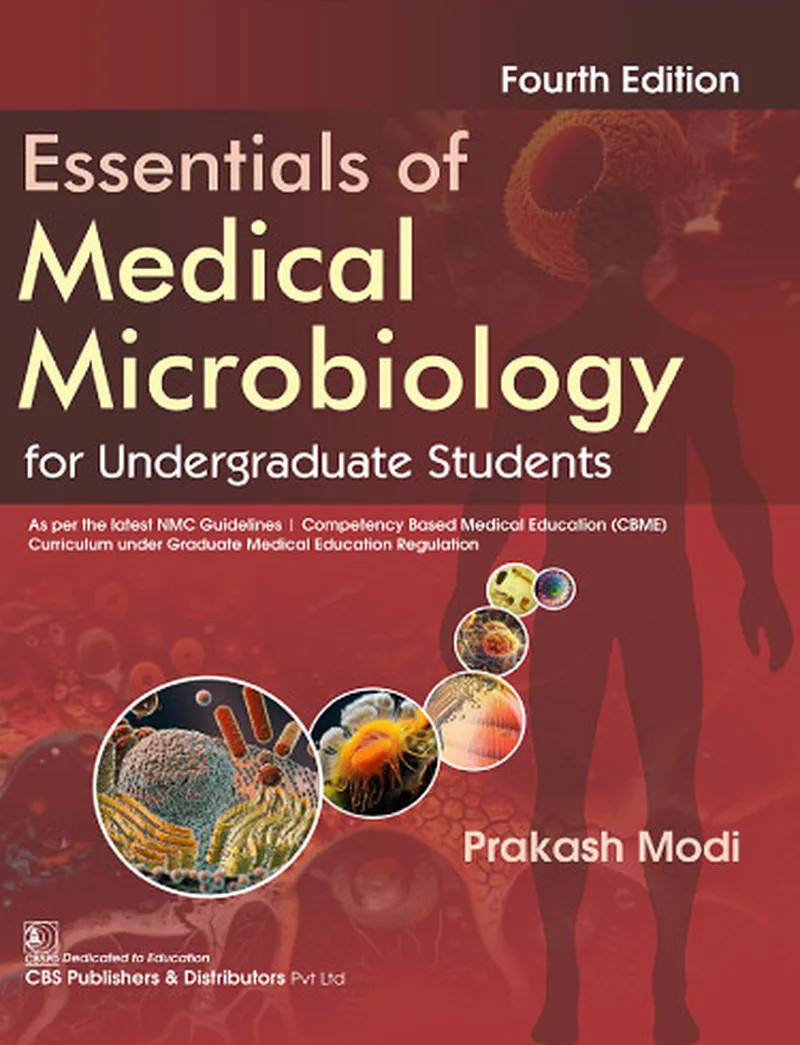

Essentials of Medical Microbiology for Undergraduate Students, 4th Edition
Essentials of Medical Microbiology for Undergraduate Students, 4th Edition by Prakash Modi is a comprehensive textbook designed to introduce undergraduate students to the fundamental concepts of medical microbiology and infectious diseases. Published by CBS Publishers and Distributors Pvt. Ltd., the fourth edition provides extensive coverage of microorganisms of medical importance, their characteristics, mechanisms of disease, laboratory diagnosis, treatment, and prevention.
With 1,104 pages, this edition offers substantial coverage for students who need a detailed foundation in medical microbiology. The book is particularly relevant to undergraduate students in medicine and other health-related disciplines who need to understand how microorganisms interact with the human body and how infectious diseases are investigated and controlled.
About Essentials of Medical Microbiology
Medical microbiology connects the study of microorganisms with human health and disease. Students need to understand not only the biology of bacteria, viruses, fungi, and parasites but also how these organisms produce disease, how the immune system responds to them, and how infections can be diagnosed and prevented.
Essentials of Medical Microbiology for Undergraduate Students approaches these subjects from an academic and clinical perspective. The book provides students with the fundamental knowledge required to recognize medically important microorganisms and understand their role in infectious diseases.
Its extensive coverage makes it suitable as a primary study resource as well as a reference for reviewing microbiology topics throughout an undergraduate medical curriculum.
Understanding Microorganisms
The study of medical microbiology begins with an understanding of the microbial world.
Students are introduced to the major groups of microorganisms and the characteristics that distinguish them. Understanding microbial structure, physiology, growth, and reproduction provides the foundation for studying how microorganisms survive and interact with their hosts.
These basic concepts are essential when moving into more clinically focused areas such as microbial pathogenesis, laboratory diagnosis, and antimicrobial treatment.
Bacteriology
Bacteria are responsible for many important human infections.
The book covers medically significant bacteria and examines their characteristics, pathogenic mechanisms, clinical relevance, and laboratory identification.
Students learn to associate bacterial organisms with the diseases they cause while also understanding the microbiological characteristics that help distinguish one organism from another.
This knowledge is particularly important for medical students because bacterial infections are encountered across virtually every area of clinical practice.
Virology
Viruses are fundamentally different from cellular microorganisms and require host cells for replication.
Medical virology introduces students to viral structure, replication, transmission, and disease mechanisms. Understanding these principles provides a foundation for studying important viral infections as well as their diagnosis, prevention, and treatment.
The subject is also closely connected with vaccination and public-health strategies for controlling viral diseases.
Medical Mycology
Fungi can produce a wide range of infections in humans.
Some fungal infections affect superficial tissues, while others can become invasive and serious, particularly in individuals with compromised immune defenses.
The textbook introduces medically important fungi and provides students with the background needed to understand fungal infections and their diagnosis.
Parasitology
Parasitic diseases represent another important component of medical microbiology.
Protozoa and helminths can have complex life cycles and may be transmitted through food, water, insects, animals, or other routes.
Understanding their life cycles and transmission patterns helps students recognize the clinical and epidemiological characteristics of parasitic infections.
Microbial Pathogenesis
A microorganism does not necessarily cause disease simply because it enters the human body.
Disease depends on the interaction between the pathogen and the host. Microorganisms may use mechanisms such as adhesion, invasion, toxin production, immune evasion, and tissue damage to establish infections.
Understanding microbial pathogenesis allows students to connect the biological characteristics of microorganisms with the clinical manifestations of disease.
Immunology and Host Defense
The immune system plays a central role in protecting humans from infectious microorganisms.
The book introduces the mechanisms of host defense and explains how innate and adaptive immune responses recognize and respond to pathogens.
This knowledge is important for understanding susceptibility to infection, immune-mediated disease, vaccination, and the relationship between host immunity and microbial pathogenesis.
Laboratory Diagnosis
Clinical microbiology laboratories provide essential information for diagnosing infectious diseases.
Depending on the suspected pathogen, laboratory investigation may involve:
- Microscopy and staining
- Culture
- Biochemical identification
- Antigen detection
- Serological testing
- Molecular diagnostic techniques
- Antimicrobial susceptibility testing
Understanding these methods helps students appreciate how laboratory evidence is used to identify infectious agents and guide clinical management.
Antimicrobial Therapy
Antimicrobial drugs are an important part of the management of infectious diseases.
Students need to understand how antimicrobial agents work, which microorganisms they affect, and why treatment choices may differ between infections.
The study of antimicrobial therapy also introduces the important problem of antimicrobial resistance.
Antimicrobial Resistance
The emergence and spread of antimicrobial-resistant microorganisms is one of the major challenges facing modern healthcare.
Resistance can arise through genetic changes and can spread among microbial populations. Understanding the biological basis of resistance helps students appreciate the importance of appropriate antimicrobial use, susceptibility testing, infection prevention, and antimicrobial stewardship.
Infection Prevention and Control
Medical microbiology also has an important role in preventing infections.
Students learn the microbiological principles behind measures such as sterilization, disinfection, sanitation, vaccination, and infection-control practices.
These principles are particularly important in healthcare settings, where preventing the transmission of infectious microorganisms can protect both patients and healthcare workers.
Epidemiology of Infectious Diseases
Infectious diseases are influenced by the interaction between microorganisms, hosts, and environments.
Understanding how pathogens are transmitted helps explain patterns of disease within populations. Epidemiological concepts are therefore closely connected with microbiology and public health.
Knowledge of reservoirs, transmission routes, susceptible populations, and preventive measures can help students understand how infectious diseases are controlled at the community level.
Clinical Relevance
One of the most important aspects of medical microbiology is connecting basic microbiological knowledge with clinical practice.
Students need to be able to move from identifying a microorganism to understanding the disease it causes, the laboratory methods used for diagnosis, and the general principles of treatment and prevention.
This clinical perspective makes microbiology relevant to many areas of medicine and healthcare.
Who Is This Book For?
Essentials of Medical Microbiology for Undergraduate Students, 4th Edition can be particularly useful for:
- Medical students
- Undergraduate microbiology students
- Dental students
- Nursing and allied-health students
- Biomedical science students
- Pharmacy students
- Students studying infectious diseases
- Healthcare students preparing for examinations
- Students seeking a comprehensive medical microbiology reference
The book’s extensive coverage also makes it useful for revising microbiology topics throughout an undergraduate medical or health-science program.
Why Study Essentials of Medical Microbiology?
Medical microbiology contains a considerable amount of information, and students need to develop both factual knowledge and an understanding of relationships between microorganisms and disease.
A useful study approach is to connect each pathogen with its:
- Biological characteristics
- Mode of transmission
- Virulence mechanisms
- Clinical manifestations
- Laboratory diagnosis
- Antimicrobial susceptibility
- Treatment principles
- Prevention and control
This approach helps students move beyond memorization and develop a more practical understanding of infectious diseases.
Final Thoughts
Essentials of Medical Microbiology for Undergraduate Students, 4th Edition by Prakash Modi is a substantial academic resource covering the major principles of medical microbiology and their relevance to human disease.
The book provides broad coverage of bacteriology, virology, mycology, parasitology, microbial pathogenesis, immunology, laboratory diagnosis, antimicrobial therapy, antimicrobial resistance, epidemiology, and infection control.
With its extensive 1,104-page format, the fourth edition can serve as a detailed foundation for undergraduate students who need to study medical microbiology systematically.
For students in medicine, dentistry, microbiology, nursing, pharmacy, biomedical sciences, and related health disciplines, this textbook can be a valuable resource for developing a strong understanding of microorganisms and the infectious diseases they cause.
Book Information
Title: Essentials of Medical Microbiology for Undergraduate Students
Edition: 4th Edition
Author: Prakash Modi
Publisher: CBS Publishers and Distributors Pvt. Ltd.
Publication Date: October 28, 2024
Print Length: 1,104 pages
ASIN: B0DLB9DVMH
Subject: Medical Microbiology / Infectious Diseases / Medical Education
Essentials of Medical Microbiology for Undergraduate Students, 4th Edition provides a comprehensive foundation for understanding microorganisms, infectious diseases, microbial pathogenesis, immunity, laboratory diagnosis, antimicrobial therapy, and infection prevention, making it a useful academic resource for undergraduate healthcare and medical students.
Support the Creators!
If you enjoy this book, please consider supporting the author and publisher by purchasing a physical or digital copy. Buying official copies ensures authors can keep writing great books.