
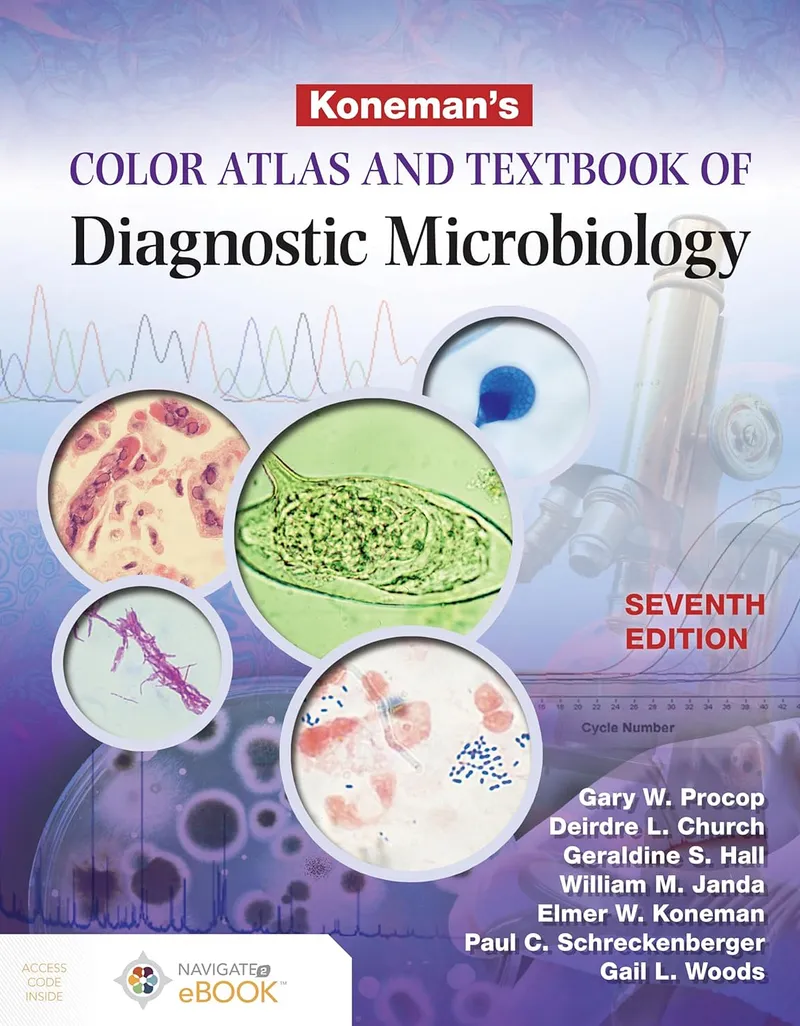

Koneman’s Color Atlas and Textbook of Diagnostic Microbiology, 7th Edition
Koneman’s Color Atlas and Textbook of Diagnostic Microbiology, 7th Edition is a comprehensive resource for understanding the principles and practices of clinical and diagnostic microbiology. Published by Jones & Bartlett Learning, this extensive edition combines detailed microbiology concepts with laboratory diagnosis, making it particularly useful for students and professionals working with clinical specimens and infectious diseases.
With approximately 1,830 pages, the book provides broad coverage of bacterial, fungal, viral, and parasitic pathogens, along with the laboratory methods used to identify them. Its atlas and textbook format makes it especially valuable for readers who need to connect written explanations with the visual characteristics encountered in the microbiology laboratory.
About Koneman’s Diagnostic Microbiology
Diagnostic microbiology is concerned with identifying microorganisms responsible for infectious diseases and providing laboratory information that can support clinical decisions.
Successful laboratory diagnosis requires more than simply growing an organism. Microbiology professionals need to understand specimen collection, microscopy, staining, culture, biochemical reactions, identification methods, antimicrobial susceptibility testing, and the clinical significance of laboratory findings.
Koneman’s Color Atlas and Textbook of Diagnostic Microbiology brings these concepts together in a detailed reference designed around the practical process of identifying clinically important microorganisms.
Bacteriology
Bacteria represent one of the largest areas of diagnostic microbiology.
The book examines clinically important bacterial groups and the characteristics used to identify them. These may include cellular morphology, Gram-stain reactions, colony characteristics, biochemical properties, and other laboratory findings.
Learning to recognize these characteristics allows students and laboratory professionals to distinguish between microorganisms that may appear similar but have very different clinical significance.
Specimen Collection and Processing
Accurate microbiological diagnosis begins with obtaining an appropriate clinical specimen.
The quality and type of specimen can directly affect laboratory results. Proper collection, transport, processing, and storage are therefore important components of diagnostic microbiology.
Understanding these steps also helps reduce contamination and improves the likelihood of recovering the microorganism responsible for an infection.
Microscopy and Staining
Microscopy remains an important part of microbiological investigation.
Staining techniques can reveal important characteristics of microorganisms and help guide subsequent laboratory testing. Gram staining, for example, provides an early indication of bacterial morphology and cell-wall characteristics.
Visual examination can therefore provide valuable information before more specialized identification methods are performed.
Culture and Microbial Identification
Culturing microorganisms allows laboratories to isolate and study organisms from clinical specimens.
Once an organism has been recovered, microbiologists may examine colony morphology, microscopic appearance, biochemical reactions, and other characteristics to determine its identity.
The process of identification demonstrates how multiple pieces of laboratory evidence can be combined to reach a reliable conclusion.
Biochemical Testing
Biochemical reactions have traditionally played an important role in bacterial identification.
Different microorganisms possess different metabolic capabilities, and these differences can be detected using laboratory tests.
Understanding the principles behind biochemical testing helps students appreciate why particular reactions are useful for distinguishing related organisms.
Molecular and Modern Diagnostic Methods
Modern diagnostic microbiology increasingly incorporates molecular and other advanced technologies.
Methods that detect microbial nucleic acids or other specific biological markers can provide rapid information about infectious agents. These techniques complement traditional culture and biochemical approaches and can be particularly valuable when microorganisms are difficult to grow or when rapid diagnosis is important.
Understanding both conventional and modern diagnostic methods gives students a broader view of contemporary clinical microbiology.
Mycology
The diagnosis of fungal infections can be challenging because fungi vary considerably in their morphology, growth characteristics, and clinical behavior.
Laboratory investigation may involve direct microscopic examination, culture, morphological assessment, and other diagnostic methods.
The book provides a detailed foundation for recognizing and investigating medically important fungi.
Parasitology
Parasitic organisms can also require specialized diagnostic approaches.
Microscopic examination may be particularly important when identifying protozoa, helminth eggs, larvae, or other parasitic forms in clinical specimens.
Understanding parasite morphology and life cycles can help laboratory professionals recognize organisms and distinguish clinically important species.
Clinical Virology
Viruses require diagnostic methods that differ from those commonly used for bacteria and fungi.
Clinical virology may involve antigen detection, serological testing, molecular techniques, and other specialized approaches.
Understanding the relationship between viral biology and diagnostic methodology helps students appreciate why different laboratory techniques are selected for different infections.
Antimicrobial Susceptibility Testing
Identifying a microorganism is often only part of the diagnostic process.
Laboratories may also need to determine how susceptible an organism is to particular antimicrobial agents. Susceptibility testing can provide information that assists clinicians in selecting appropriate therapy.
This area of diagnostic microbiology is especially important as antimicrobial resistance continues to challenge the treatment of infectious diseases.
Antimicrobial Resistance
Resistant microorganisms can complicate both laboratory diagnosis and clinical treatment.
Diagnostic laboratories play an important role in detecting resistance by identifying organisms and determining their susceptibility patterns.
Understanding resistance mechanisms and the laboratory methods used to recognize them is therefore an essential part of modern diagnostic microbiology.
The Clinical Significance of Laboratory Results
Laboratory findings must always be interpreted within a clinical context.
The detection of a microorganism does not automatically mean that it is responsible for disease. Some organisms may represent normal microbiota or contamination, while others are significant pathogens when recovered from particular sites or specimens.
This is why diagnostic microbiology requires both technical laboratory skills and an understanding of clinical circumstances.
The Importance of Visual Learning
One of the distinguishing features of Koneman’s Color Atlas and Textbook of Diagnostic Microbiology is its combination of textbook material with an atlas-style presentation.
Microbiology is inherently visual. Students often need to recognize bacterial morphology, stained preparations, fungal structures, parasite forms, and culture characteristics.
Visual resources can help learners develop the ability to recognize these features and connect them with the corresponding laboratory concepts.
Who Is This Book For?
The 7th edition can be useful for:
- Medical laboratory science students
- Clinical microbiology students
- Medical students
- Biomedical science students
- Microbiology students
- Laboratory technologists
- Clinical microbiologists
- Healthcare professionals
- Students studying infectious diseases
- Professionals reviewing diagnostic microbiology
Its extensive coverage makes it particularly suitable for readers who need more detail than a basic introductory microbiology textbook provides.
A Resource for Laboratory-Based Learning
Diagnostic microbiology is a discipline where theoretical knowledge and practical observation work together.
A student may learn about a bacterial species in a textbook, but laboratory work requires recognizing its microscopic appearance, growth characteristics, biochemical profile, and clinical significance.
Koneman’s provides a framework for connecting these different forms of information, making it a useful companion for laboratory courses and clinical microbiology study.
Final Thoughts
Koneman’s Color Atlas and Textbook of Diagnostic Microbiology, 7th Edition is a comprehensive resource for studying the identification and diagnosis of microorganisms associated with human disease.
The book covers major areas including bacteriology, mycology, parasitology, virology, microscopy, staining, culture, biochemical testing, molecular diagnostics, antimicrobial susceptibility testing, and antimicrobial resistance.
Its extensive 1,830-page format and combination of detailed explanations with visual material make it particularly valuable for students and professionals who want to develop both theoretical knowledge and practical diagnostic skills.
For those studying medical laboratory science, clinical microbiology, medicine, biomedical science, or related disciplines, the 7th edition provides a detailed reference for understanding how clinical specimens are investigated and how laboratory findings contribute to the diagnosis and management of infectious diseases.
Book Information
Title: Koneman’s Color Atlas and Textbook of Diagnostic Microbiology
Edition: 7th Edition
Publisher: Jones & Bartlett Learning
Publication Date: July 15, 2020
Language: English
Print Length: 1,830 pages
ISBN-10: 1284322378
ISBN-13: 978-1284322378
Subject: Diagnostic Microbiology / Clinical Microbiology / Medical Laboratory Science / Infectious Diseases
Koneman’s Color Atlas and Textbook of Diagnostic Microbiology, 7th Edition is a detailed reference for understanding microbial identification, laboratory diagnosis, clinical specimens, visual microbiology, antimicrobial susceptibility testing, and modern diagnostic techniques.
Support the Creators!
If you enjoy this book, please consider supporting the author and publisher by purchasing a physical or digital copy. Buying official copies ensures authors can keep writing great books.