
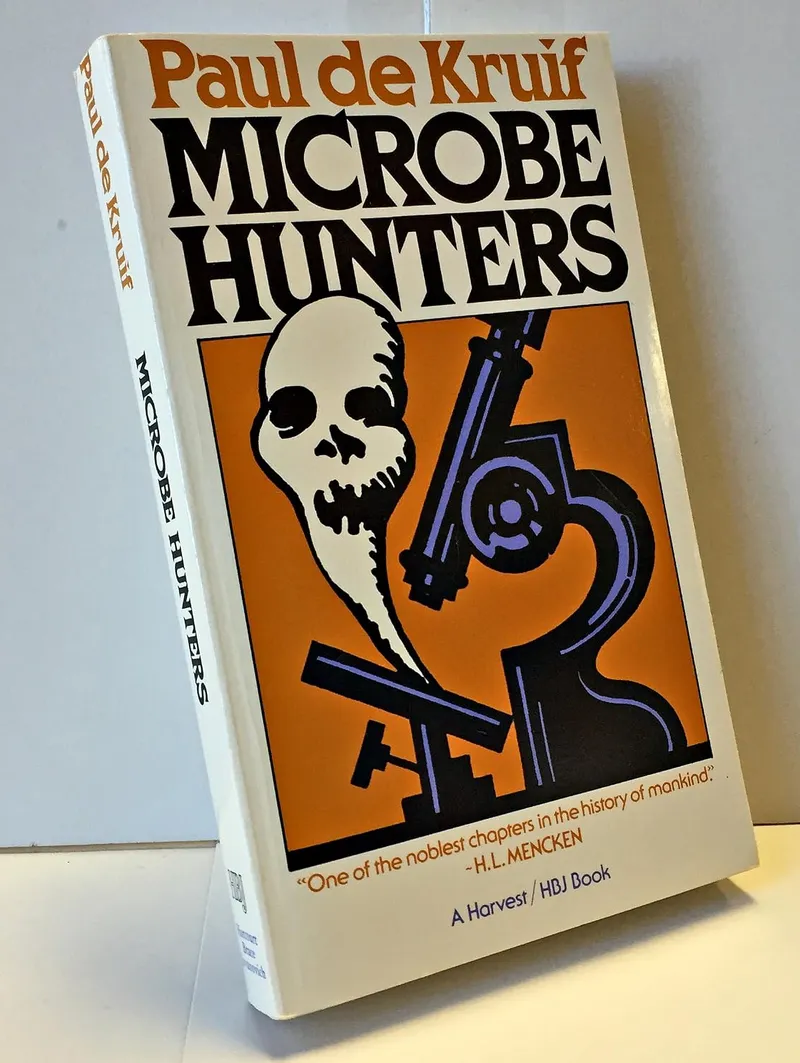

Microbe Hunters – Paul de Kruif
Microbe Hunters by Paul de Kruif is a classic work of popular science that introduces readers to the pioneers who helped establish modern microbiology. First published in the early twentieth century and later reprinted in numerous editions, the book tells the stories of scientists who investigated microorganisms and infectious diseases at a time when many of the fundamental principles of microbiology were still being discovered.
Rather than presenting microbiology as a conventional textbook, de Kruif tells the history of the field through the experiences, discoveries, challenges, and personalities of early microbiologists. The result is a narrative that makes the development of microbiology accessible to readers who may have little or no scientific background.
About Microbe Hunters
The history of microbiology is closely connected with the development of the microscope and the gradual realization that invisible organisms could influence human health, disease, food, and the environment.
Before microorganisms were widely understood, many infectious diseases were explained through ideas that had little connection with microbial causes. The work of early investigators gradually changed this understanding.
Microbe Hunters explores this transformation through stories of scientists who searched for the organisms responsible for disease and other biological phenomena.
The Pioneers of Microbiology
Paul de Kruif focuses on the individuals who helped transform microbiology into a scientific discipline.
Their investigations often involved difficult experiments, limited technology, and considerable uncertainty. These scientists had to develop new methods for observing microorganisms, cultivating them, testing their effects, and establishing connections between microbes and disease.
Their work laid important foundations for modern bacteriology, infectious disease research, immunology, and laboratory medicine.
Microorganisms and Infectious Disease
One of the central themes of Microbe Hunters is the discovery that microorganisms can be responsible for infectious diseases.
Understanding this relationship fundamentally changed medicine. Once scientists could identify specific microorganisms associated with disease, new possibilities emerged for diagnosis, prevention, vaccination, sanitation, and treatment.
The book presents this scientific transformation through historical narratives rather than technical explanations, allowing readers to appreciate how difficult and significant these discoveries were.
The Development of Germ Theory
The development of germ theory of disease was one of the most important changes in the history of medicine.
The idea that microorganisms could cause disease challenged older explanations of infection and gradually gained acceptance through experimental evidence.
The work of researchers investigating microbial causes of disease helped establish the principles that would eventually become central to medical microbiology.
Understanding this history provides useful context for modern concepts such as pathogens, infection, transmission, sterilization, and epidemiology.
Scientific Discovery Through Experimentation
An interesting aspect of Microbe Hunters is its emphasis on the investigative nature of science.
Scientific discoveries rarely happen simply because someone knows the correct answer in advance. Researchers observe unexpected results, develop hypotheses, design experiments, encounter failures, and revise their ideas.
The stories in the book demonstrate how observation and experimentation contributed to major advances in microbiology.
For students, this historical perspective can provide a different way of thinking about scientific discovery.
From Microscopes to Modern Microbiology
Early microbiologists worked with technologies that were primitive compared with today’s laboratory equipment.
Microscopes, staining techniques, culture methods, and experimental procedures were continually improved as researchers attempted to understand the microbial world.
Modern microbiology now includes sophisticated molecular techniques, genome sequencing, mass spectrometry, and advanced imaging. Looking back at the early history of the field helps illustrate how far microbiological science has developed.
Why Read Microbe Hunters?
Unlike a conventional microbiology textbook, Microbe Hunters focuses primarily on scientific history and storytelling.
This makes it useful for readers who want to understand the human side of scientific discovery.
The book can help readers appreciate:
- How microbiology developed as a scientific discipline
- How microorganisms became linked to infectious diseases
- The importance of experimentation in science
- The historical development of germ theory
- The challenges faced by early microbiologists
- The impact of microbiological discoveries on medicine
It can also provide an enjoyable complement to more technical microbiology textbooks.
Who Is This Book For?
Microbe Hunters can be interesting for:
- Microbiology students
- Biology students
- Medical students
- History of science enthusiasts
- Healthcare students
- Science educators
- Readers interested in infectious diseases
- General readers interested in scientific discovery
Because the book is written as a collection of scientific narratives, it can also be read by people without formal training in microbiology.
A Different Way to Learn Microbiology
Traditional textbooks explain microorganisms through definitions, classifications, diagrams, laboratory procedures, and scientific principles.
Microbe Hunters takes another route: it tells the story of the people who helped discover those principles.
This historical approach can make concepts such as microbial disease, bacteriology, and laboratory investigation more memorable. Instead of encountering scientific ideas as isolated facts, readers see how they emerged from questions, observations, experiments, and discoveries.
Historical Perspective and Modern Science
Although the book is a historical work rather than a modern microbiology textbook, its subject remains relevant.
Many principles that are fundamental to microbiology today emerged from the investigations described in the book. Understanding the history behind these ideas can provide additional context for students studying contemporary microbiology and infectious diseases.
It is therefore best considered a historical and popular-science companion to microbiology, rather than a replacement for a current scientific textbook.
Final Thoughts
Microbe Hunters by Paul de Kruif is a classic science book that brings the early history of microbiology to life through stories of the researchers who investigated the invisible world of microorganisms.
The book explores the development of ideas surrounding microbes, infectious diseases, germ theory, bacteriology, and scientific experimentation, while emphasizing the challenges and personalities behind important discoveries.
For microbiology and biology students, it offers an opportunity to step away from purely technical study and explore how some of the foundational ideas of modern microbiology emerged. For general readers, it provides an accessible introduction to the history of scientific discovery and the scientists who helped transform our understanding of disease.
Book Information
Title: Microbe Hunters
Author: Paul de Kruif
Edition: Reprint
Publisher: Harvest Books
Publication Date: January 1, 1995
Language: English
Print Length: 337 pages
ISBN-10: 0156594137
ISBN-13: 978-0156594134
Subject: Microbiology / History of Science / Infectious Diseases / Popular Science
Microbe Hunters remains an engaging introduction to the history of microbiology, offering readers a human-centered look at the scientists and discoveries that helped establish our modern understanding of microorganisms and infectious disease.
Support the Creators!
If you enjoy this book, please consider supporting the author and publisher by purchasing a physical or digital copy. Buying official copies ensures authors can keep writing great books.