
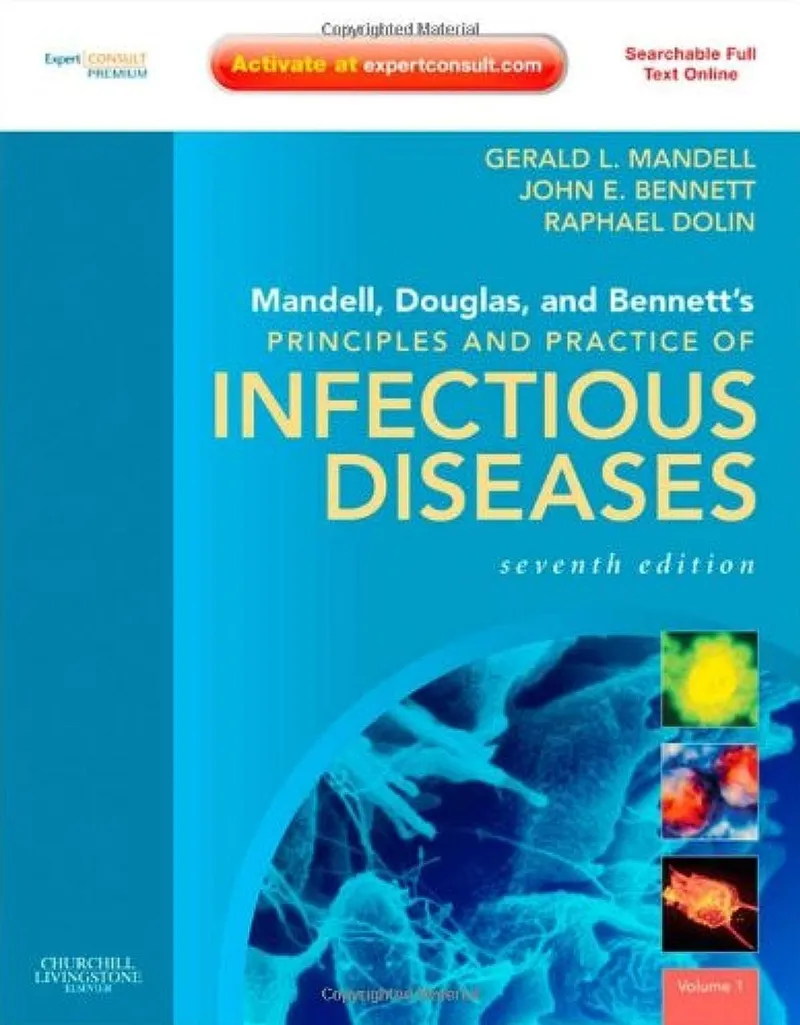

Mandell, Douglas, and Bennett’s Principles and Practice of Infectious Diseases, 7th Edition
Mandell, Douglas, and Bennett’s Principles and Practice of Infectious Diseases, 7th Edition is a comprehensive reference covering the science, diagnosis, treatment, and prevention of infectious diseases. Published by Churchill Livingstone, this two-volume edition provides extensive coverage of infectious diseases and the microorganisms responsible for them.
With 4,320 pages, the book is designed as a detailed reference for physicians, infectious disease specialists, microbiologists, medical students, and other healthcare professionals who require in-depth information about infectious diseases and their clinical management.
About Principles and Practice of Infectious Diseases
Infectious diseases involve complex interactions between microorganisms and their human hosts. Understanding them requires knowledge from several fields, including microbiology, immunology, pathology, pharmacology, epidemiology, and clinical medicine.
Mandell, Douglas, and Bennett’s Principles and Practice of Infectious Diseases brings these areas together to provide a broad framework for understanding infectious diseases from their biological foundations through diagnosis, treatment, and prevention.
The book addresses both general principles and individual infectious diseases, making it useful for readers who want to understand not only what causes an infection but also how it should be investigated and managed.
Principles of Infectious Disease
A strong understanding of infectious diseases begins with the relationship between pathogens and their hosts.
The book examines fundamental concepts such as microbial transmission, colonization, invasion, virulence, host defenses, and the factors that influence susceptibility to infection.
These principles provide a foundation for understanding why microorganisms cause different diseases and why the same pathogen can produce different outcomes in different patients.
Bacterial Infections
Bacterial infections represent a major area of infectious disease medicine.
The book provides detailed coverage of clinically important bacterial pathogens and the diseases associated with them. Understanding bacterial characteristics, mechanisms of pathogenicity, clinical manifestations, and laboratory diagnosis helps clinicians recognize and manage bacterial infections.
The relationship between bacterial infections and antimicrobial therapy is also an important part of clinical decision-making.
Viral Infections
Viruses cause a wide range of human diseases, from relatively mild infections to severe systemic illnesses.
The textbook examines important viral infections and discusses their clinical presentation, diagnosis, treatment, and prevention.
Modern viral diagnosis may involve molecular testing, antigen detection, serology, and other laboratory techniques, while prevention may include vaccination and infection-control measures.
Fungal and Parasitic Infections
Fungal and parasitic diseases are important components of infectious disease medicine.
Fungal infections can range from superficial diseases to serious invasive infections, particularly in patients with impaired immune defenses. Parasitic diseases may involve complex life cycles, specific geographic distributions, and distinctive routes of transmission.
Understanding these infections requires combining microbiological knowledge with clinical and epidemiological information.
Diagnosis of Infectious Diseases
Accurate diagnosis is essential for effective treatment.
The evaluation of an infectious disease may involve clinical examination, imaging, laboratory testing, microbiological culture, molecular diagnostics, serological testing, and other specialized investigations.
The book emphasizes the importance of integrating laboratory findings with the patient’s clinical presentation rather than interpreting individual test results in isolation.
Antimicrobial Therapy
Antimicrobial treatment is a central component of infectious disease management.
Selecting an appropriate antimicrobial agent requires consideration of the suspected or confirmed pathogen, the site of infection, drug characteristics, patient factors, and antimicrobial susceptibility.
Understanding the principles of antimicrobial therapy helps clinicians balance effective treatment with the potential for adverse effects and the development of resistance.
Antimicrobial Resistance
Antimicrobial resistance is one of the most important challenges in infectious disease medicine.
Microorganisms can develop or acquire mechanisms that allow them to survive exposure to antimicrobial drugs. Resistant infections can limit treatment options and increase the complexity of clinical management.
Understanding resistance mechanisms, susceptibility testing, antimicrobial selection, and appropriate drug use is therefore an essential part of infectious disease practice.
Infection Prevention and Control
Preventing the transmission of infectious diseases is an important part of healthcare.
The book examines principles relevant to infection prevention, including transmission pathways, vaccination, isolation, sanitation, and other control measures.
These principles are particularly important in hospitals and other healthcare environments where vulnerable patients may be exposed to infectious microorganisms.
Epidemiology of Infectious Diseases
Infectious diseases are influenced by geography, population behavior, environmental conditions, travel, animal reservoirs, and patterns of microbial transmission.
Epidemiological knowledge helps healthcare professionals understand how infections spread and how outbreaks can be detected and controlled.
This perspective also connects individual patient care with broader public-health strategies.
Emerging and Global Infections
The infectious disease landscape changes continuously.
New pathogens can emerge, microorganisms can develop resistance, and previously controlled diseases can reappear under changing environmental or social conditions.
Understanding infectious diseases therefore requires awareness of both established pathogens and the broader factors that influence disease emergence and transmission.
Clinical Approach to Infectious Diseases
One of the strengths of a comprehensive infectious disease reference is its integration of microbiology with clinical reasoning.
A clinician may begin with a patient’s symptoms and examination findings, develop a differential diagnosis, select appropriate laboratory investigations, identify a likely pathogen, and then determine an appropriate treatment strategy.
Understanding each step helps demonstrate how microbiological information contributes directly to patient care.
Who Is This Book For?
Mandell, Douglas, and Bennett’s Principles and Practice of Infectious Diseases, 7th Edition can be particularly useful for:
- Infectious disease specialists
- Physicians
- Medical students
- Clinical microbiologists
- Microbiology students
- Pharmacists
- Medical laboratory professionals
- Researchers studying infectious diseases
- Healthcare professionals preparing for examinations
- Advanced students studying clinical medicine
Because of its extensive coverage, it is best suited to readers seeking a detailed reference rather than a brief introductory textbook.
A Comprehensive Infectious Disease Reference
With 4,320 pages across two volumes, this edition provides considerably more depth than a standard medical microbiology textbook.
Its broad scope allows readers to explore infectious diseases from multiple perspectives, including microbial biology, clinical manifestations, diagnosis, treatment, epidemiology, and prevention.
For students, it can serve as an advanced supplementary reference. For healthcare professionals, it can provide detailed background when reviewing specific infectious diseases or clinical management principles.
Final Thoughts
Mandell, Douglas, and Bennett’s Principles and Practice of Infectious Diseases, 7th Edition is an extensive reference for understanding infectious diseases and their management.
The two-volume set covers major areas including bacterial, viral, fungal, and parasitic infections, microbial pathogenesis, diagnosis, antimicrobial therapy, antimicrobial resistance, infection prevention, epidemiology, and emerging infectious diseases.
Its substantial 4,320-page format makes it particularly suitable for advanced study and professional reference. By bringing together microbiology, clinical medicine, pharmacology, immunology, and epidemiology, the book provides a broad framework for understanding infectious diseases from the initial infection through diagnosis, treatment, and prevention.
For readers studying medicine, infectious diseases, clinical microbiology, pharmacy, or related healthcare disciplines, the 7th edition can serve as a valuable reference for developing a deeper understanding of the principles and practice of infectious disease medicine.
Book Information
Title: Mandell, Douglas, and Bennett’s Principles and Practice of Infectious Diseases
Edition: 7th Edition
Format: Two-Volume Set
Publisher: Churchill Livingstone
Publication Date: October 2, 2009
Language: English
Print Length: 4,320 pages
ISBN-10: 0443068399
ISBN-13: 978-0443068393
Subject: Infectious Diseases / Medical Microbiology / Clinical Medicine
Mandell, Douglas, and Bennett’s Principles and Practice of Infectious Diseases, 7th Edition provides an extensive reference for studying infectious disease diagnosis, microbial pathogenesis, antimicrobial treatment, resistance, epidemiology, and prevention.
Support the Creators!
If you enjoy this book, please consider supporting the author and publisher by purchasing a physical or digital copy. Buying official copies ensures authors can keep writing great books.