
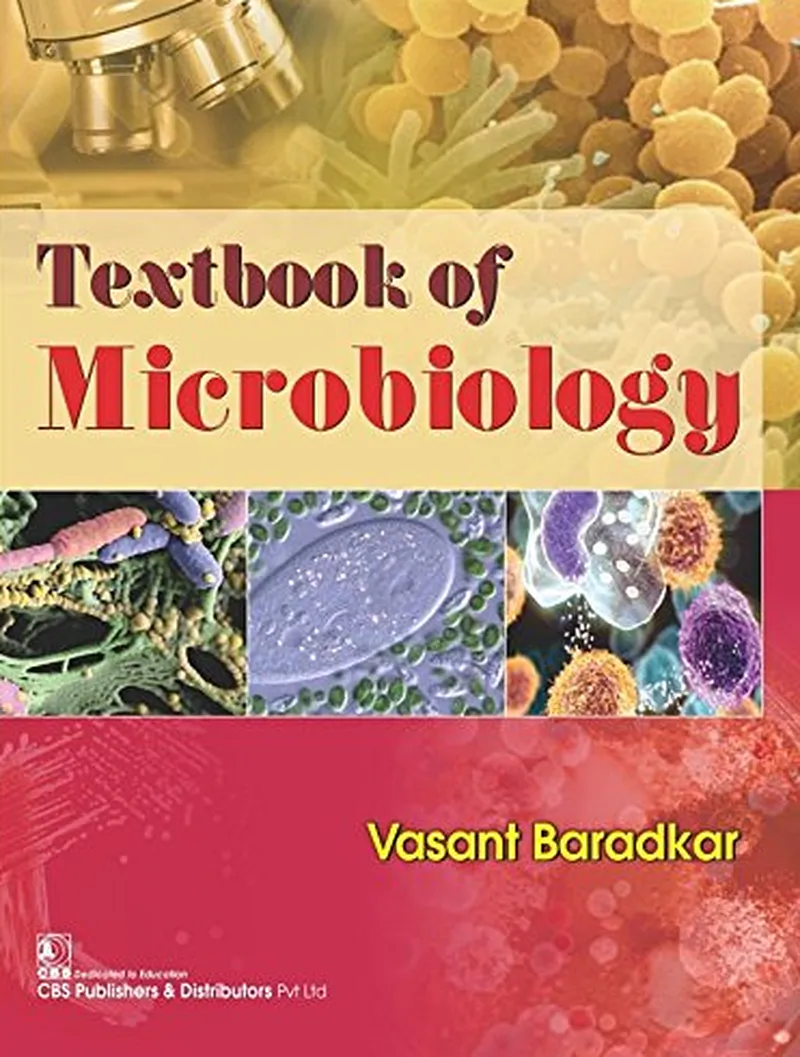

Textbook of Microbiology – Vasant Baradkar
Textbook of Microbiology by Vasant Baradkar is a comprehensive academic resource introducing the fundamental principles of microbiology and their applications in health and disease. Published by CBS Publishers & Distributors Pvt. Ltd., the book provides students with a structured foundation for understanding microorganisms, microbial processes, infectious diseases, laboratory diagnosis, and related concepts.
With 640 pages, the textbook offers a balanced amount of material for students who need to build a solid understanding of microbiology without relying exclusively on highly specialized reference books.
About Textbook of Microbiology
Microbiology is the study of microorganisms and their interactions with humans, animals, plants, and the environment.
Understanding the subject requires knowledge of microbial structure, growth, genetics, metabolism, pathogenicity, immunity, and laboratory methods. These concepts form the foundation for studying infectious diseases and many applications of microbiology.
Textbook of Microbiology provides students with a broad introduction to these principles while connecting basic microbiology with medically relevant topics.
Understanding Microorganisms
Microorganisms include bacteria, viruses, fungi, parasites, and other microscopic forms of life.
Each group has distinctive biological characteristics, growth requirements, and relationships with its host or environment. Learning these differences helps students understand why microorganisms behave differently and why some are capable of causing disease.
The study of microbial diversity also demonstrates that microorganisms are not exclusively harmful. Many are essential for ecosystems, food production, biotechnology, and normal human biology.
Bacteriology
Bacteria are among the most important subjects in microbiology.
Students need to understand bacterial structure, classification, growth, metabolism, genetics, and mechanisms of pathogenicity. These concepts provide a foundation for recognizing medically important bacteria and understanding the diseases associated with them.
Bacterial identification also relies on laboratory observations such as morphology, staining characteristics, culture properties, and biochemical reactions.
Virology
Viruses differ fundamentally from cellular microorganisms because they depend on host cells for replication.
Understanding viral structure, replication, transmission, and interactions with host cells provides a foundation for studying viral diseases.
Knowledge of virology is also important for understanding vaccination, antiviral therapy, viral diagnostics, and infection-control measures.
Mycology and Parasitology
Fungi and parasites are also important causes of human disease.
Fungal infections can affect superficial tissues or, in some cases, cause serious systemic disease. Parasites may have complex life cycles and specific transmission routes involving food, water, insects, animals, or environmental sources.
Studying these organisms helps students understand the diversity of infectious diseases and the different approaches required for their diagnosis.
Microbial Pathogenesis
Microorganisms can cause disease through a variety of mechanisms.
Pathogens may attach to host tissues, invade cells, produce toxins, damage tissues, or evade immune defenses. The outcome of an infection depends on both microbial characteristics and the condition of the host.
Understanding microbial pathogenesis helps students connect basic microbiology with the clinical manifestations of infectious diseases.
Immunity and Host Defense
The immune system provides protection against many microorganisms.
Basic immunology helps explain how the body recognizes pathogens and mounts defensive responses against them. It also provides important background for understanding vaccination, immune disorders, and susceptibility to infection.
The interaction between microorganisms and host defenses is therefore an essential part of medical microbiology.
Laboratory Diagnosis
Microbiology laboratories play an important role in identifying microorganisms and investigating infectious diseases.
Laboratory methods may include:
- Microscopy
- Staining techniques
- Culture
- Biochemical testing
- Antigen detection
- Serological methods
- Molecular diagnostics
- Antimicrobial susceptibility testing
Learning the principles behind these methods helps students understand how laboratory findings can contribute to the diagnosis and management of infections.
Antimicrobial Agents and Resistance
Antimicrobial drugs are used to control infections caused by susceptible microorganisms.
Understanding how these agents work provides insight into the treatment of infectious diseases. At the same time, microorganisms can develop or acquire resistance mechanisms that reduce the effectiveness of antimicrobial therapy.
Antimicrobial resistance is therefore an important area connecting microbial genetics, evolution, laboratory testing, and clinical treatment.
Infection Prevention and Control
Microbiology also provides the scientific foundation for preventing infectious diseases.
Sterilization, disinfection, sanitation, vaccination, appropriate laboratory practices, and infection-control procedures all depend on an understanding of how microorganisms survive and spread.
These principles are especially important in healthcare environments where preventing transmission can protect patients and healthcare workers.
Who Is This Book For?
Textbook of Microbiology can be useful for:
- Undergraduate microbiology students
- Medical students
- Nursing students
- Pharmacy students
- Medical laboratory students
- Biotechnology students
- Biomedical science students
- Biology students
- Healthcare students
- Students preparing for microbiology examinations
It can also be used as a supplementary reference for readers reviewing fundamental microbiology concepts.
Building a Strong Foundation in Microbiology
Microbiology contains many interconnected subjects, and students can sometimes find it difficult to see how individual topics relate to one another.
A strong foundation can be developed by connecting microbial structure with function, genetics with adaptation, microbial growth with environmental conditions, and pathogenicity with host immunity.
This integrated approach makes it easier to understand why microorganisms behave as they do and how microbiological knowledge is applied in medicine and healthcare.
Final Thoughts
Textbook of Microbiology by Vasant Baradkar provides a broad introduction to microbiology, covering fundamental concepts alongside topics relevant to human health and infectious disease.
The book introduces important areas including microbial diversity, bacteriology, virology, mycology, parasitology, microbial pathogenesis, immunity, laboratory diagnosis, antimicrobial therapy, antimicrobial resistance, and infection prevention.
With 640 pages, it offers a substantial foundation for students beginning or continuing their study of microbiology.
For students in microbiology, medicine, nursing, pharmacy, biotechnology, medical laboratory science, and related disciplines, this textbook can serve as a useful academic resource for developing an understanding of microorganisms and their roles in health and disease.
Book Information
Title: Textbook of Microbiology
Author: Vasant Baradkar
Publisher: CBS Publishers & Distributors Pvt. Ltd., India
Publication Date: October 30, 2017
Language: English
Print Length: 640 pages
ISBN-10: 9386478145
ISBN-13: 978-9386478146
Subject: Microbiology / Medical Microbiology / Infectious Diseases / Laboratory Science
Textbook of Microbiology provides a comprehensive foundation in microbial biology, bacteriology, virology, mycology, parasitology, pathogenesis, immunity, laboratory diagnosis, antimicrobial resistance, and infection control, making it a useful study resource for students in microbiology and related health sciences.
Support the Creators!
If you enjoy this book, please consider supporting the author and publisher by purchasing a physical or digital copy. Buying official copies ensures authors can keep writing great books.