

Viruses in Foods, 1st Edition
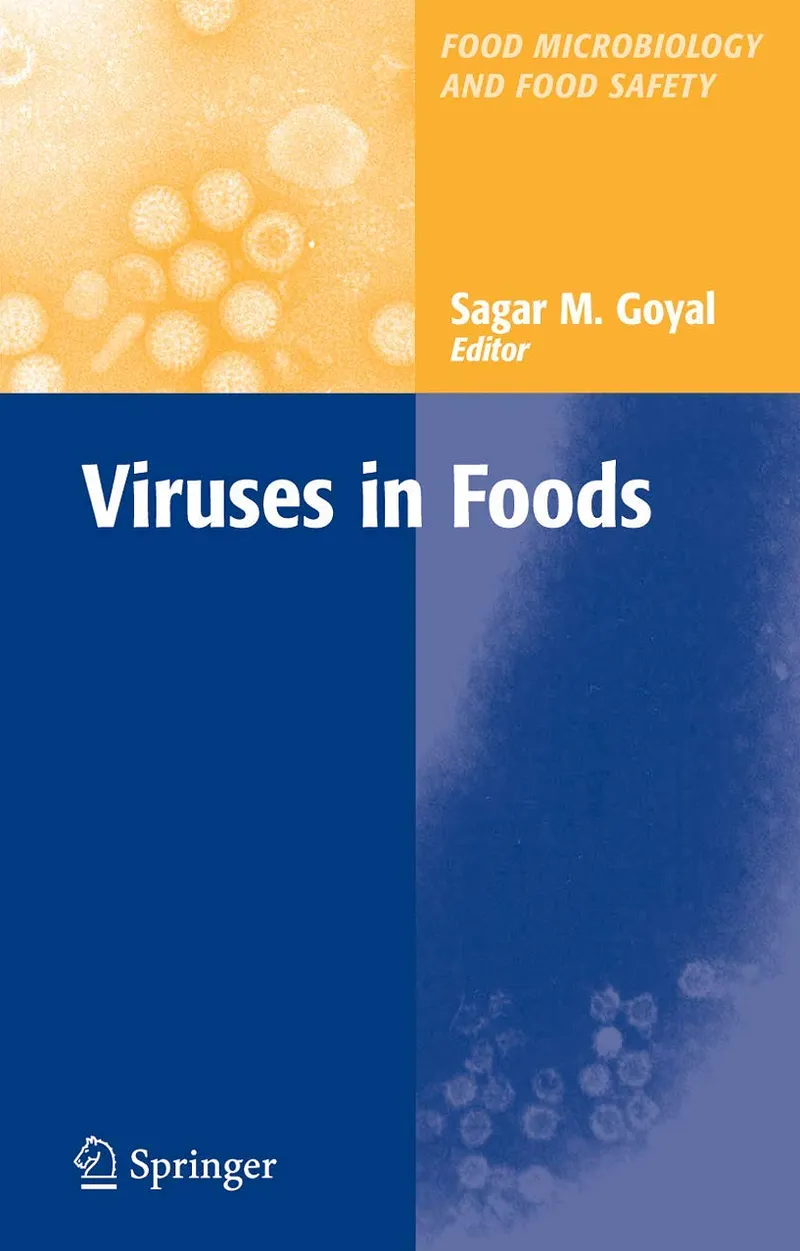
Viruses in Foods is a specialized reference exploring the role of viruses in food microbiology and food safety. Published by Springer as part of the Food Microbiology and Food Safety series, the book focuses on foodborne viruses, their transmission, survival in food environments, detection, and methods used to reduce the risk of viral contamination.
With 364 pages, this edition provides a focused examination of an important area of food safety. Unlike many food microbiology textbooks that concentrate heavily on bacteria and fungi, this book places viruses at the center of the discussion.
About Viruses in Foods
Food can play an important role in the transmission of certain viruses.
Unlike bacteria, viruses cannot reproduce independently in food because they require living host cells for replication. However, viruses can contaminate food and remain infectious under suitable conditions.
Understanding how viral contamination occurs is therefore an important part of modern food microbiology and public health.
Foodborne Viruses
Foodborne viruses can enter the food chain through contaminated water, infected food handlers, contaminated surfaces, or environmental sources.
Foods that are consumed without extensive cooking can be particularly important in foodborne viral transmission.
Understanding the sources and routes of contamination helps researchers and food-safety professionals develop strategies for reducing viral exposure.
Viral Survival in Foods
One of the important questions in food virology is how viruses behave after entering a food environment.
Factors such as temperature, acidity, moisture, food composition, and processing conditions can influence viral survival.
Because viruses do not multiply in food, their persistence depends primarily on their ability to remain infectious until they reach a susceptible host.
Viruses and Food Safety
Food safety systems traditionally place significant emphasis on bacterial pathogens, but viral contamination represents a separate challenge.
Viral particles may be present at levels that are difficult to detect and can sometimes remain infectious despite environmental conditions that inhibit many bacteria.
This makes understanding viral persistence, contamination pathways, and effective control measures particularly important.
Detection of Viruses in Food
Detecting viruses in food requires specialized laboratory approaches.
Modern food virology can involve molecular methods and other analytical techniques designed to identify viral genetic material or determine whether infectious viral particles are present.
Accurate detection is important for investigating outbreaks, monitoring contamination, and improving food-safety practices.
Food Processing and Viral Control
Food processing can influence the survival of viruses.
Methods such as heating, freezing, washing, disinfection, and other processing procedures may affect viral infectivity to different degrees.
Understanding these effects is important when developing food-processing and food-safety strategies intended to reduce viral contamination.
Viral Outbreaks and Public Health
Foodborne viral outbreaks can affect large numbers of people, particularly when contaminated products are distributed widely.
Investigating an outbreak requires identifying the likely source, tracing transmission pathways, testing relevant samples, and implementing measures to prevent further exposure.
Food virology therefore connects laboratory microbiology with epidemiology and public health.
Major Areas of Food Virology
The study of viruses in foods involves several interconnected areas, including:
- Foodborne viral pathogens
- Viral contamination of food and water
- Viral survival and persistence
- Food-processing effects
- Laboratory detection
- Molecular methods
- Foodborne disease outbreaks
- Epidemiology
- Food-safety management
- Prevention and control
Together, these areas provide a framework for understanding the role of viruses throughout the food chain.
Who Is This Book For?
Viruses in Foods can be useful for:
- Food microbiology students
- Microbiology students
- Food science students
- Food safety professionals
- Public-health researchers
- Virology students
- Biotechnology students
- Environmental health professionals
- Researchers studying foodborne diseases
- Professionals involved in food production and quality control
It can also serve as a specialized reference for readers who want to explore the intersection of virology, microbiology, food science, and public health.
Why Study Viruses in Foods?
Foodborne viruses represent an important area of microbiological research because their behavior differs from that of bacterial foodborne pathogens.
Understanding these differences helps explain why conventional approaches to bacterial contamination cannot always be applied directly to viruses.
The study of foodborne viruses also demonstrates how microbiology can be applied throughout the food production chain, from environmental sources and processing facilities to consumer health.
Final Thoughts
Viruses in Foods, 1st Edition provides a focused examination of viruses associated with food and their importance to food microbiology and public health.
The book explores topics including foodborne viral contamination, viral survival, transmission, detection, food processing, outbreak investigation, epidemiology, and food-safety strategies.
With 364 pages, it offers a specialized resource for readers interested in the role of viruses within the food chain.
For students and professionals in microbiology, virology, food science, food safety, biotechnology, and public health, Viruses in Foods provides valuable background for understanding how viral contamination can occur and why controlling foodborne viruses is an important component of modern food safety.
Book Information
Title: Viruses in Foods
Series: Food Microbiology and Food Safety
Edition: 1st Edition
Publisher: Springer
Publication Date: November 25, 2010
Language: English
Print Length: 364 pages
ISBN-10: 1441939628
ISBN-13: 978-1441939623
Subject: Food Microbiology / Food Safety / Virology / Foodborne Diseases / Public Health
Viruses in Foods provides a specialized introduction to foodborne viruses, viral contamination, survival in food environments, detection, food processing, outbreak investigation, and prevention, making it a useful reference for students and professionals working in food microbiology and food safety.
Support the Creators!
If you enjoy this book, please consider supporting the author and publisher by purchasing a physical or digital copy. Buying official copies ensures authors can keep writing great books.