

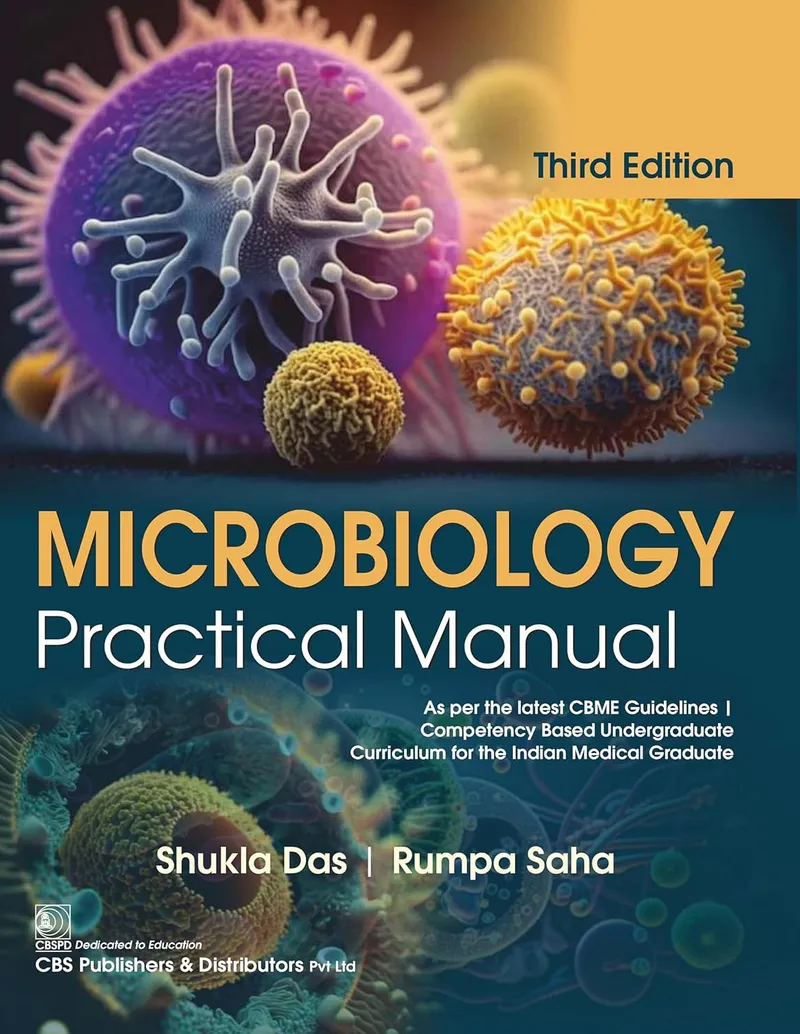

Microbiology Practical Manual, 3rd Edition
Microbiology Practical Manual by Shukla Das is a laboratory-focused resource designed to help students develop practical skills in microbiology. Published by CBS Publishers and Distributors Pvt. Ltd., the manual provides guidance for understanding and performing common microbiological laboratory procedures, making it a useful companion to theoretical microbiology textbooks.
Practical work is an essential part of microbiology education because many concepts become clearer when students observe microorganisms, prepare specimens, perform staining procedures, culture organisms, and interpret laboratory results.
About Microbiology Practical Manual
Microbiology laboratory work introduces students to the techniques used to observe, isolate, identify, and study microorganisms.
A practical manual provides a structured way to approach these activities, helping students understand not only how a laboratory procedure is performed but also the scientific principle behind it.
The book is particularly relevant to students who are beginning practical microbiology and need a reference for laboratory exercises and examination preparation.
Microscopy and Staining
Microscopy is one of the fundamental skills in microbiology.
Students learn how microorganisms can be observed and differentiated using microscopic techniques and staining procedures. Stains can reveal important characteristics such as microbial shape, arrangement, and cellular structures.
These techniques provide some of the first opportunities for students to directly observe the organisms they study in theory.
Culture and Isolation of Microorganisms
Culturing microorganisms allows individual organisms to be grown and studied under controlled laboratory conditions.
Practical microbiology introduces students to concepts such as culture media, inoculation, incubation, colony morphology, and isolation.
Learning these techniques provides a foundation for subsequent microbial identification and laboratory investigation.
Microbial Identification
Identifying an unknown microorganism requires the interpretation of multiple observations.
Students may examine microscopic characteristics, colony appearance, biochemical reactions, and other laboratory findings to distinguish one organism from another.
This process demonstrates how microbiologists combine different types of evidence when investigating microorganisms.
Sterilization and Laboratory Safety
Maintaining a controlled and safe laboratory environment is essential when working with microorganisms.
Sterilization, disinfection, aseptic technique, appropriate handling of laboratory materials, and proper disposal of biological waste are important components of practical microbiology.
Developing these habits early helps students understand the importance of contamination control and laboratory safety.
Biochemical Testing
Biochemical tests can provide useful information for identifying microorganisms.
Different microorganisms possess different metabolic capabilities, and laboratory tests can reveal these differences.
Learning how to perform and interpret biochemical tests helps students connect microbial physiology with practical identification procedures.
Antimicrobial Susceptibility Testing
Microbiology laboratories may also investigate how microorganisms respond to antimicrobial agents.
Susceptibility testing introduces students to the principles used to determine whether particular microorganisms are inhibited by specific antimicrobial drugs.
This practical area connects basic microbiology with clinical microbiology and the growing problem of antimicrobial resistance.
Who Is This Book For?
Microbiology Practical Manual can be useful for:
- Undergraduate microbiology students
- Medical students
- Medical laboratory students
- Nursing students
- Pharmacy students
- Biotechnology students
- Biomedical science students
- Biology students
- Students preparing for practical examinations
- Students learning basic microbiology laboratory techniques
It can also serve as a supplementary reference alongside a theoretical microbiology textbook.
Why Practical Microbiology Matters
Microbiology is a science that depends heavily on observation and experimentation.
Reading about bacterial morphology or microbial growth provides theoretical knowledge, but performing a staining procedure, observing a culture, or interpreting a biochemical reaction provides a different level of understanding.
Practical laboratory work helps students develop skills in observation, measurement, experimental technique, interpretation, and scientific reasoning.
Final Thoughts
Microbiology Practical Manual by Shukla Das is a laboratory-oriented resource for students who want to develop their understanding of practical microbiology.
The manual focuses on the techniques and principles involved in areas such as microscopy, staining, microbial culture, isolation, identification, biochemical testing, sterilization, laboratory safety, and antimicrobial susceptibility testing.
For students studying microbiology, medicine, medical laboratory science, biotechnology, pharmacy, nursing, and related biological disciplines, the book can be a useful companion for laboratory courses and practical examination preparation.
Its practical orientation makes it particularly suitable for students who want to connect the concepts learned in microbiology lectures with actual laboratory procedures and observations.
Book Information
Title: Microbiology Practical Manual
Author: Shukla Das
Edition: 3rd Edition
Publisher: CBS Publishers and Distributors Pvt. Ltd.
Publication Date: February 19, 2024
Language: English
ISBN-13: 978-9354667862
ASIN: B0CVXK4BRF
Subject: Microbiology / Laboratory Techniques / Practical Microbiology / Medical Laboratory Science
Microbiology Practical Manual provides a practical introduction to microbiology laboratory techniques, microbial observation, staining, culture, identification, biochemical testing, sterilization, and laboratory safety, making it a useful study companion for students developing hands-on microbiology skills.
Support the Creators!
If you enjoy this book, please consider supporting the author and publisher by purchasing a physical or digital copy. Buying official copies ensures authors can keep writing great books.


Thanks very much for your support and kindness
You are welcome Mr. Ihsan.