
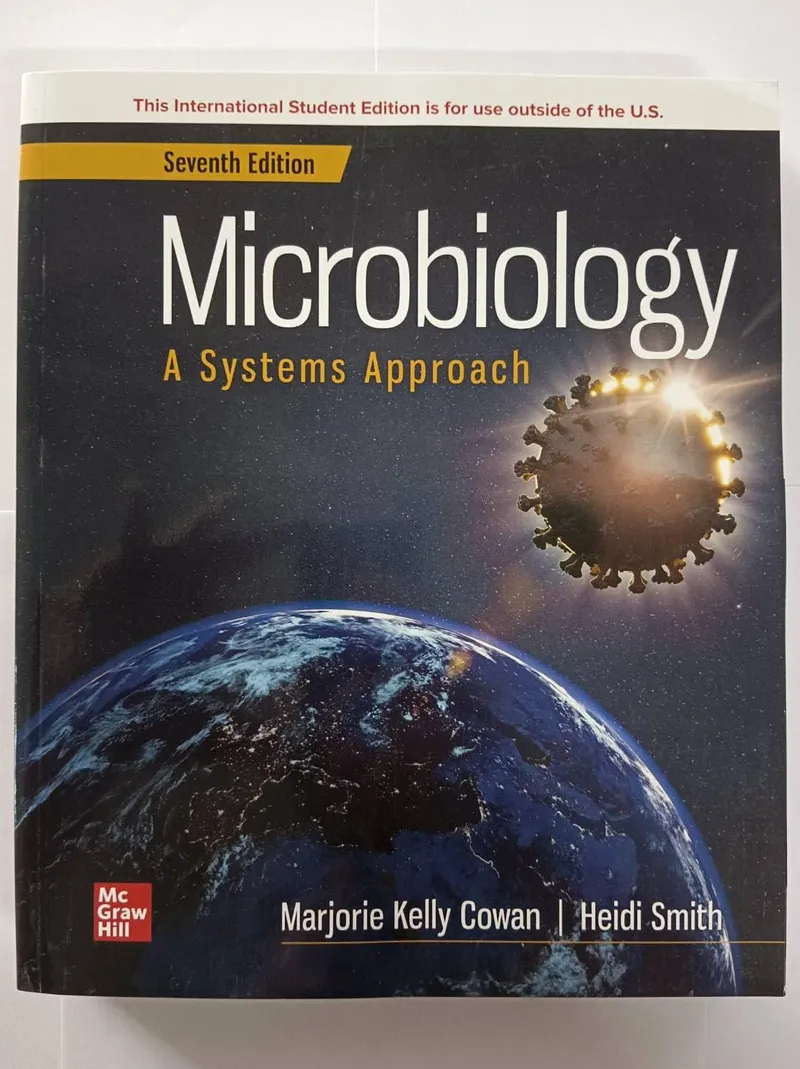

Microbiology: A Systems Approach, 7th Edition
Microbiology: A Systems Approach, 7th Edition is a comprehensive textbook that presents microbiology through an integrated and systems-based perspective. Published by McGraw-Hill Education, this edition connects fundamental concepts such as microbial structure, metabolism, genetics, and growth with broader topics including infectious diseases, immunity, biotechnology, and microbial ecology.
With 832 pages, the seventh edition provides substantial coverage while maintaining a clear connection between individual microbiological concepts. Rather than studying microorganisms as isolated facts, readers are encouraged to understand how microbial structures and processes work together and how microorganisms interact with their hosts and environments.
About Microbiology: A Systems Approach
Microbiology involves much more than identifying bacteria, viruses, fungi, and other microorganisms.
Microorganisms are dynamic biological systems whose structures, genes, metabolic pathways, and environmental interactions are closely connected. Understanding these relationships can make complex microbiology topics easier to organize and apply.
Microbiology: A Systems Approach introduces microbiology from this broader perspective, helping students connect basic microbial biology with applications in health, disease, biotechnology, and the environment.
Microbial Structure and Function
Understanding microbial structure provides the foundation for studying how microorganisms function.
The textbook examines fundamental cellular components and processes and explains how structures such as membranes, cell walls, genetic material, and cellular machinery contribute to microbial survival and growth.
These principles provide a basis for understanding microbial physiology, genetics, metabolism, and disease.
Microbial Metabolism and Growth
Microorganisms have remarkable metabolic diversity.
They can obtain energy and nutrients through many different pathways, allowing them to survive in environments ranging from the human body to soil, water, and extreme habitats.
Understanding microbial metabolism also helps explain how microorganisms grow and how environmental factors such as temperature, pH, oxygen, and nutrient availability influence their populations.
Microbial Genetics
Genetics is central to modern microbiology.
Microbial DNA contains the information needed for cellular functions, while changes in genetic material can produce new characteristics within microbial populations.
The study of gene expression, mutation, genetic exchange, and regulation helps explain microbial adaptation, evolution, biotechnology, and antimicrobial resistance.
Microbial Diversity and Ecology
Microorganisms occupy virtually every environment on Earth.
They contribute to nutrient cycling, decomposition, symbiotic relationships, and ecosystem stability. Some microorganisms can survive under extreme environmental conditions, demonstrating the remarkable adaptability of microbial life.
Studying microbial diversity provides a broader understanding of the importance of microorganisms beyond infectious disease.
Microorganisms and Human Health
Microorganisms have complex relationships with humans.
Many live harmlessly or beneficially on and within the body, while others can cause infectious diseases. The textbook examines the relationship between microbial characteristics, host defenses, and disease development.
This perspective helps students understand why some microorganisms become pathogens while others are important components of the normal microbiota.
Infectious Diseases and Pathogenesis
Microbial pathogens can cause disease through different mechanisms.
They may attach to host tissues, invade cells, produce toxins, evade immune defenses, or disrupt normal biological processes.
Understanding these mechanisms allows students to connect the biology of microorganisms with the symptoms, progression, and clinical consequences of infectious diseases.
Immunology and Host Defense
The immune system is an essential part of the body’s defense against microorganisms.
The book introduces fundamental concepts of innate and adaptive immunity and explains how immune responses interact with microbial pathogens.
This knowledge is also important for understanding vaccination, immune protection, and the factors that influence susceptibility to infection.
Laboratory Microbiology
Microbiology relies on laboratory techniques for observing, identifying, and studying microorganisms.
Common approaches include:
- Microscopy
- Staining
- Culture
- Biochemical testing
- Molecular methods
- Microbial identification
- Antimicrobial susceptibility testing
Learning the principles behind these techniques helps students understand how microorganisms are investigated in research, clinical, and industrial laboratories.
Antimicrobial Drugs and Resistance
Antimicrobial agents are used to control or eliminate microorganisms responsible for infectious diseases.
Understanding their mechanisms of action helps explain why particular drugs work against certain organisms and why resistance can develop.
Antimicrobial resistance is an important example of microbiology operating as a system: genetic variation, microbial selection, environmental pressures, and antimicrobial exposure can interact to produce populations that are increasingly difficult to treat.
Microbiology and Biotechnology
Microorganisms have many applications beyond medicine.
Their metabolic and genetic capabilities make them useful in biotechnology, food production, pharmaceutical manufacturing, environmental applications, and industrial processes.
Understanding microbial systems allows scientists to use microorganisms as biological tools for producing useful compounds and solving practical problems.
Environmental Microbiology
Microorganisms play essential roles in natural ecosystems.
They contribute to the cycling of carbon, nitrogen, sulfur, and other elements and participate in relationships with plants, animals, and other microorganisms.
These processes demonstrate how microbial activity can influence entire ecosystems and global environmental processes.
Who Is This Book For?
Microbiology: A Systems Approach, 7th Edition can be useful for:
- Microbiology students
- Biology students
- Pre-medical students
- Nursing and allied-health students
- Biomedical science students
- Biotechnology students
- Environmental science students
- Healthcare students
- Students preparing for microbiology examinations
Its broad coverage makes it suitable for university-level microbiology courses and as a reference for reviewing fundamental and applied microbiology.
Why a Systems Approach?
One of the major benefits of a systems-based perspective is that it encourages students to connect concepts rather than memorize them independently.
For example, microbial genetics can be connected to metabolism, metabolism to growth, growth to ecology, and microbial adaptation to antimicrobial resistance.
This approach helps demonstrate how the different areas of microbiology influence one another and provides a more integrated understanding of microbial life.
Final Thoughts
Microbiology: A Systems Approach, 7th Edition provides a broad introduction to microbiology while emphasizing the relationships between microbial structures, biological processes, environments, and hosts.
The textbook covers important areas including microbial structure, metabolism, growth, genetics, diversity, ecology, infectious diseases, pathogenesis, immunity, laboratory methods, antimicrobial therapy, resistance, and biotechnology.
With 832 pages, the seventh edition offers substantial material for university-level study without limiting microbiology to the study of pathogens alone.
For students studying microbiology, biology, medicine, healthcare, biotechnology, and environmental sciences, this textbook provides a useful framework for understanding microorganisms as complex biological systems and appreciating their roles in human health, disease, ecosystems, and biotechnology.
Book Information
Title: Microbiology: A Systems Approach
Edition: 7th Edition
Publisher: McGraw-Hill Education
Publication Date: January 1, 2023
Language: English
Print Length: 832 pages
ISBN-10: 1266177337
ISBN-13: 978-1266177330
Subject: Microbiology / Microbial Biology / Medical Microbiology / Biotechnology / Environmental Microbiology
Microbiology: A Systems Approach, 7th Edition provides an integrated foundation in microbial biology, genetics, metabolism, ecology, infectious diseases, immunity, antimicrobial resistance, laboratory microbiology, and biotechnology, making it a useful resource for students beginning or advancing their study of microbiology.
Support the Creators!
If you enjoy this book, please consider supporting the author and publisher by purchasing a physical or digital copy. Buying official copies ensures authors can keep writing great books.