

Brief Lessons in Microbiology: From the Origin of Life to Artificial Intelligence
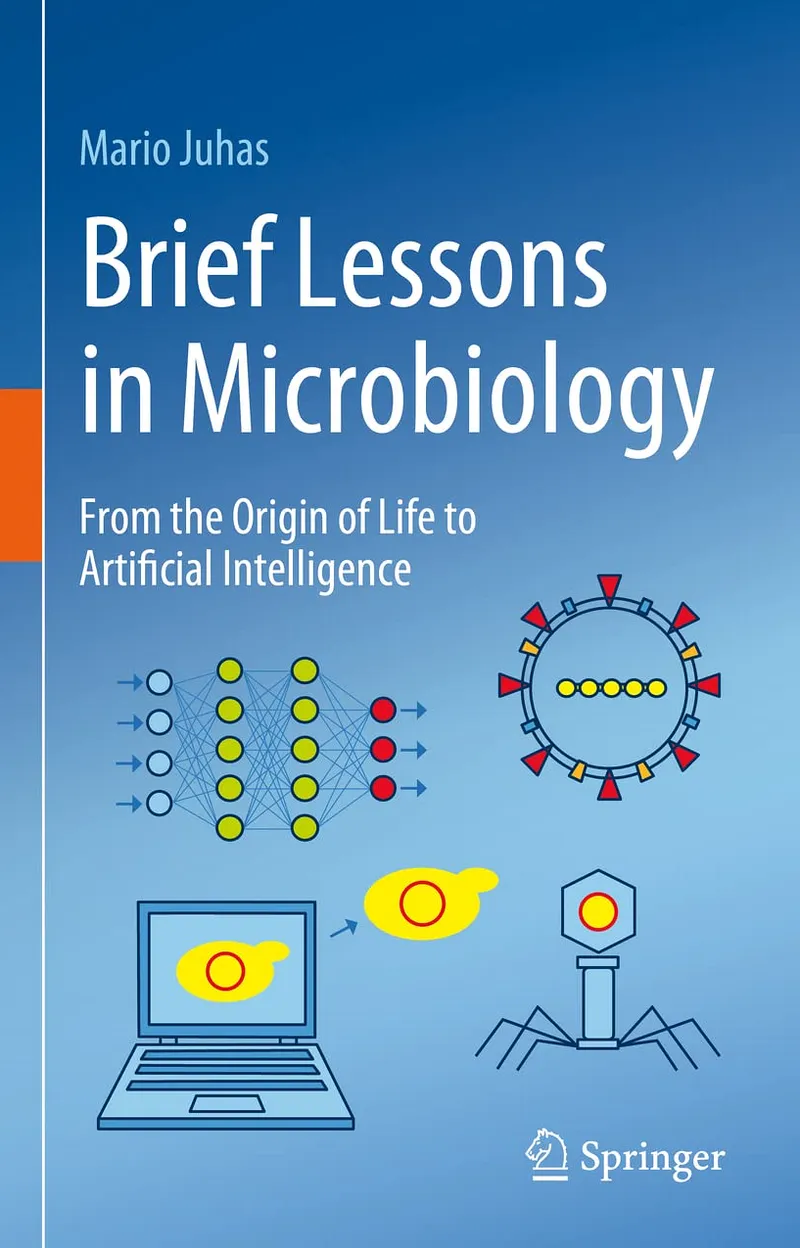
Brief Lessons in Microbiology: From the Origin of Life to Artificial Intelligence by Mario Juhas is a concise and modern introduction to microbiology that explores the subject from its historical and biological foundations to emerging technologies. Published by Springer in 2023, the book provides an accessible way to explore how microorganisms have shaped life on Earth and how microbiology continues to influence modern science and technology.
With 175 pages, the book offers a relatively compact approach to a subject that can otherwise become highly technical and extensive. It is particularly suitable for readers who want an overview of microbiology and its development without starting with a large, traditional textbook.
About Brief Lessons in Microbiology
Microbiology is a broad scientific discipline that extends far beyond the study of infectious diseases.
Microorganisms have played an important role in the history of life, the development of ecosystems, human health, biotechnology, and scientific discovery. Modern microbiology has also become closely connected with fields such as genetics, molecular biology, synthetic biology, and artificial intelligence.
Brief Lessons in Microbiology provides a journey through these interconnected topics, helping readers see how microbiology has developed and where the discipline may be heading.
From the Origin of Life to Modern Microbiology
The study of microorganisms provides an opportunity to explore some of the fundamental questions surrounding life itself.
Microbial life has existed for an enormous period of Earth’s history, and microorganisms have contributed to major biological and environmental changes. Studying them can therefore provide insights into evolution, biodiversity, and the development of life on our planet.
This historical perspective gives microbiology a broader context beyond its medical applications.
Understanding Microorganisms
Microorganisms include a diverse collection of biological forms with remarkably different structures, lifestyles, and functions.
Bacteria and other microbes can survive in environments ranging from ordinary soils and oceans to habitats with extreme temperatures, acidity, salinity, or pressure.
Understanding microbial diversity demonstrates the adaptability of life and helps explain why microorganisms are found almost everywhere.
Microbiology and Human Health
Microorganisms have a close relationship with humans.
Some microbes are associated with infectious diseases, while others form important communities within and on the human body. The study of microbial interactions with their hosts helps explain infection, immunity, the microbiome, and the complex relationships between microorganisms and human health.
This makes microbiology an important foundation for medicine and biomedical science.
Microbial Genetics and Molecular Biology
Modern microbiology is strongly connected to genetics and molecular biology.
Studying microbial DNA, gene expression, mutation, and genetic regulation has contributed to our understanding of fundamental biological processes.
Microorganisms are also valuable experimental systems because they can be studied efficiently and used to investigate biological mechanisms at the molecular level.
Microorganisms and Biotechnology
Microbial research has led to numerous practical applications.
Microorganisms can be used to produce useful biological compounds, enzymes, pharmaceuticals, foods, and industrial products. Advances in genetic engineering and synthetic biology have further expanded the ability of researchers to modify and utilize microbial systems.
These applications demonstrate how fundamental microbiology can contribute to technological development.
Microbiology in the Age of Artificial Intelligence
One of the interesting themes suggested by the book’s title is the connection between microbiology and artificial intelligence.
Modern microbiology generates enormous quantities of biological data. Genomic sequences, microbial communities, protein information, and experimental results can be analyzed using increasingly sophisticated computational methods.
Artificial intelligence and related computational approaches have the potential to help researchers identify patterns in biological data, accelerate discovery, and develop new approaches to studying microorganisms.
This connection illustrates how contemporary microbiology increasingly overlaps with computer science and data-driven research.
A Concise Approach to Microbiology
Unlike a large reference textbook, Brief Lessons in Microbiology is relatively short, with 175 pages.
Its compact format can make it suitable for readers who want to develop a broad understanding of microbiology before moving into more specialized subjects.
It can also provide a useful review for students who want to revisit the major ideas of microbiology without working through hundreds of pages of detailed material.
Who Is This Book For?
Brief Lessons in Microbiology can be useful for:
- Microbiology students
- Biology students
- Biomedical science students
- Biotechnology students
- Medical and healthcare students
- Students interested in molecular biology
- Readers interested in the history of life
- Science enthusiasts
- Readers interested in emerging biological technologies
- Anyone looking for a concise introduction to microbiology
Its relatively short format makes it particularly approachable for readers who are new to the subject.
Why Read Brief Lessons in Microbiology?
One of the appealing aspects of a concise microbiology book is the ability to see the larger picture.
Instead of concentrating exclusively on individual microorganisms or detailed laboratory procedures, readers can explore how different areas of microbiology connect with one another.
The relationship between microbial evolution, genetics, human health, biotechnology, and modern computational science provides a broader perspective on why microbiology remains such an important scientific field.
Final Thoughts
Brief Lessons in Microbiology: From the Origin of Life to Artificial Intelligence by Mario Juhas offers a concise exploration of microbiology and its connections to some of the major questions and technologies of modern science.
The book touches on themes including the origin and evolution of life, microbial diversity, human health, genetics, molecular biology, biotechnology, and the emerging relationship between microbiology and artificial intelligence.
With only 175 pages, it provides a compact alternative to traditional microbiology textbooks and can serve as an accessible introduction or supplementary reading for students and general readers.
For anyone interested in microbiology, biology, biotechnology, molecular science, or the future of biological research, this book offers an opportunity to explore how the study of microorganisms has developed from observations of microscopic life into a modern scientific discipline connected to advanced technologies.
Book Information
Title: Brief Lessons in Microbiology: From the Origin of Life to Artificial Intelligence
Author: Mario Juhas
Edition: 2023
Publisher: Springer
Publication Date: April 30, 2023
Language: English
Print Length: 175 pages
ISBN-10: 3031295439
ISBN-13: 978-3031295430
Subject: Microbiology / Biology / Molecular Biology / Biotechnology / Artificial Intelligence
Brief Lessons in Microbiology provides a concise journey through microbial life, evolution, genetics, human health, biotechnology, and emerging technologies, making it an interesting resource for readers who want to understand both the foundations and the changing future of microbiology.
Support the Creators!
If you enjoy this book, please consider supporting the author and publisher by purchasing a physical or digital copy. Buying official copies ensures authors can keep writing great books.