
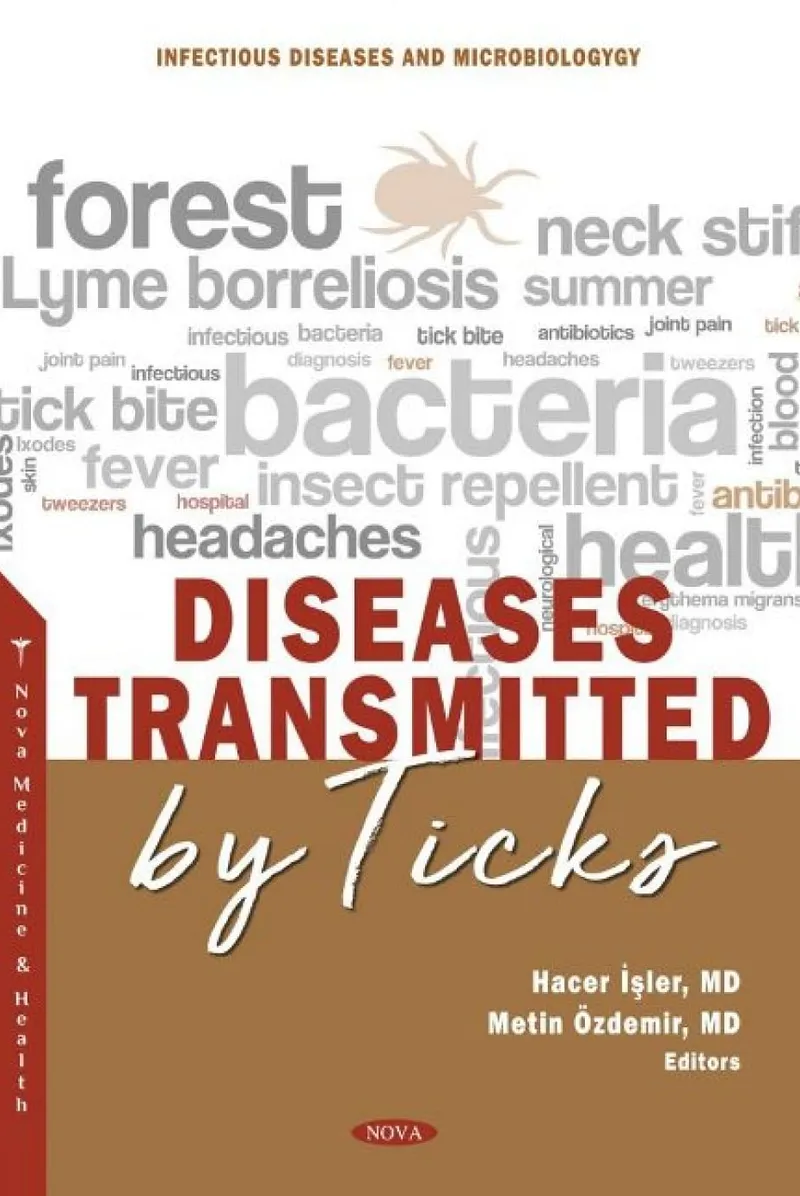

Diseases Transmitted by Ticks
Diseases Transmitted by Ticks is a specialized resource examining infectious diseases associated with ticks and the microorganisms they transmit to humans and other hosts. Published by Nova Science Publishers, Inc. as part of the Infectious Diseases and Microbiology series, the book provides useful background on tick-borne infections, their transmission, clinical importance, and microbiological aspects.
With 359 pages, the book offers a focused resource for readers interested in medical microbiology, infectious diseases, parasitology, vector biology, epidemiology, and public health.
About Diseases Transmitted by Ticks
Ticks are important vectors of infectious microorganisms and can transmit a variety of pathogens during feeding.
The organisms associated with tick-borne diseases may include bacteria, viruses, and parasites, with different pathogens producing different clinical manifestations and requiring different approaches to diagnosis and management.
Understanding these diseases requires knowledge of both the microorganisms involved and the biology of their tick vectors.
Tick-Borne Infections
Tick-borne diseases occur when an infected tick transmits a pathogen to a susceptible host.
The risk of infection can depend on factors such as the tick species, geographic distribution, pathogen prevalence, environmental conditions, and human exposure to tick habitats.
Studying these factors helps explain why certain tick-borne diseases are more common in particular regions and populations.
Ticks as Disease Vectors
Ticks have complex life cycles and can acquire microorganisms from infected hosts before transmitting them to other animals or humans.
Their role as biological vectors makes them an important subject in medical entomology, microbiology, and epidemiology.
Understanding vector biology can help researchers and public health professionals develop strategies for reducing transmission.
Bacterial Tick-Borne Diseases
Several medically important bacterial pathogens can be transmitted by ticks.
These infections can produce a wide range of clinical manifestations, depending on the organism involved. Accurate diagnosis often requires consideration of the patient’s symptoms, exposure history, geographic location, and appropriate laboratory testing.
Studying the microbiology of these organisms is essential for understanding their transmission and disease mechanisms.
Viral Tick-Borne Diseases
Ticks can also transmit a variety of viruses.
Tick-borne viral infections demonstrate the complex relationship between viruses, vectors, animal reservoirs, and human populations.
Understanding viral transmission and geographic distribution is important for surveillance and public health preparedness.
Parasitic Infections
Some tick-associated diseases involve parasitic organisms.
These infections add another layer of complexity to the study of tick-borne disease because parasites have different biological characteristics and life cycles compared with bacterial and viral pathogens.
Understanding these differences helps students distinguish between the major categories of tick-borne infections.
Diagnosis of Tick-Borne Diseases
Diagnosing a tick-borne infection can sometimes be challenging because different diseases may produce similar symptoms.
Laboratory methods can include:
- Microscopic examination
- Serological testing
- Molecular diagnostics
- Culture-based methods for appropriate organisms
- Detection of pathogen-specific markers
Clinical findings and exposure history are also important components of the diagnostic process.
Epidemiology and Geographic Distribution
Tick-borne diseases are strongly influenced by geography and ecology.
The distribution of tick species, animal hosts, pathogens, and environmental conditions can determine where particular diseases occur.
Epidemiological surveillance helps researchers identify changes in disease patterns and monitor the emergence or expansion of tick-borne infections.
Prevention and Public Health
Preventing tick-borne disease involves reducing opportunities for ticks to transmit pathogens.
Public health strategies may include tick avoidance, appropriate protective clothing, environmental management, vector surveillance, education, and early recognition of potential infections.
Understanding the biology of tick transmission provides the scientific foundation for these preventive approaches.
Climate and Environmental Factors
Environmental conditions can influence the distribution and activity of ticks.
Changes in temperature, vegetation, animal populations, and land use can affect interactions among ticks, hosts, and pathogens.
For this reason, tick-borne diseases are also relevant to environmental health and infectious disease surveillance.
Who Is This Book For?
Diseases Transmitted by Ticks can be useful for:
- Microbiology students
- Medical students
- Infectious disease students
- Parasitology students
- Public health students
- Epidemiology students
- Medical laboratory students
- Veterinary science students
- Researchers studying vector-borne diseases
- Professionals working in infectious disease and public health
It can also provide supplementary reading for readers interested in the relationship between vectors, pathogens, and human disease.
Why Study Tick-Borne Diseases?
Tick-borne diseases demonstrate the interconnected nature of microbiology, ecology, vector biology, and public health.
A complete understanding requires more than studying the pathogen itself. Researchers must also consider the tick vector, animal reservoirs, environmental conditions, human behavior, and patterns of transmission.
This makes tick-borne disease an important multidisciplinary area of modern infectious disease research.
Final Thoughts
Diseases Transmitted by Ticks provides a focused examination of infections associated with ticks and the microorganisms they transmit.
The book explores important concepts related to tick-borne bacteria, viruses, parasites, vector biology, disease transmission, diagnosis, epidemiology, prevention, and public health.
With 359 pages, it offers a useful resource for readers seeking to understand the biological and epidemiological factors that contribute to tick-borne infections.
For students and professionals in microbiology, medicine, parasitology, epidemiology, veterinary science, public health, and infectious disease research, this book provides valuable background on the complex relationship between ticks, pathogens, hosts, and the environment.
Book Information
Title: Diseases Transmitted by Ticks
Series: Infectious Diseases and Microbiology
Publisher: Nova Science Publishers, Inc.
Publication Date: December 15, 2021
Language: English
Print Length: 359 pages
ISBN-10: 168507359X
ISBN-13: 978-1685073596
Subject: Tick-Borne Diseases / Medical Microbiology / Infectious Diseases / Parasitology / Vector Biology / Epidemiology / Public Health
Diseases Transmitted by Ticks explores tick-borne infections, microbial pathogens, vector biology, disease transmission, diagnosis, epidemiology, and prevention, making it a useful resource for readers interested in the intersection of microbiology, parasitology, infectious diseases, and public health.
Support the Creators!
If you enjoy this book, please consider supporting the author and publisher by purchasing a physical or digital copy. Buying official copies ensures authors can keep writing great books.