
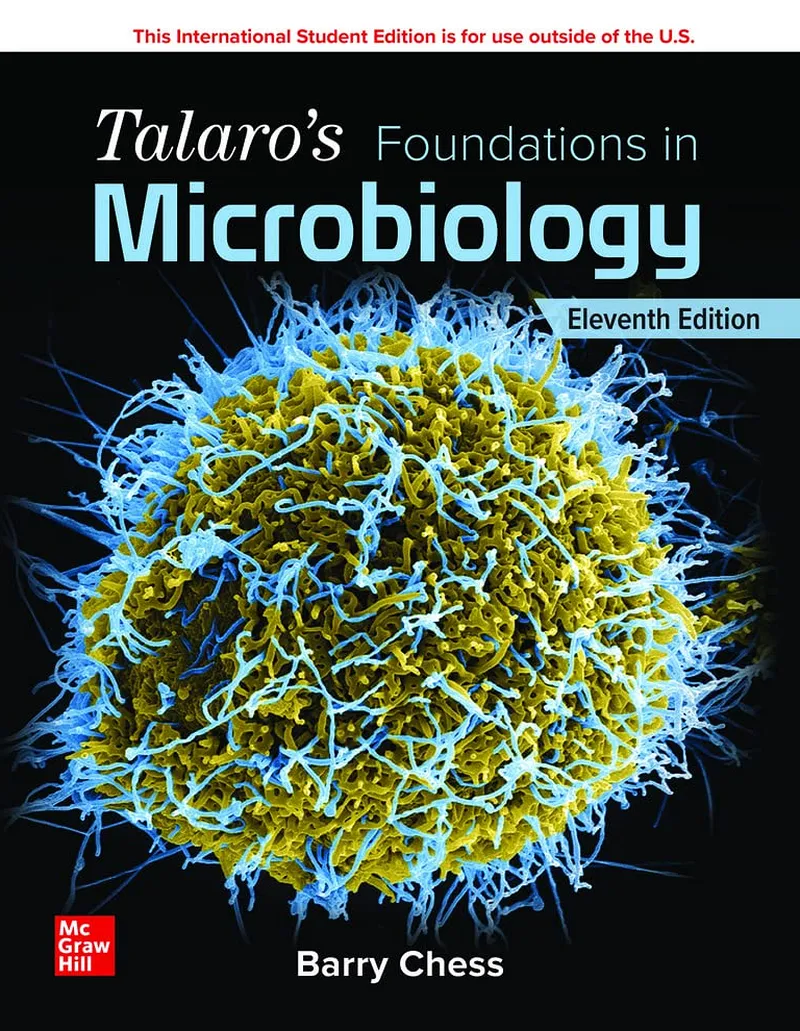

Talaro’s Foundations in Microbiology: Basic Principles, 11th Edition
Talaro’s Foundations in Microbiology: Basic Principles, 11th Edition by Barry Chess is a comprehensive introductory microbiology textbook designed to help students understand the fundamental principles of microorganisms and their roles in biology, health, and disease. Published by McGraw Hill, this edition provides a structured introduction to the field while connecting basic microbiological concepts with practical and clinical applications.
With 656 pages, it is a useful resource for students beginning their study of microbiology, medical microbiology, biotechnology, and related life sciences.
About Talaro’s Foundations in Microbiology
Microbiology is the study of microorganisms and their interactions with humans, animals, plants, and the environment.
A strong understanding of microbiology begins with fundamental concepts such as microbial structure, metabolism, genetics, growth, reproduction, and classification. These principles provide the foundation for more advanced topics such as infectious diseases, biotechnology, and microbial ecology.
This textbook presents these core concepts in an organized manner suitable for introductory microbiology study.
Microbial Structure and Function
Understanding the structure of microorganisms is essential for explaining how they survive and reproduce.
Important topics include bacterial cells, cellular components, membranes, microbial structures, viruses, fungi, and other microorganisms.
Connecting structure with function helps students understand how microorganisms interact with their environments and hosts.
Microbial Growth and Metabolism
Microorganisms require nutrients and appropriate environmental conditions to grow.
Microbial growth is influenced by factors such as temperature, pH, oxygen availability, nutrients, and environmental conditions.
Microbial metabolism explains how microorganisms obtain energy and transform nutrients, providing a foundation for understanding their roles in ecosystems and disease.
Microbial Genetics
Genetics is an important part of modern microbiology.
Microbial genetics examines DNA, genes, mutation, gene expression, genetic exchange, and regulation.
These concepts help explain how microorganisms adapt to changing environments and acquire characteristics such as antimicrobial resistance.
Microorganisms and Disease
Some microorganisms are capable of causing disease in humans.
Understanding microbial pathogenesis requires knowledge of how pathogens colonize hosts, invade tissues, produce harmful factors, and interact with the immune system.
These principles provide an important foundation for studying infectious diseases and medical microbiology.
Host-Microbe Interactions
Microorganisms and their hosts interact in many different ways.
Some microbes can exist harmlessly within the body, while others may cause disease under particular conditions.
Studying normal microbiota, host defenses, immunity, and microbial pathogenesis helps explain the complex relationship between microorganisms and human health.
Antimicrobial Agents and Resistance
Microbiology also provides the foundation for understanding antimicrobial drugs.
Students can explore how antimicrobial agents affect microorganisms and how microbial populations can develop resistance.
Antimicrobial resistance is particularly important in modern healthcare and demonstrates the practical importance of microbial genetics and evolution.
Microbiology in Everyday Life
Microorganisms are not limited to clinical disease.
They play important roles in food production, environmental processes, agriculture, biotechnology, medicine, and industrial applications.
Understanding these beneficial and harmful roles provides a broader perspective on why microbiology is important across many scientific disciplines.
Who Is This Book For?
Talaro’s Foundations in Microbiology: Basic Principles, 11th Edition can be useful for:
- Undergraduate microbiology students
- Biology students
- Pre-medical students
- Nursing students
- Allied health students
- Biotechnology students
- Medical laboratory students
- Health science students
- Students preparing for microbiology examinations
It can also serve as a foundation for readers planning to progress into medical microbiology, molecular biology, biotechnology, or infectious disease studies.
Why Study Foundations of Microbiology?
Microbiology provides the foundation for understanding many areas of modern biology and medicine.
Learning the basic principles of microbial structure, growth, metabolism, genetics, ecology, host interactions, and disease allows students to approach more advanced subjects with a stronger scientific background.
A foundational textbook can therefore be valuable both for introductory courses and as a reference when revisiting essential microbiological concepts.
Final Thoughts
Talaro’s Foundations in Microbiology: Basic Principles, 11th Edition provides a broad introduction to the fundamental concepts of microbiology.
The book covers important areas related to microbial structure and function, growth, metabolism, genetics, microorganisms and disease, host-microbe interactions, antimicrobial agents, resistance, and applied microbiology.
With 656 pages, this edition offers substantial material for students who want to develop a solid understanding of microbiology before moving into more specialized areas.
For students studying microbiology, biology, medicine, nursing, biotechnology, medical laboratory science, and health sciences, this textbook can serve as a useful foundation for understanding the microbial world and its importance in science and human health.
Book Information
Title: Talaro’s Foundations in Microbiology: Basic Principles
Edition: 11th Edition
Author: Barry Chess
Publisher: McGraw Hill
Publication Date: January 14, 2020
Language: English
Print Length: 656 pages
ISBN-10: 1260451437
ISBN-13: 978-1260451436
Subject: Microbiology / Basic Microbiology / Medical Microbiology / Microbial Genetics / Infectious Diseases
Talaro’s Foundations in Microbiology: Basic Principles, 11th Edition introduces the essential concepts of microbial structure, growth, metabolism, genetics, host-microbe interactions, infectious diseases, antimicrobial resistance, and applied microbiology, making it a useful textbook for students beginning their study of microbiology.
Support the Creators!
If you enjoy this book, please consider supporting the author and publisher by purchasing a physical or digital copy. Buying official copies ensures authors can keep writing great books.