
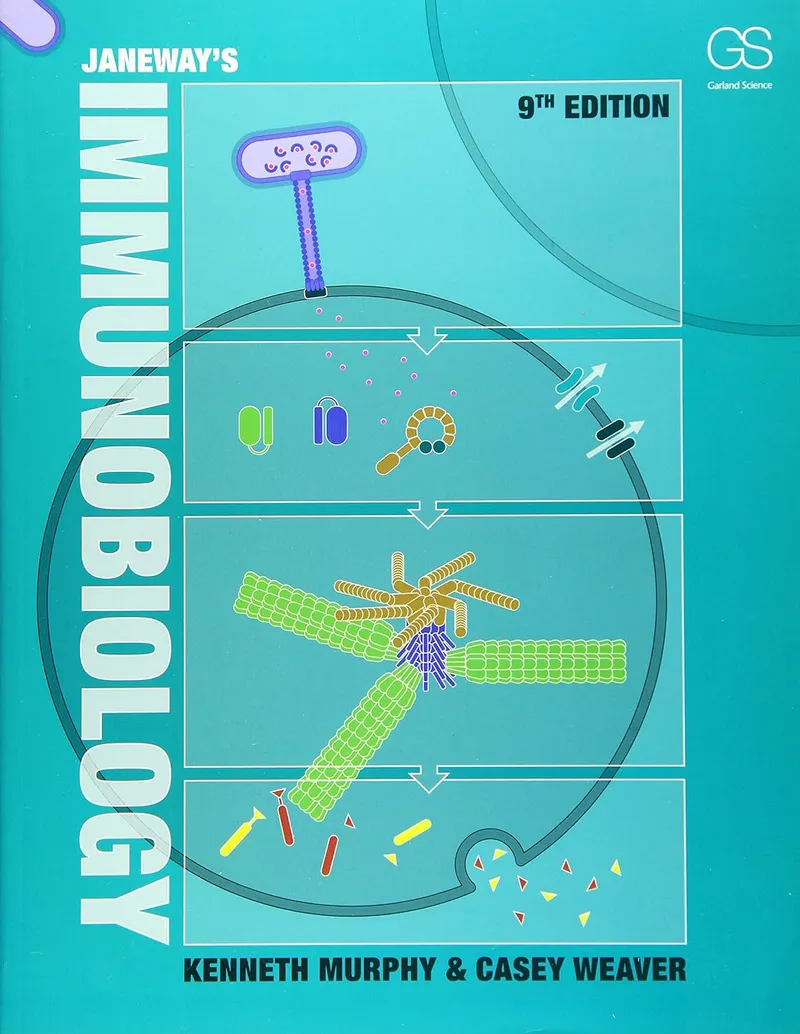

Janeway’s Immunobiology, 9th Edition
Janeway’s Immunobiology, 9th Edition by Kenneth Murphy and Casey Weaver is a comprehensive textbook covering the principles, mechanisms, and functions of the immune system. Published by W. W. Norton & Company, this edition provides an integrated approach to modern immunology, connecting molecular and cellular mechanisms with immune responses, infection, disease, and therapeutic applications.
With 904 pages, it is a substantial academic resource for students and researchers studying immunology, microbiology, molecular biology, cell biology, medicine, and biomedical sciences.
About the Book
The immune system relies on an intricate network of cells, receptors, signaling molecules, and tissues to recognize threats and maintain the body’s biological balance.
The book develops immunology from its fundamental principles, explaining how innate and adaptive immune responses are initiated, regulated, and coordinated.
Innate Immunity
Innate immunity provides an immediate response to invading organisms and tissue damage.
The book examines physical barriers, pattern-recognition receptors, innate immune cells, inflammation, complement, and other mechanisms involved in early host defense.
Adaptive Immunity
Adaptive immunity provides highly specific and long-lasting responses.
The text explores B cells, T cells, antigen recognition, clonal selection, antibody production, cellular immunity, and immunological memory.
Antigen Recognition
The ability to distinguish different molecular structures is fundamental to immune defense.
The book examines antigens, antigen receptors, antibodies, T-cell receptors, and the molecular mechanisms involved in immune recognition.
B Cells and Antibodies
B lymphocytes are responsible for antibody-mediated immune responses.
The text explains B-cell development, activation, antibody structure, antibody diversity, class switching, affinity maturation, and mechanisms of humoral immunity.
T Cells and Cellular Immunity
T lymphocytes coordinate and execute important components of adaptive immunity.
The book explores T-cell development, antigen recognition, T-cell activation, helper T-cell responses, cytotoxic T cells, and mechanisms of cell-mediated immunity.
Major Histocompatibility Complex
Antigen presentation allows T cells to recognize infected or abnormal cells.
The text examines MHC molecules, antigen processing, peptide presentation, and the molecular basis of T-cell recognition.
Cytokines and Immune Signaling
Immune responses require extensive communication between cells.
The book discusses cytokines, receptors, intracellular signaling pathways, and molecular mechanisms that regulate immune-cell behavior.
Complement and Innate Defense
Complement is an important component of host defense.
The text explains complement activation, regulation, pathogen recognition, inflammation, and mechanisms that contribute to microbial elimination.
Immune System Development
Immune cells develop through highly regulated processes.
The book examines the development and selection of B cells and T cells, including mechanisms that help establish functional immune repertoires.
Immunological Tolerance
The immune system must distinguish foreign molecules from the body’s own tissues.
The text explores central and peripheral tolerance, regulatory mechanisms, and the consequences of failures in immune tolerance.
Autoimmunity and Hypersensitivity
Abnormal immune responses can cause tissue damage and disease.
The book discusses autoimmune diseases, hypersensitivity reactions, and mechanisms through which inappropriate immune activation can affect tissues.
Immunodeficiency
Defects in immune components can increase susceptibility to infection and other diseases.
The text examines the principles underlying primary and acquired immunodeficiencies and their effects on immune function.
Immunity to Infection
The immune system responds differently depending on the characteristics of the invading pathogen.
The book explores host responses to bacteria, viruses, fungi, and parasites, explaining how innate and adaptive immunity cooperate to control infection.
Cancer Immunology
Immune responses can influence the development and control of cancer.
The text introduces tumor immunity, immune recognition of abnormal cells, mechanisms of immune evasion, and principles underlying cancer immunotherapy.
Transplantation and Immune Responses
The immune system can recognize transplanted tissues as foreign.
The book examines the immunological principles behind transplant rejection, tissue compatibility, and immune tolerance.
Vaccination and Immunological Memory
Long-term immune protection is a major application of immunology.
The text explains the principles of vaccination, memory responses, protective immunity, and the development of effective immune responses against infectious diseases.
Who Is This Book For?
Janeway’s Immunobiology, 9th Edition can be useful for:
- Immunology students
- Medical students
- Microbiology students
- Biology students
- Molecular biology students
- Biomedical science students
- Biotechnology students
- Graduate students
- Immunology researchers
- Healthcare professionals
It is particularly appropriate for advanced undergraduate and graduate-level study of immunology.
Final Thoughts
Janeway’s Immunobiology, 9th Edition provides a detailed and integrated examination of the mechanisms underlying immune defense.
Its coverage of innate and adaptive immunity, antigen recognition, B and T cells, antibodies, MHC, cytokines, complement, immune tolerance, autoimmunity, immunodeficiency, infection, cancer, transplantation, and vaccination makes it an important textbook for students and researchers in immunology and related biomedical sciences.
Book Information
Title: Janeway’s Immunobiology
Edition: 9th Edition
Authors: Kenneth Murphy, Casey Weaver
Publisher: W. W. Norton & Company
Publication Date: March 15, 2017
Language: English
Print Length: 904 pages
ISBN-10: 0815344457
ISBN-13: 978-0815344452
Subject: Immunology / Microbiology / Molecular Biology / Cell Biology / Biomedical Sciences
Janeway’s Immunobiology, 9th Edition provides a comprehensive foundation in innate and adaptive immunity, antigen recognition, immune-cell development, antibodies, T-cell responses, immune regulation, infection, autoimmunity, immunodeficiency, cancer, and vaccination, making it a valuable academic resource for immunology and biomedical science students.
Support the Creators!
If you enjoy this book, please consider supporting the author and publisher by purchasing a physical or digital copy. Buying official copies ensures authors can keep writing great books.