
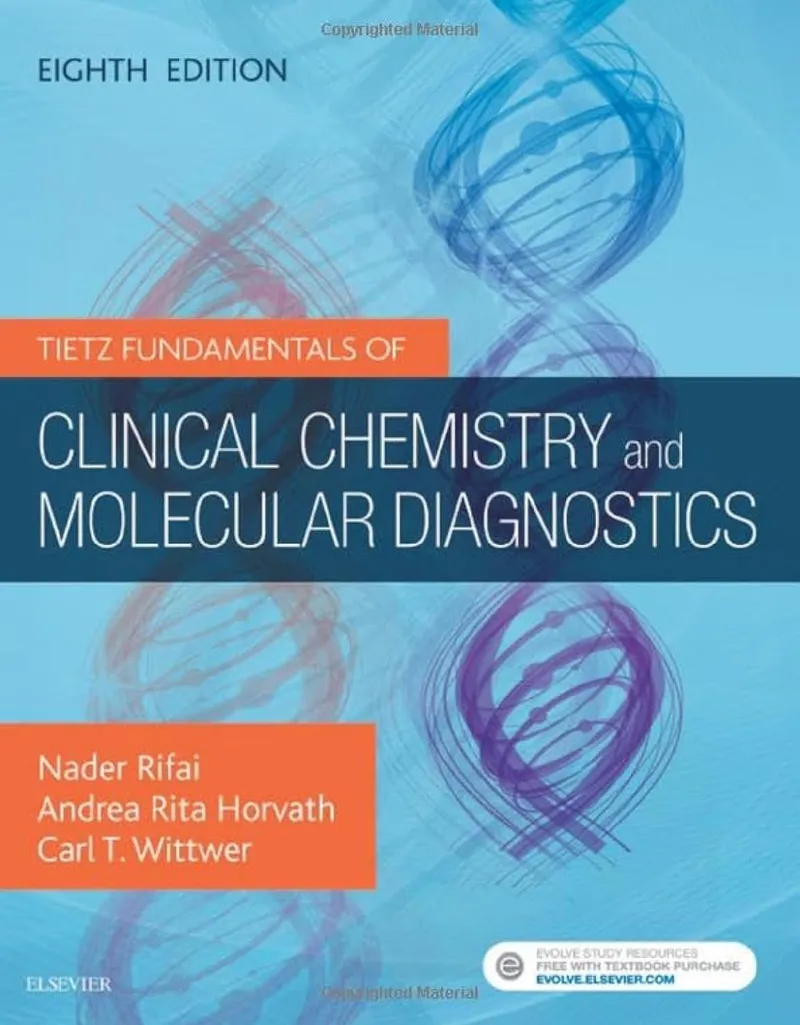

Tietz Fundamentals of Clinical Chemistry and Molecular Diagnostics, 8th Edition
Tietz Fundamentals of Clinical Chemistry and Molecular Diagnostics, 8th Edition is a comprehensive textbook covering the scientific foundations and clinical applications of clinical chemistry, laboratory medicine, and molecular diagnostics. Published by Saunders, this edition provides students and laboratory professionals with a detailed understanding of biochemical testing, analytical methods, disease-related laboratory findings, and modern molecular technologies.
With 1,088 pages, it serves as an extensive study and reference resource for clinical laboratory science, medical laboratory technology, biomedical science, and related healthcare disciplines.
About the Book
Clinical chemistry examines measurable substances in biological specimens and uses these findings to help diagnose and monitor disease.
Tietz Fundamentals of Clinical Chemistry and Molecular Diagnostics combines fundamental scientific principles with practical laboratory applications, helping readers understand both how laboratory tests work and what their results mean clinically.
Principles of Clinical Chemistry
The book establishes the core concepts behind laboratory analysis.
It covers analytical techniques, specimen collection and handling, measurement principles, quality control, reference intervals, and interpretation of laboratory results.
Biochemistry and Metabolism
Biochemical processes provide the foundation for many laboratory tests.
The text examines carbohydrate, lipid, protein, nucleic acid, and energy metabolism, connecting biochemical pathways with laboratory measurements and disease processes.
Enzymes and Proteins
Enzymes and proteins are important laboratory biomarkers.
The book discusses the measurement and clinical interpretation of enzymes, plasma proteins, and other biochemical markers used to assess physiological and pathological conditions.
Electrolytes and Acid–Base Balance
Electrolyte measurements are essential for evaluating many aspects of patient health.
The text covers sodium, potassium, chloride, calcium, magnesium, phosphate, osmolality, blood gases, and acid–base balance, together with their clinical significance.
Endocrinology
Laboratory testing is central to the evaluation of endocrine function.
The book examines hormones, endocrine regulation, and laboratory assessment of endocrine disorders, helping readers understand the relationship between hormone concentrations and disease.
Clinical Chemistry of Organ Systems
Laboratory results can provide valuable information about the function of major organs.
The text addresses biochemical evaluation of systems including the liver, kidneys, heart, pancreas, and other organs, connecting laboratory findings with clinical conditions.
Hematology and Related Testing
Clinical chemistry overlaps with several other areas of laboratory medicine.
The book introduces laboratory measurements relevant to blood and related physiological processes, supporting an integrated understanding of clinical laboratory testing.
Molecular Diagnostics
Modern clinical laboratories increasingly use molecular techniques to identify genetic and infectious disease markers.
The text provides an introduction to molecular biology, nucleic acid analysis, amplification techniques, genetic testing, and molecular diagnostic applications.
Genetic Testing
Molecular diagnostics can be used to investigate inherited and acquired conditions.
The book explores principles behind genetic variation, molecular testing, mutation analysis, and applications of molecular methods in clinical diagnosis.
Immunoassays
Immunological techniques are widely used in clinical chemistry.
The text discusses antigen–antibody interactions and immunoassay methods used to detect and quantify clinically important substances.
Toxicology and Therapeutic Drug Monitoring
Laboratory analysis can help evaluate medication levels and exposure to toxic substances.
The book covers principles related to therapeutic drug monitoring and clinical toxicology, including laboratory measurements and their interpretation.
Urinalysis and Other Specimens
Clinical laboratory testing is not limited to blood.
The text introduces the analysis of urine and other biological specimens, demonstrating how laboratory findings can contribute to clinical assessment.
Quality Management
Accurate laboratory results depend on effective quality systems.
The book discusses quality control, analytical performance, laboratory errors, reference intervals, and quality assurance, helping readers understand how reliable laboratory testing is maintained.
Clinical Interpretation
Laboratory results must be interpreted within an appropriate clinical context.
The text connects analytical findings with physiological processes, pathological changes, reference ranges, and clinical decision-making.
Who Is This Book For?
Tietz Fundamentals of Clinical Chemistry and Molecular Diagnostics, 8th Edition can be useful for:
- Medical laboratory science students
- Clinical chemistry students
- Medical laboratory technologists
- Clinical laboratory scientists
- Medical students
- Biomedical science students
- Molecular diagnostics students
- Pathology students
- Graduate students
- Healthcare professionals
It is particularly appropriate for learners seeking a detailed foundation in clinical chemistry combined with modern molecular diagnostic principles.
Final Thoughts
Tietz Fundamentals of Clinical Chemistry and Molecular Diagnostics, 8th Edition provides comprehensive coverage of the scientific principles and laboratory applications underlying modern clinical chemistry.
Its discussion of biochemistry, metabolism, enzymes, proteins, electrolytes, acid–base balance, endocrinology, organ function, immunoassays, molecular diagnostics, genetic testing, toxicology, therapeutic drug monitoring, and laboratory quality makes it a valuable resource for students and professionals in clinical laboratory science.
Book Information
Title: Tietz Fundamentals of Clinical Chemistry and Molecular Diagnostics
Edition: 8th Edition
Publisher: Saunders
Publication Date: January 2, 2019
Language: English
Print Length: 1,088 pages
ISBN-10: 0323549756
ISBN-13: 978-0323549752
Subject: Clinical Chemistry / Molecular Diagnostics / Laboratory Medicine / Medical Laboratory Science / Biochemistry
Tietz Fundamentals of Clinical Chemistry and Molecular Diagnostics, 8th Edition provides comprehensive coverage of clinical chemistry, biochemistry, metabolism, enzymes, proteins, electrolytes, endocrinology, immunoassays, molecular diagnostics, genetic testing, toxicology, therapeutic drug monitoring, and laboratory quality, making it a valuable study and reference resource for students and professionals in clinical laboratory medicine.
Support the Creators!
If you enjoy this book, please consider supporting the author and publisher by purchasing a physical or digital copy. Buying official copies ensures authors can keep writing great books.