
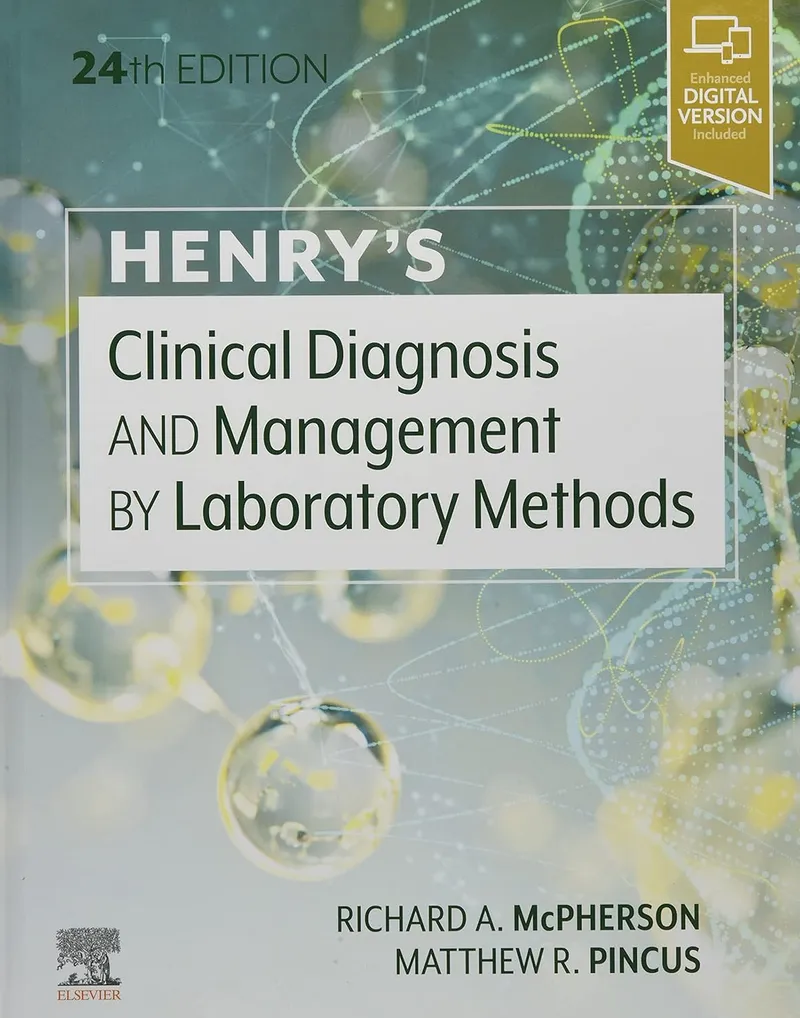

Henry’s Clinical Diagnosis and Management by Laboratory Methods, 24th Edition
Henry’s Clinical Diagnosis and Management by Laboratory Methods, 24th Edition is a comprehensive reference on the role of laboratory medicine in clinical diagnosis, disease assessment, and patient management. Published by Elsevier, this edition brings together the scientific principles, analytical methods, and clinical applications used across modern medical laboratory practice.
With extensive coverage spanning major areas of laboratory medicine, the book is a valuable resource for medical laboratory scientists, pathologists, physicians, students, and other healthcare professionals.
About the Book
Laboratory testing provides essential information for diagnosing disease, assessing patient health, monitoring treatment, and determining prognosis.
Henry’s Clinical Diagnosis and Management by Laboratory Methods connects laboratory science with clinical practice, explaining how specimens are analyzed and how laboratory findings can be interpreted in the context of patient care.
Clinical Laboratory Principles
The book begins with fundamental concepts underlying laboratory testing.
It covers important areas such as specimen collection, specimen processing, analytical methods, quality control, laboratory safety, reference intervals, and interpretation of laboratory results.
Clinical Chemistry
Clinical chemistry provides measurements of numerous substances used to evaluate organ function and disease.
The text covers electrolytes, metabolites, enzymes, proteins, lipids, and other biochemical markers, explaining their laboratory measurement and clinical significance.
Hematology and Coagulation
Laboratory examination of blood is essential in the diagnosis of many disorders.
The book covers blood cell analysis, hematologic diseases, coagulation, hemostasis, and related laboratory investigations.
Immunology and Serology
Immune system disorders and immune responses can be evaluated using a variety of laboratory methods.
The text discusses antigens, antibodies, immunological reactions, autoimmune testing, serological assays, and other immunodiagnostic approaches.
Microbiology
Clinical laboratories play an essential role in diagnosing infectious diseases.
The book provides coverage of bacteriology, virology, mycology, parasitology, specimen examination, microbial identification, and laboratory diagnosis of infectious diseases.
Molecular Diagnostics
Molecular methods have become increasingly important in clinical laboratory medicine.
The text examines applications involving nucleic acid testing, molecular detection, genetic analysis, and other molecular diagnostic technologies.
Urinalysis and Body Fluids
Urine and body fluids can provide important information about disease processes.
The book covers laboratory evaluation of urine, cerebrospinal fluid, serous fluids, synovial fluid, and other biological specimens, including physical, chemical, and microscopic analysis.
Endocrinology
Laboratory testing is fundamental to the evaluation of endocrine function.
The text discusses hormonal measurements and laboratory investigation of endocrine disorders, connecting analytical results with clinical interpretation.
Toxicology and Therapeutic Drug Monitoring
Laboratory medicine also supports the evaluation of toxic exposures and medication levels.
The book covers principles of clinical toxicology and therapeutic drug monitoring, including laboratory measurements used in appropriate clinical settings.
Transfusion Medicine
Laboratory testing is critical to the safe use of blood and blood products.
The text covers blood groups, compatibility testing, antibody detection, transfusion reactions, and immunohematological procedures.
Laboratory Quality and Management
Accurate laboratory testing depends on effective quality systems.
The book addresses quality assurance, quality control, laboratory workflow, safety, analytical performance, and laboratory management.
Clinical Interpretation
One of the central purposes of laboratory medicine is to translate analytical results into clinically useful information.
The text emphasizes relationships between laboratory findings, disease processes, reference intervals, test limitations, and clinical decision-making.
Who Is This Book For?
Henry’s Clinical Diagnosis and Management by Laboratory Methods, 24th Edition can be useful for:
- Medical laboratory scientists
- Clinical laboratory scientists
- Medical students
- Pathology students
- Physicians
- Pathologists
- Biomedical science students
- Laboratory technologists
- Clinical chemistry students
- Microbiology students
- Graduate students
- Healthcare professionals
It is particularly suitable for readers seeking an extensive reference covering the major disciplines and methods of clinical laboratory medicine.
Final Thoughts
Henry’s Clinical Diagnosis and Management by Laboratory Methods, 24th Edition provides a broad and detailed examination of modern laboratory medicine and its role in patient care.
Its coverage of clinical chemistry, hematology, coagulation, immunology, microbiology, molecular diagnostics, urinalysis, body fluids, endocrinology, toxicology, transfusion medicine, quality management, and clinical interpretation makes it a valuable study and reference resource for professionals and students in laboratory medicine.
Book Information
Title: Henry’s Clinical Diagnosis and Management by Laboratory Methods
Edition: 24th Edition
Publisher: Elsevier India
Publication Date: October 23, 2021
Language: English
Print Length: 9,840 pages*
ISBN-13: 978-8131264522
ASIN: B09MRZXNMZ
Subject: Clinical Laboratory Medicine / Laboratory Diagnostics / Clinical Chemistry / Hematology / Microbiology / Immunology
*The supplied listing reports 9,840 pages; this figure may reflect the electronic edition or its platform-specific pagination.
Henry’s Clinical Diagnosis and Management by Laboratory Methods, 24th Edition provides comprehensive coverage of clinical chemistry, hematology, microbiology, immunology, molecular diagnostics, urinalysis, body fluid analysis, endocrinology, toxicology, transfusion medicine, and laboratory quality, making it a valuable reference for understanding how laboratory methods support modern clinical diagnosis and patient management.
Support the Creators!
If you enjoy this book, please consider supporting the author and publisher by purchasing a physical or digital copy. Buying official copies ensures authors can keep writing great books.