
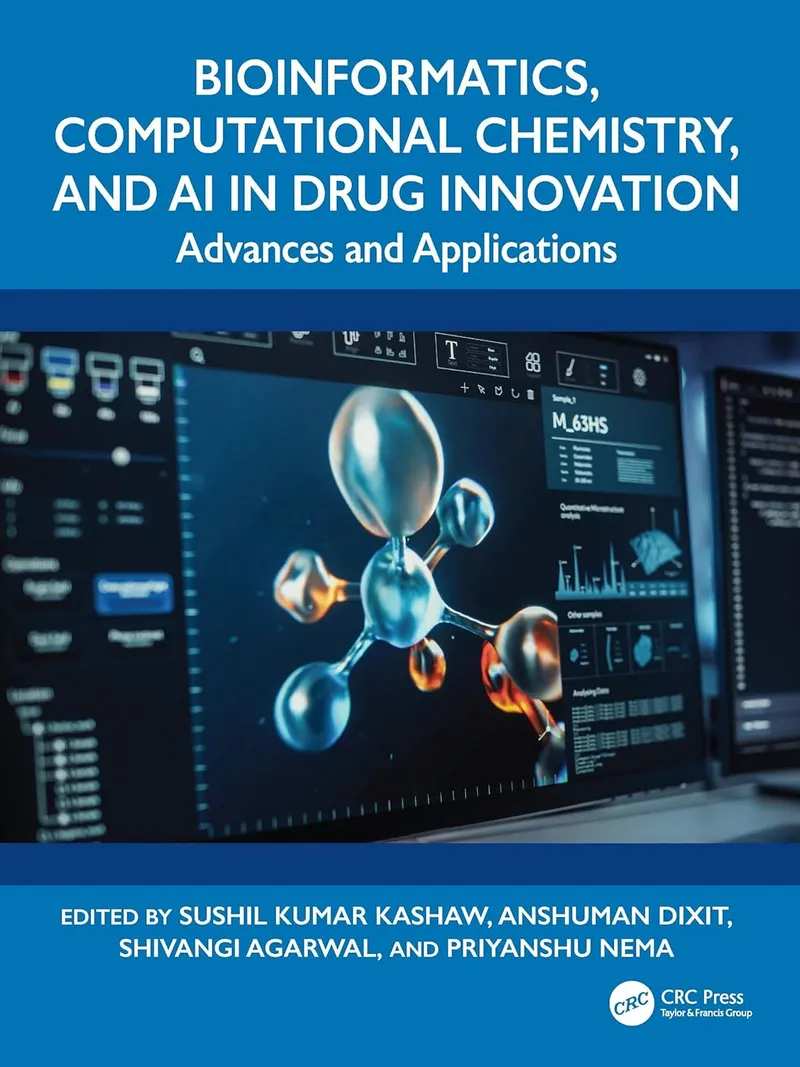

Bioinformatics, Computational Chemistry, and AI in Drug Innovation: Advances and Applications
Bioinformatics, Computational Chemistry, and AI in Drug Innovation: Advances and Applications is a comprehensive introduction to the computational technologies transforming modern drug discovery and pharmaceutical innovation. Published by CRC Press in 2026, this first edition brings together bioinformatics, computational chemistry, artificial intelligence, and machine learning to explain how biological and chemical data can be used to accelerate the development of new therapeutic candidates.
The book covers the journey from biological data management and computational analysis to molecular modeling, drug-target identification, and AI-assisted drug discovery. It introduces important concepts such as structural bioinformatics, biological databases, molecular docking, pharmacophore modeling, quantitative structure–activity relationships, molecular dynamics, and computational genomics.
About the Book
Modern drug discovery increasingly depends on the ability to analyze large amounts of biological and chemical information. Bioinformatics, Computational Chemistry, and AI in Drug Innovation provides a multidisciplinary perspective on these technologies and their applications in pharmaceutical research.
The book begins with foundational concepts in bioinformatics and biological data management before progressing toward computational methods used to understand proteins, identify potential drug targets, and predict interactions between molecules. It also examines how artificial intelligence and machine learning are becoming increasingly important in drug discovery and innovation.
Bioinformatics and Biological Data Management
Bioinformatics provides essential tools for organizing, analyzing, and interpreting biological information. The book introduces several important areas of computational biology while explaining how biological databases support modern research.
Key topics include:
- Computational molecular phylogeny
- Structural bioinformatics
- Metabolic computing
- Biological databases
- Data mining
- Data storage and retrieval
- Database structure and organization
- Biological data annotation
- Computational genomics
These concepts provide a foundation for understanding how large and complex biological datasets can be transformed into useful information for pharmaceutical research.
Computational Chemistry and Molecular Modeling
Computational chemistry provides researchers with methods for investigating molecules and their interactions before compounds are tested experimentally. The book discusses several established computational approaches used in drug design and molecular analysis.
Topics include:
- Computational protein modeling
- Molecular docking
- Pharmacophore modeling
- Quantitative structure–activity relationships (QSAR)
- Protein–ligand interactions
- Molecular dynamics simulations
- Density functional theory (DFT)
- Computational approaches to drug target identification
Together, these methods help researchers investigate molecular structures, predict interactions, and evaluate potential drug candidates.
Drug Target Identification and Drug Design
Identifying suitable biological targets is an important stage of drug discovery. Computational methods can help researchers analyze molecular structures and biological information to identify promising targets and investigate how candidate compounds may interact with them.
The book explores computational strategies for target identification as well as molecular docking, pharmacophore modeling, and QSAR approaches that can support rational drug design.
Molecular Dynamics and Protein–Ligand Interactions
Understanding how proteins and small molecules interact is central to computational drug discovery. Molecular modeling and simulation techniques can provide insights into molecular behavior and help researchers investigate the stability and dynamics of protein–ligand complexes.
The discussion of molecular dynamics, protein–ligand interactions, and computational chemistry gives readers a broader view of how computational simulations can complement experimental approaches in pharmaceutical research.
AI and Machine Learning in Drug Discovery
Artificial intelligence and machine learning are increasingly influencing the way pharmaceutical researchers analyze data and identify promising compounds. This book examines the transformative role of AI and ML in drug discovery and innovation.
These approaches can be applied to complex biological and chemical datasets, supporting tasks such as prediction, pattern recognition, molecular analysis, and candidate evaluation. The book places AI within the broader computational drug discovery workflow rather than treating it as an isolated technology.
Drug Repurposing and Pharmaceutical Innovation
Drug repurposing offers another strategy for identifying new therapeutic applications for existing compounds. Computational approaches can help researchers analyze biological relationships and existing data to identify potential new uses for known drugs.
The book discusses drug repurposing alongside other computational approaches, highlighting how data-driven methods can contribute to pharmaceutical innovation.
Pharmacokinetics and Quality by Design
The book also extends beyond early-stage drug discovery to address important aspects of pharmaceutical development. It introduces computational tools for estimating pharmacokinetic parameters and discusses Quality by Design (QbD) principles in drug formulation.
By including these topics, the book connects computational research with broader pharmaceutical development and emphasizes the importance of systematic design, prediction, and quality in formulation processes.
Who Should Use This Book?
Bioinformatics, Computational Chemistry, and AI in Drug Innovation can be useful for:
- Students of pharmaceutical sciences
- Bioinformatics and computational biology students
- Chemistry and computational chemistry students
- Biotechnology students and researchers
- Pharmaceutical researchers and professionals
- Drug discovery scientists
- Researchers working with AI and machine learning in life sciences
- Students studying molecular modeling and drug design
- Professionals interested in computational drug development
- Researchers working with biological databases and biomedical data
Final Thoughts
Bioinformatics, Computational Chemistry, and AI in Drug Innovation: Advances and Applications provides a multidisciplinary overview of the computational technologies shaping modern drug discovery. By combining bioinformatics, molecular modeling, computational chemistry, artificial intelligence, and pharmaceutical sciences, it gives readers a broad perspective on how computational methods can support the discovery and development of therapeutic compounds.
With coverage ranging from biological databases and molecular docking to AI-driven drug discovery, pharmacokinetic prediction, drug repurposing, and Quality by Design, this book is a valuable resource for students, researchers, and professionals interested in the growing intersection of bioinformatics, computational chemistry, artificial intelligence, and pharmaceutical innovation.
Book Information
Title: Bioinformatics, Computational Chemistry, and AI in Drug Innovation: Advances and Applications
Publisher: CRC Press
Publication Date: February 27, 2026
Edition: 1st Edition
Language: English
Print Length: 250 pages
ISBN-10: 1032733012
ISBN-13: 978-1032733012
Subjects: Bioinformatics, Computational Chemistry, Drug Discovery, Artificial Intelligence, Machine Learning, Computational Biology, Molecular Modeling, Pharmaceutical Sciences, Drug Design, Biotechnology
Bioinformatics, Computational Chemistry, and AI in Drug Innovation explores how computational science, artificial intelligence, and biological data are converging to create new approaches to drug discovery and pharmaceutical development.
Support the Creators!
If you enjoy this book, please consider supporting the author and publisher by purchasing a physical or digital copy. Buying official copies ensures authors can keep writing great books.