
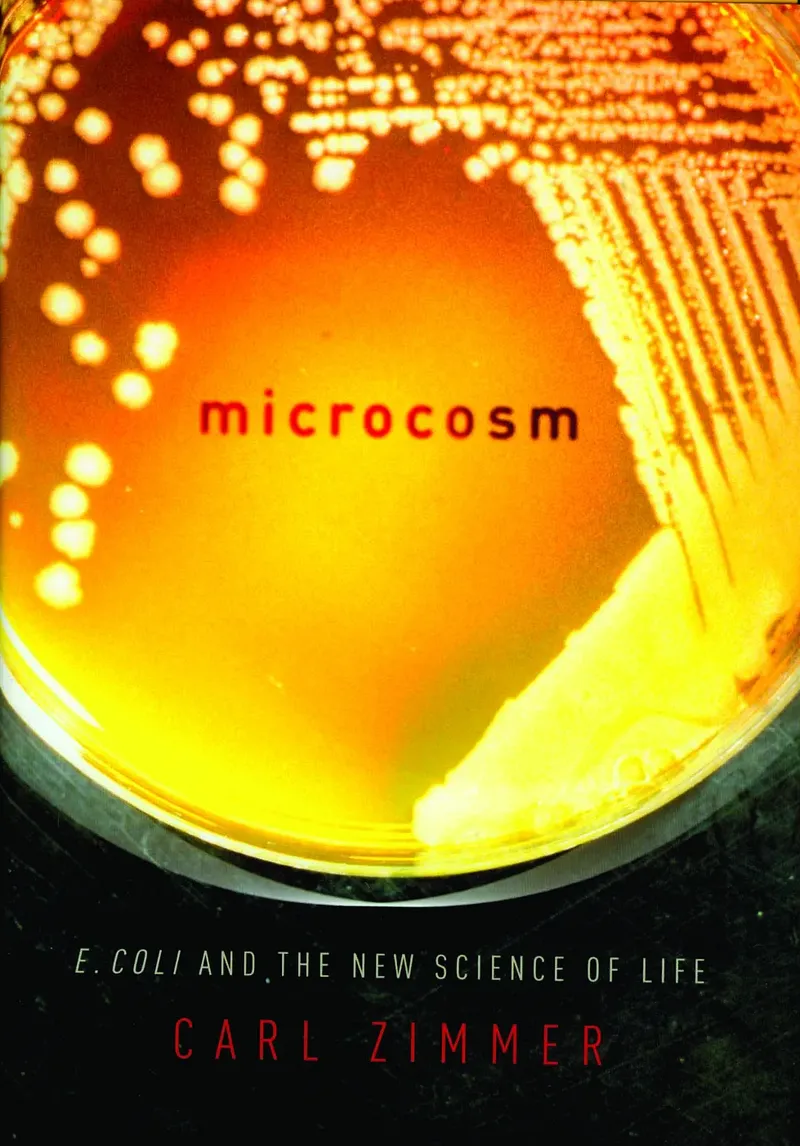

Microcosm: E. coli and the New Science of Life
Microcosm: E. coli and the New Science of Life is a fascinating exploration of one of the most familiar—and scientifically important—microorganisms on Earth. Written by science writer Carl Zimmer, the book examines Escherichia coli not simply as a bacterium associated with foodborne illness, but as a remarkably sophisticated organism that has played a central role in our understanding of genes, molecular biology, and biotechnology.
Published by Pantheon in 2008, this first edition presents E. coli as a microscopic window into the fundamental principles of life. Zimmer traces the history of scientific discoveries made using this organism and explains how research on E. coli helped reveal how genes function and contributed to the development of modern biotechnology.
About the Book
Within a short time after birth, humans acquire enormous populations of E. coli, and these bacteria can remain part of the human microbial community throughout life. Although certain strains are capable of causing serious disease, E. coli has also become one of the most extensively studied organisms in biology.
The book explores this apparent contradiction while revealing the extraordinary biological complexity contained within a microscopic cell. With thousands of genes and intricate networks of interacting molecules, E. coli provides scientists with a powerful system for investigating the mechanisms of life.
E. coli as a Model Organism
One of the central themes of Microcosm is the remarkable scientific importance of E. coli. Its biology has made it an invaluable model for investigating fundamental questions about genes, heredity, cellular processes, and molecular mechanisms.
By tracing discoveries made through research on this bacterium, Zimmer demonstrates how studying a single microorganism can lead to insights with implications far beyond microbiology.
Genes and Molecular Biology
Research on E. coli contributed significantly to scientists’ understanding of how genes work. The book follows the history of these discoveries and shows how experiments involving the bacterium helped establish important principles of molecular biology.
This historical perspective allows readers to see how concepts that are now fundamental to genetics and molecular biology emerged from experimental work with microorganisms.
E. coli and the Rise of Biotechnology
The story of E. coli extends from basic scientific research into practical biotechnology. Scientists have learned to modify and engineer bacterial strains for useful purposes, transforming E. coli into an important tool for producing biological products.
The book highlights applications ranging from the production of human insulin to the development of organisms capable of producing fuels such as jet fuel. These examples illustrate how discoveries in basic microbiology can eventually lead to major technological applications.
Pathogenic E. coli and Human Health
Not every relationship between E. coli and humans is beneficial. Some strains are capable of causing serious disease and have become associated with major public health concerns.
Microcosm places these harmful strains within the broader story of the species, showing how the same bacterial group can include organisms with very different effects on human health.
The Complexity of a Microscopic World
Despite its tiny size, E. coli contains thousands of genes and an extraordinarily complex network of molecular interactions. Zimmer uses this complexity to challenge the assumption that microscopic organisms are biologically simple.
The book demonstrates how studying the organization and behavior of a single bacterial cell can reveal broader principles concerning biological organization, adaptation, and the nature of living systems.
Rebuilding Life from the Ground Up
Another important theme is the effort by scientists to reconstruct or redesign E. coli at a fundamental level. Such work raises important questions about what is required for an organism to function as a living system.
By following these scientific efforts, the book connects traditional microbiology with emerging questions about synthetic biology and the possibility of deliberately engineering living organisms.
E. coli and the Meaning of Life
At its broadest level, Microcosm is not only a book about one bacterial species. It is an exploration of life itself. Through the history and biology of E. coli, Zimmer considers the rules governing living systems, the mysteries that remain unresolved, and the possibilities created by modern biological science.
This makes the book appealing to readers interested in both the details of microbiology and the larger scientific questions that arise from studying living organisms.
An Accessible Introduction to Microbiology
Carl Zimmer presents complex scientific ideas through history, discovery, and engaging explanations. The result is an accessible narrative that can introduce general readers to genetics, microbiology, molecular biology, and biotechnology without requiring an advanced technical background.
For students and science enthusiasts, the book also provides an engaging way to appreciate why E. coli has become such an influential organism in biological research.
Who Should Read This Book?
- Students of microbiology and molecular biology
- Students studying genetics and biotechnology
- Readers interested in bacterial biology
- Students interested in model organisms and experimental biology
- Readers curious about the history of molecular biology
- Science enthusiasts interested in biotechnology and synthetic biology
- General readers looking for an accessible exploration of microbiology
- Anyone interested in the scientific significance of E. coli
Final Thoughts
Microcosm: E. coli and the New Science of Life transforms a familiar bacterium into a fascinating guide to some of the biggest questions in modern biology. From the discovery of fundamental genetic mechanisms to the rise of biotechnology and efforts to engineer living systems, the book shows how much can be learned from studying a single microorganism.
Carl Zimmer’s narrative connects the microscopic world of E. coli with the larger story of scientific discovery and the nature of life. For readers interested in microbiology, genetics, biotechnology, or the history of biological science, Microcosm offers an engaging and accessible perspective on why this tiny bacterium has had such an enormous influence on science.
Book Information
Title: Microcosm: E. coli and the New Science of Life
Author: Carl Zimmer
Publisher: Pantheon
Publication Date: May 6, 2008
Edition: 1st
Language: English
Print Length: 256 pages
ISBN-10: 037542430X
ISBN-13: 978-0375424304
Subjects: Microbiology, Escherichia coli, Molecular Biology, Genetics, Biotechnology, Bacterial Biology, Model Organisms, Synthetic Biology, History of Science
Microcosm explores the remarkable biology of E. coli and reveals how one microscopic bacterium has transformed our understanding of genes, biotechnology, and the fundamental nature of life.
Support the Creators!
If you enjoy this book, please consider supporting the author and publisher by purchasing a physical or digital copy. Buying official copies ensures authors can keep writing great books.