
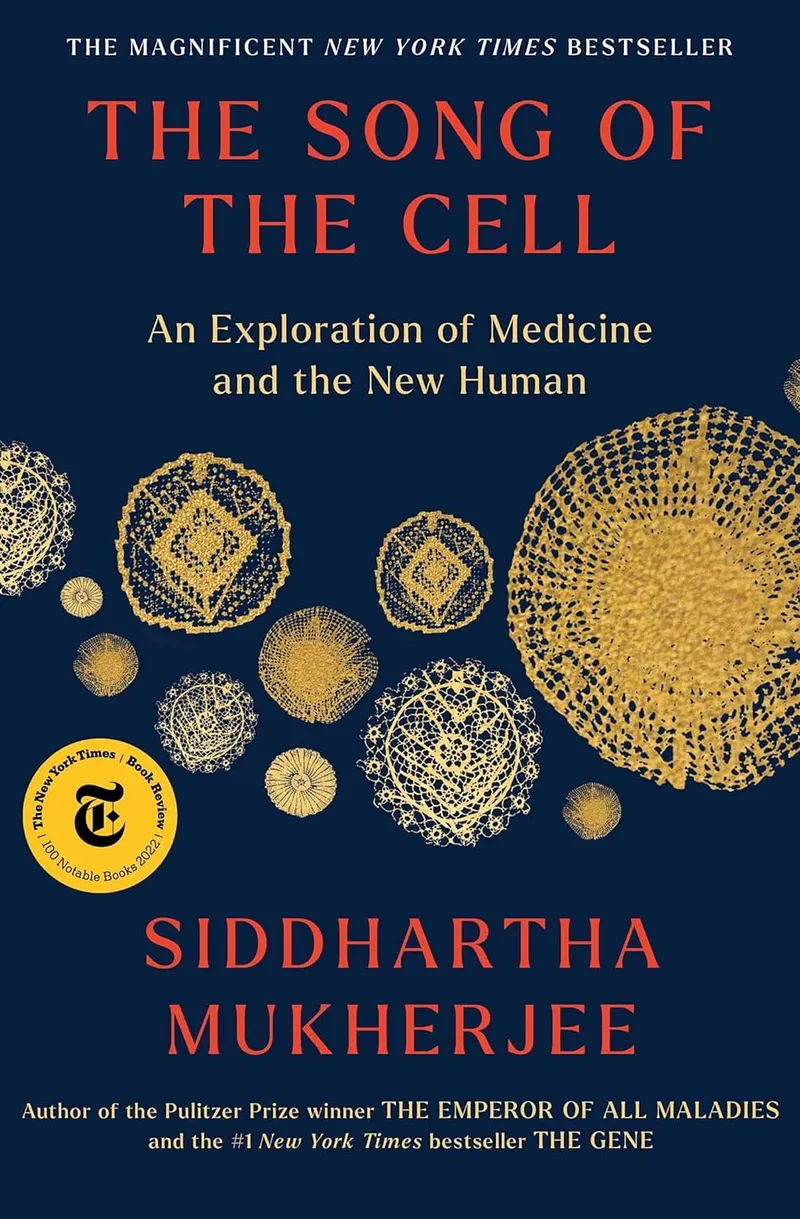

The Song of the Cell: An Exploration of Medicine and the New
The Song of the Cell: An Exploration of Medicine and the New Human is a sweeping exploration of how the discovery and understanding of cells transformed biology and medicine. Written by Pulitzer Prize–winning author Siddhartha Mukherjee, the book traces the remarkable journey from the first observations of cells under early microscopes to the development of modern therapies that manipulate cells to treat disease.
Published by Scribner in 2022, this 496-page work combines the history of science with medicine, biology, and personal stories. Mukherjee introduces readers to the scientists, physicians, researchers, and patients whose experiences illustrate how our growing understanding of cells has changed the way we think about the human body and disease.
About the Book
The story begins in the late seventeenth century with the pioneering microscopic observations of Robert Hooke and Antonie van Leeuwenhoek. Their work helped establish a revolutionary idea: complex living organisms are made up of tiny, self-contained and self-regulating units known as cells.
From this foundational discovery, Mukherjee follows the development of cellular biology and explores how the concept of the cell gradually transformed medicine. Organs such as the heart, brain, and kidneys can be understood as complex systems of cells, and disturbances in those cellular systems can help explain the origins of many diseases.
The Discovery of the Cell
One of the central themes of the book is the historical discovery of the cell. Robert Hooke’s observations through a handmade microscope led him to introduce the term “cell,” while Antonie van Leeuwenhoek’s microscopic investigations revealed an astonishing world of previously unseen biological structures.
These early discoveries helped establish a new way of understanding life. Instead of viewing the body as a single indivisible entity, scientists increasingly came to understand it as an organized ecosystem composed of countless interacting cellular units.
From Cell Biology to Modern Medicine
The book examines how the cellular view of the human body transformed medical thinking. Diseases that once appeared unrelated can be reconsidered as disorders involving individual cells or interconnected cellular systems.
Mukherjee explores how this perspective can be applied to conditions including cardiac disease, Alzheimer’s dementia, AIDS, pneumonia, lung cancer, kidney failure, arthritis, and COVID-19 pneumonia. The cellular perspective provides a conceptual foundation for understanding why therapies directed at cells can become powerful tools in modern medicine.
Cellular Therapies and the Future of Medicine
A major focus of The Song of the Cell is the growing ability of scientists and physicians to manipulate cells for therapeutic purposes. As researchers have learned more about cellular structure, behavior, communication, and dysfunction, cells themselves have increasingly become targets and tools for medical treatment.
The book considers how this emerging form of medicine may change the treatment of disease and raises broader questions about the possibilities created by our ability to modify living cells.
Scientists, Doctors, and Patients
Mukherjee does not present the history of cellular medicine as a collection of scientific facts alone. The narrative is populated by scientists making discoveries, doctors applying new knowledge, and patients whose lives are affected by advances in medicine.
These stories give the scientific discussion a human dimension and illustrate how developments in cell biology move from laboratories and research institutions into clinical practice.
The Human Body as a Cellular Ecosystem
The cellular perspective also changes how we understand ourselves. Our organs, physiology, and bodily functions emerge from the coordinated activity of enormous numbers of specialized cells.
By presenting the human body as a cellular ecosystem, the book connects fundamental biology with questions about health, disease, identity, and what it means to be human.
A History of Scientific Discovery
The Song of the Cell spans centuries of scientific progress, connecting early microscopy with contemporary biomedical research. It demonstrates how a seemingly simple observation—that living organisms are composed of cells—eventually became one of the foundational ideas of modern biology and medicine.
The result is both a history of scientific discovery and an exploration of how scientific knowledge can reshape medical practice.
An Accessible Approach to Complex Science
Although the book deals with sophisticated scientific and medical ideas, Mukherjee presents them through vivid stories and accessible explanations. His experience as a researcher and physician provides an additional perspective on the development and application of biomedical knowledge.
The book is therefore suitable not only for readers with a background in science and medicine, but also for anyone interested in the history of biology, medical innovation, and the scientific understanding of the human body.
Who Should Read This Book?
- Students of biology, medicine, and biomedical sciences
- Medical students and healthcare professionals
- Readers interested in cell biology and cellular medicine
- Students and researchers interested in the history of medicine
- Readers interested in modern biomedical research
- Anyone curious about how scientific discoveries transform medical practice
- General readers looking for an accessible exploration of biology and medicine
Final Thoughts
The Song of the Cell tells the story of one of the most consequential ideas in modern science: that life is built from cells and that understanding these microscopic units can transform our understanding of health and disease. From the first observations of Hooke and Leeuwenhoek to contemporary cellular therapies, Siddhartha Mukherjee connects centuries of scientific discovery into a compelling account of modern medicine.
Blending science, history, medicine, and human stories, the book offers a broad perspective on the remarkable progress of cellular biology and the possibilities it creates for the future. It is an engaging introduction to the cellular foundations of medicine and to the continuing effort to understand—and potentially reshape—the human body.
Book Information
Title: The Song of the Cell: An Exploration of Medicine and the New Human
Author: Siddhartha Mukherjee
Publisher: Scribner
Publication Date: October 25, 2022
Language: English
Print Length: 496 pages
ISBN-10: 1668011905
ISBN-13: 978-1668011904
Subjects: Cell Biology, Cellular Medicine, Medicine, Biomedical Science, History of Medicine, Medical Research, Cellular Therapies, Human Biology
The Song of the Cell explores how the discovery of cells transformed our understanding of life and disease and how cellular science is opening new possibilities for modern medicine.
Support the Creators!
If you enjoy this book, please consider supporting the author and publisher by purchasing a physical or digital copy. Buying official copies ensures authors can keep writing great books.