
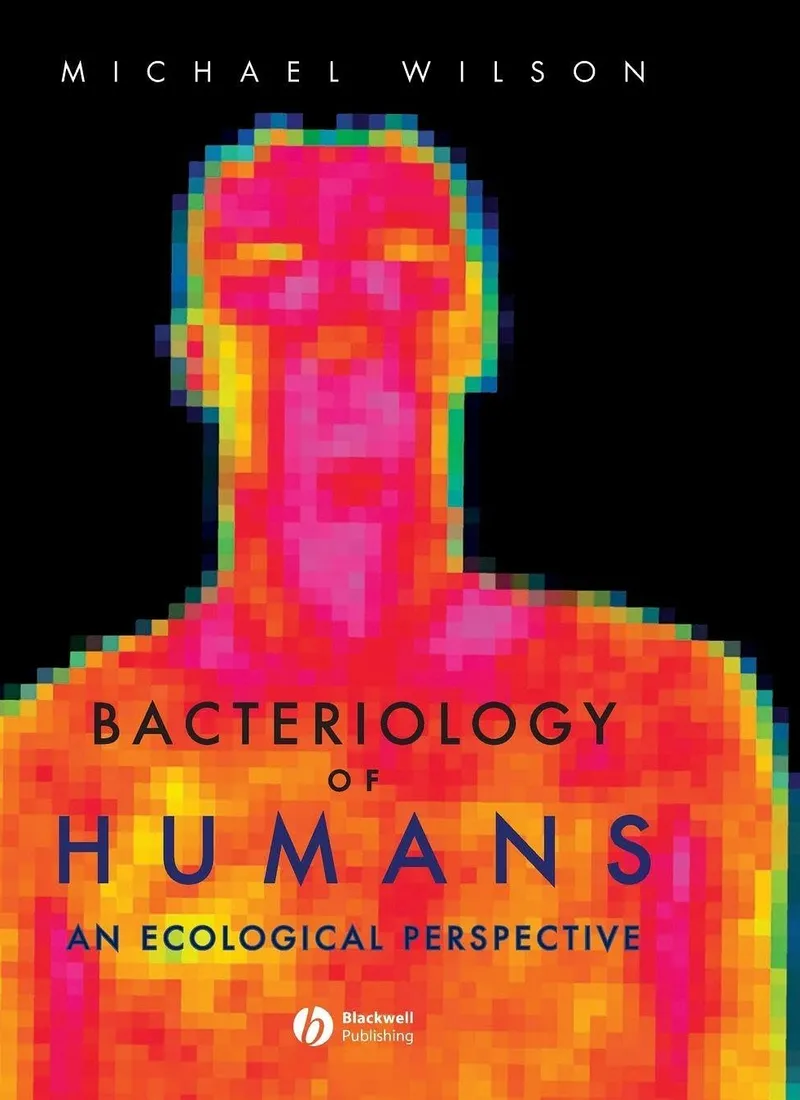

Bacteriology of Humans: An Ecological Perspective
Bacteriology of Humans: An Ecological Perspective provides a comprehensive introduction to the microorganisms that inhabit the human body, with particular emphasis on the indigenous human microbiota and the ecological relationships between humans and their resident microbial communities. Rather than focusing primarily on disease-causing organisms, the book examines the microorganisms that normally coexist with humans and explores their distribution, development, and biological significance.
Published by Wiley-Blackwell in 2008, this first edition presents human bacteriology from an ecological perspective, connecting the microorganisms found at different anatomical sites with the physical and chemical conditions of those environments. Its combination of microbiology, ecology, human biology, and health sciences makes it a useful academic reference for students and professionals interested in the human microbiota.
About the Book
For many years, microbiology placed considerable emphasis on microorganisms responsible for infectious diseases, while the indigenous microbial communities living on and within the human body received comparatively less attention. Bacteriology of Humans takes a different approach by examining these microbial communities as important components of human biology.
The book discusses how indigenous microbiota can contribute to protection against external pathogens and examines their relationships with human development and nutrition. It provides an organized overview of the development, composition, and distribution of microbial communities associated with different parts of the human body.
An Ecological Approach to Human Microbiota
One of the defining features of the book is its ecological framework. Rather than simply listing microorganisms associated with particular organs or body sites, it examines the environmental conditions that influence which organisms can survive in a specific anatomical location.
The book establishes connections between the physicochemical characteristics of anatomical sites and the microorganisms found there. This approach helps readers understand why different parts of the human body support distinct microbial communities.
Key Topics and Features
- Comprehensive overview of the human indigenous microbiota
- Ecological approach to human bacteriology
- Introduction to human-microbe symbiosis
- Development, composition, and distribution of microbial communities
- Examination of major human body systems and organs with indigenous microbiota
- Relationships between anatomical environments and microbial populations
- Discussion of the potential roles of microbiota in human protection, development, and nutrition
- Extensive color figures, diagrams, tables, charts, and maps
- References at the end of each chapter for further study
- Links to key websites and additional resources
- Accessible presentation suitable for undergraduate and graduate study
Human-Microbe Symbiosis
A central theme is the relationship between humans and their resident microorganisms. The book illustrates how microbial communities can coexist with their human hosts and how these relationships contribute to broader aspects of human biology.
This perspective provides an important complement to traditional medical microbiology, where the focus is often placed on pathogens and infectious disease. Understanding the normal microbiota also provides useful background for appreciating the interactions between microbial communities, immunity, nutrition, and disease.
Visual and Reference Resources
The book makes extensive use of color illustrations, diagrams, tables, charts, and maps to support the text. These visual resources are particularly useful when studying the distribution of microorganisms across different anatomical locations.
Each chapter also includes references for further study, along with links to selected websites, allowing readers to explore topics beyond the core text.
Who Should Read This Book?
Bacteriology of Humans: An Ecological Perspective is relevant to:
- Microbiology students
- Medical microbiology students
- Microbial ecology students
- Immunology students
- Medical and biomedical science students
- Medicine and dentistry students
- Nursing and health sciences students
- Pharmacy students
- Researchers interested in the human microbiota
- Readers studying infectious diseases and human-microbe interactions
Historical Context
Published in 2008, this edition reflects the scientific understanding of the human microbiota available at that time. Since research into the human microbiome has expanded considerably, readers studying current microbiome science should supplement this book with newer literature and contemporary research. Nevertheless, its ecological framework provides a useful foundation for understanding the relationship between anatomical environments and resident microbial communities.
Final Thoughts
Bacteriology of Humans: An Ecological Perspective offers a distinctive way to study human-associated microorganisms by placing bacteriology within an ecological framework. Its focus on microbial communities, human-microbe symbiosis, anatomical environments, and the distribution of indigenous microbiota makes it a valuable reference for students and readers exploring microbiology beyond the traditional study of pathogens.
Book Information
Title: Bacteriology of Humans: An Ecological Perspective
Publisher: Wiley-Blackwell
Publication Date: May 5, 2008
Edition: 1st Edition
Language: English
Print Length: 368 pages
ISBN-10: 1405161655
ISBN-13: 978-1405161657
Subjects: Human Microbiota, Bacteriology, Microbiology, Microbial Ecology, Medical Microbiology, Human-Microbe Symbiosis, Immunology, Infectious Diseases, Biomedical Sciences
Support the Creators!
If you enjoy this book, please consider supporting the author and publisher by purchasing a physical or digital copy. Buying official copies ensures authors can keep writing great books.