
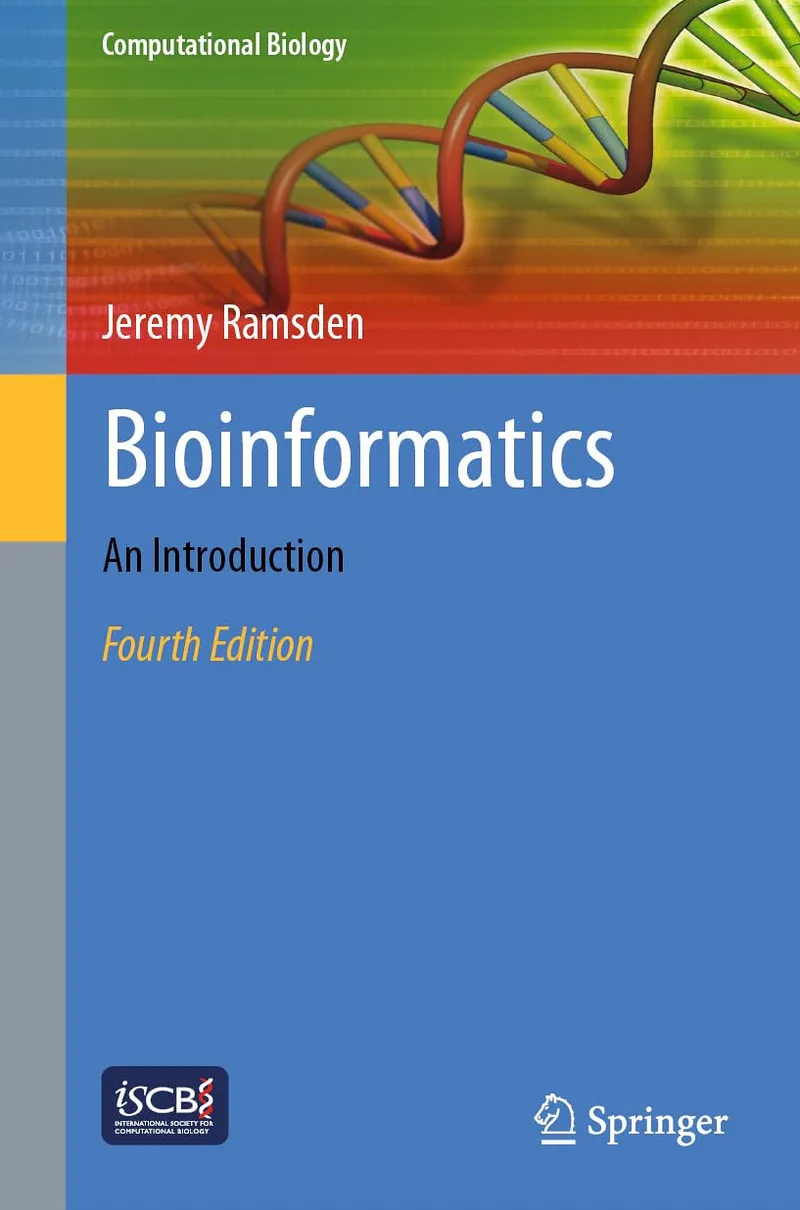

Bioinformatics: An Introduction, 4th Edition
Bioinformatics: An Introduction, 4th Edition provides a comprehensive yet accessible introduction to the rapidly developing field of bioinformatics. Published by Springer, this thoroughly revised edition combines biological knowledge, computational thinking, and fundamental mathematical concepts to help readers understand how information science can be applied to biological research and real-world scientific problems.
The fourth edition significantly expands the scope of the book with new and updated material covering regulation and control networks, evolution, viruses, microbiomes, single-cell analysis, drug discovery, forensic applications, and the origins of life. It also explores recent developments in sequencing technologies, gene editing, phenomics, brain modeling, ecosystems, and medical bioinformatics.
About the Book
Bioinformatics sits at the intersection of biology, mathematics, computer science, and information science. Bioinformatics: An Introduction presents these connections through a self-contained approach designed to build both conceptual understanding and practical awareness.
The fourth edition maintains broad coverage while remaining relatively concise and accessible. It introduces the mathematical and computational foundations needed to understand bioinformatics while emphasizing the biological knowledge required to interpret computational results.
Mathematical and Computational Foundations
A strong understanding of bioinformatics requires familiarity with several mathematical and computational concepts. The book introduces these ideas in the context of biological applications rather than treating them as purely abstract topics.
Key concepts include:
- Set theory and combinatorics
- Probability and likelihood
- Statistics and causation
- Clustering
- Pattern recognition
- Randomness
- Complexity
- Systems and networks
- Data mining
- Computational approaches to biological information
These foundations help readers understand the theoretical principles behind many bioinformatics methods and applications.
Genomics and Molecular Biology
The book explores both organism-level and molecular aspects of biological information. Readers are introduced to topics involving genome structure, ontogeny, phylogeny, gene regulation, and molecular biology.
By connecting computational concepts with biological processes, the book helps demonstrate how bioinformatics can be used to investigate biological organization across different scales.
New Developments in Bioinformatics
The fourth edition introduces a wide range of developments that have expanded the role of bioinformatics in modern research. New chapters and updated material address:
- Regulation and control networks
- Origins of life
- Evolution
- Viruses
- Microbiomes
- Single-cell analysis
- Drug discovery
- Forensic applications
- Ecosystems
- Phenomics
- New sequencing technologies
- Gene editing
- Brain modeling
- Medical applications
This expanded coverage makes the fourth edition particularly relevant to readers interested in the rapidly changing landscape of computational biology.
Bioinformatics and the Coronavirus Pandemic
A new chapter examines the bioinformatics aspects of the coronavirus pandemic, providing an example of how computational biology can contribute to the analysis and understanding of major infectious disease challenges.
This topic illustrates the practical importance of bioinformatics in contemporary biomedical research and demonstrates how biological data and computational methods can be combined to investigate rapidly evolving scientific problems.
Practical Applications and Data Analysis
The book goes beyond theoretical concepts by examining important practical applications of bioinformatics. It provides descriptions of both the experimental processes that generate biological data and the computational analysis required to interpret those datasets.
This approach helps readers understand the complete relationship between biological experiments, data generation, computational analysis, and scientific interpretation.
Single-Cell Analysis, Microbiomes, and Viruses
Modern biological research increasingly focuses on complex biological systems at fine scales. The fourth edition expands its coverage to include single-cell analysis, microbiomes, and viruses, demonstrating how bioinformatics can be applied to diverse types of biological data.
These topics also illustrate the importance of computational approaches for understanding biological complexity that cannot easily be captured through traditional analysis methods.
Drug Discovery and Medical Applications
Bioinformatics has become increasingly important in pharmaceutical and medical research. The book introduces applications related to drug discovery and explores developments in medical bioinformatics.
Its interdisciplinary approach helps readers understand how computational methods can contribute to biological research, healthcare-related applications, and the analysis of complex biomedical information.
Problems and Further Reading
Problems are included throughout the book to encourage readers to apply concepts and think more deeply about the material. An extensive bibliography also provides opportunities for further exploration of individual topics and advanced areas of bioinformatics.
These resources make the book suitable not only as an introductory reference but also as a starting point for continued study and research.
Who Should Use This Book?
Bioinformatics: An Introduction, 4th Edition can be useful for:
- Undergraduate students studying bioinformatics
- Beginning graduate students
- Computer science students interested in biological applications
- Biology and life science students
- Biologists seeking computational foundations
- Students of computational biology
- Physical science students looking for an introduction to biology
- Students interested in genomics and biological data analysis
- Researchers beginning to explore bioinformatics
- Readers interested in interdisciplinary applications of information science
Final Thoughts
Bioinformatics: An Introduction, 4th Edition offers a broad and interdisciplinary foundation for understanding modern bioinformatics. Its combination of mathematical concepts, computational principles, biological knowledge, and practical applications makes it useful for readers approaching the field from different academic backgrounds.
With expanded coverage of single-cell analysis, microbiomes, viruses, drug discovery, gene editing, sequencing technologies, phenomics, ecosystems, medical applications, and AI-era biological data analysis, this edition provides a current perspective on a field that continues to evolve rapidly.
Book Information
Title: Bioinformatics: An Introduction
Publisher: Springer
Publication Date: September 15, 2023
Edition: 4th Edition
Language: English
Print Length: 401 pages
ISBN-13: 978-3030456078
ASIN: B0C88DZ18P
Subjects: Bioinformatics, Computational Biology, Genomics, Biological Data Analysis, Computational Genomics, Systems Biology, Molecular Biology, Data Mining, Biotechnology, Medical Bioinformatics
Bioinformatics: An Introduction, 4th Edition provides a self-contained and interdisciplinary introduction to bioinformatics, combining mathematics, computing, biology, and practical applications to explain how biological information can be analyzed and understood.
Support the Creators!
If you enjoy this book, please consider supporting the author and publisher by purchasing a physical or digital copy. Buying official copies ensures authors can keep writing great books.