

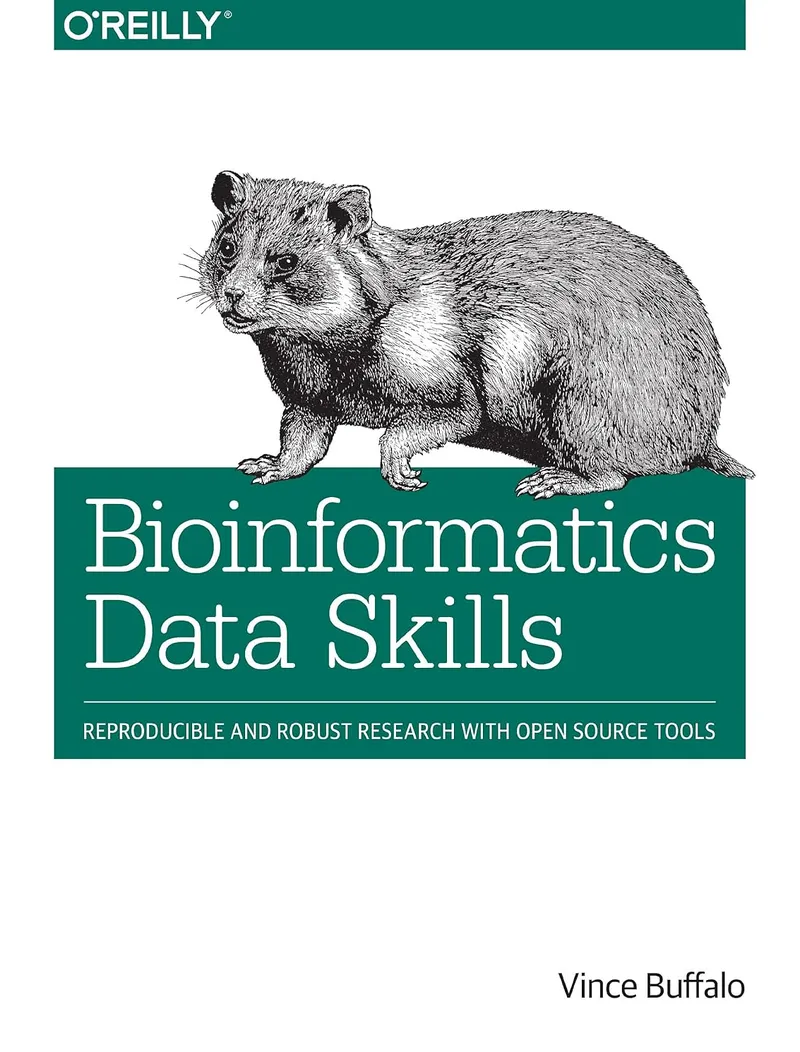

Bioinformatics Data Skills: Reproducible and Robust Research with Open Source Tools
Bioinformatics Data Skills: Reproducible and Robust Research with Open Source Tools is a practical guide to the computational and data-analysis skills needed to work effectively with modern biological datasets. Published by O’Reilly, this first edition focuses on helping researchers transform large and complex sequencing datasets into reliable, reproducible biological findings using freely available open-source tools.
Written for intermediate-level learners, the book moves beyond basic scripting and introduces practical approaches for organizing, processing, analyzing, and managing bioinformatics data. Readers with some experience in a scripting language such as Python can use the book to develop more efficient workflows and apply computational tools to real biological data.
About the Book
Modern biological research increasingly depends on the ability to process and analyze large datasets. Bioinformatics Data Skills addresses this challenge by teaching general-purpose computational and data skills that can be applied across a wide range of bioinformatics projects.
Rather than focusing exclusively on individual biological applications, the book emphasizes robust, efficient, and reproducible research practices. It shows readers how to move from small, messy scripts toward organized workflows capable of handling larger and more complex data-processing tasks.
Working with Bioinformatics Data
A central focus of the book is learning how to handle biological datasets efficiently. Readers are introduced to practical data-processing approaches that can help turn raw and complex information into useful biological results.
The emphasis on open-source tools also makes the techniques accessible to researchers and students who want to build computational workflows using freely available software.
Unix Pipelines and Data Tools
The book introduces powerful Unix pipelines and command-line data tools for processing bioinformatics datasets. These approaches allow researchers to combine specialized tools into efficient workflows and automate repetitive data-processing tasks.
Learning to work effectively at the command line is particularly valuable when dealing with datasets that are too large or complex to process efficiently through manual methods.
Exploratory Data Analysis with R
Readers also learn exploratory data analysis using the R programming language. These techniques provide ways to examine datasets, identify patterns, and better understand biological information before performing more specialized analyses.
The combination of command-line tools and R gives learners practical skills for approaching biological datasets from multiple computational perspectives.
Genomic Range Data
Efficiently working with genomic coordinates and regions is another important component of modern bioinformatics. The book introduces methods for handling genomic range data and range operations, helping readers work more effectively with genomic features and coordinate-based datasets.
These skills are particularly relevant to researchers working with sequencing and genome analysis data.
FASTA, FASTQ, SAM, and BAM Formats
The book provides practical guidance for working with common genomics file formats, including FASTA, FASTQ, SAM, and BAM.
Understanding these formats and learning how to manipulate their contents efficiently are essential skills for many sequencing and genomics workflows. The book places these formats within a broader framework of practical data processing and analysis.
Git and Reproducible Research
Reproducibility is a major theme of the book. Readers learn how to use the Git version control system to manage bioinformatics projects, track changes, and maintain organized research workflows.
Version control can make computational research easier to document, reproduce, and maintain, particularly as projects grow in size and complexity.
Bash Scripts and Makefiles
The book also covers Bash scripting and Makefiles for automating repetitive data-processing tasks. These tools allow researchers to build more efficient workflows and reduce the need for manually repeating complex computational operations.
Automation is particularly valuable in bioinformatics, where analyses may involve many files, processing steps, and repeated transformations.
From Scripts to Robust Workflows
A key goal of Bioinformatics Data Skills is helping readers progress from ad hoc computational work toward more reliable research practices. The book demonstrates how scripting, command-line tools, version control, data analysis, and workflow automation can work together.
This broader perspective helps readers develop computational habits that are useful beyond any single bioinformatics project.
Who Should Use This Book?
Bioinformatics Data Skills: Reproducible and Robust Research with Open Source Tools is particularly useful for:
- Intermediate-level students studying bioinformatics and computational biology.
- Biology and life science researchers working with sequencing data.
- Graduate students beginning computational research.
- Researchers who want to improve their biological data-analysis workflows.
- Bioinformatics learners with basic Python or scripting experience.
- Students working with genomics and sequencing datasets.
- Researchers interested in reproducible and robust computational research.
- Readers seeking practical experience with Unix, R, Git, Bash, and bioinformatics file formats.
Final Thoughts
Bioinformatics Data Skills provides a practical foundation for researchers who need to work confidently with modern biological data. Instead of concentrating only on biological theory, it develops the computational habits and technical skills required to process large datasets, automate analyses, organize projects, and produce reproducible results.
By bringing together Unix pipelines, R, genomic range operations, common sequencing formats, Git, Bash scripting, and Makefiles, the book provides a useful toolkit for students and researchers developing practical bioinformatics workflows.
Book Information
Title: Bioinformatics Data Skills: Reproducible and Robust Research with Open Source Tools
Publisher: O’Reilly
Publication Date: 14 July 2015
Edition: 1st
Language: English
Print Length: 536 pages
ISBN-10: 1449367372
ISBN-13: 978-1449367374
Subjects: Bioinformatics, computational biology, biological data analysis, genomics, sequencing data, reproducible research, Unix, R, Python, Git, Bash scripting, Makefiles, genomic range data, FASTA, FASTQ, SAM, and BAM.
Bioinformatics Data Skills provides practical computational techniques for processing biological data and building robust, efficient, and reproducible bioinformatics research workflows with open-source tools.
Support the Creators!
If you enjoy this book, please consider supporting the author and publisher by purchasing a physical or digital copy. Buying official copies ensures authors can keep writing great books.