
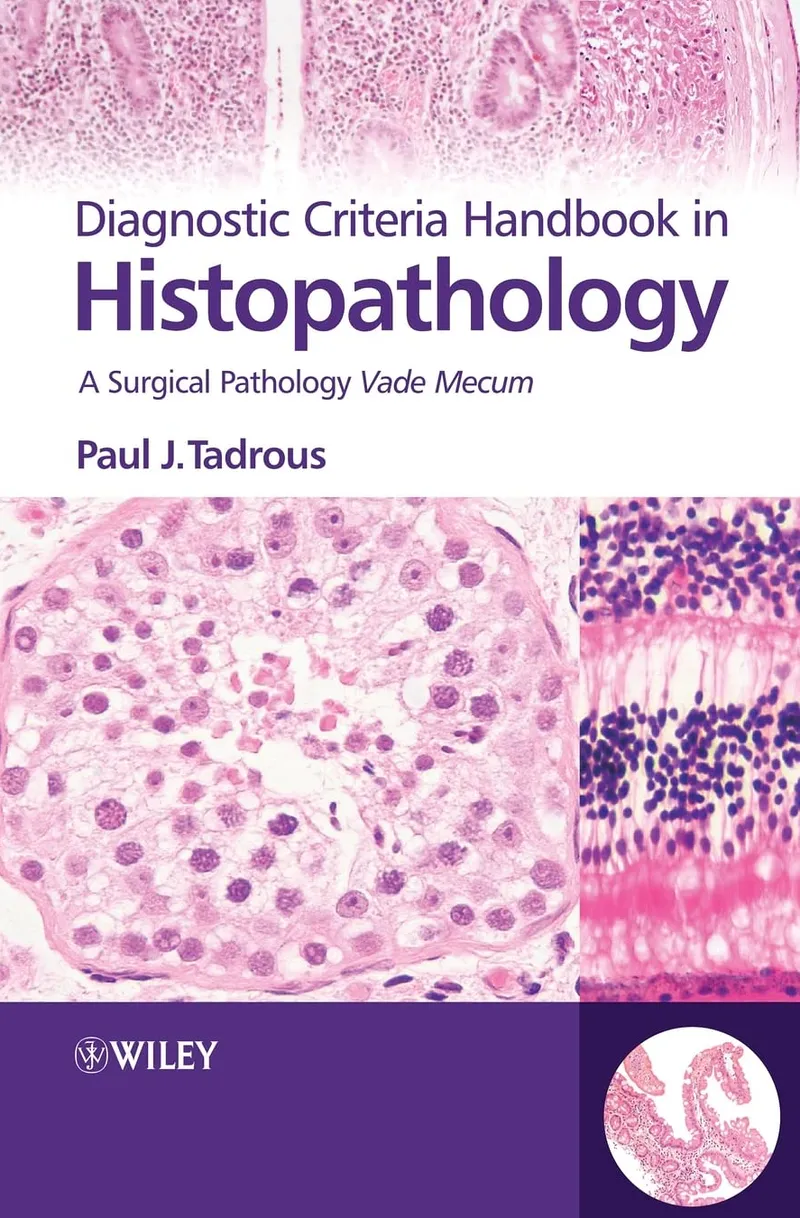

Diagnostic Criteria Handbook in Histopathology: A Surgical Pathology Vade Mecum
Diagnostic Criteria Handbook in Histopathology: A Surgical Pathology Vade Mecum is a compact practical reference designed to help working histopathologists quickly locate important diagnostic information during routine surgical pathology practice. Rather than functioning as a conventional textbook, the handbook is organized as a rapid-access resource that allows readers to review key criteria, diagnostic distinctions, and practical guidance efficiently.
Its concise presentation uses bullet points, tables, diagrams, and anatomical illustrations to make information easy to find during a busy working day. The book is particularly suited to practicing histopathologists and trainees who already have a basic understanding of pathology and need a convenient reference for day-to-day diagnostic work.
Rapid Access to Diagnostic Information
The handbook is designed around the practical needs of surgical pathology. Its format allows important information to be located quickly without requiring the reader to work through lengthy explanations.
Key information is presented through:
- Bullet-point summaries
- Tables and diagrams
- Anatomical diagrams
- Differential diagnosis lists
- Diagnostic criteria
- Grading and scoring systems
- Frozen-section guidance
- Molecular and immunohistochemical findings
This structure makes the book particularly useful as a bench-side or workstation reference.
Surgical Pathology and Cut-Up Guidance
An important component of the handbook is its practical discussion of specimen handling and “cut-up” procedures. It places particular emphasis on core datasets and the information required during specimen examination and processing.
The book therefore extends beyond microscopic diagnostic criteria to include practical aspects of surgical pathology workflow, helping readers connect specimen handling with subsequent pathological assessment.
Differential Diagnosis and Ancillary Findings
The handbook includes differential diagnosis lists where they are useful for distinguishing between related pathological conditions. It also incorporates diagnostically relevant molecular and immunohistochemical findings, providing additional information that can assist with modern pathological diagnosis.
A dedicated index makes specific categories of information easier to locate, including:
- Frozen-section advice
- Grading systems
- Scoring systems
Broad Histopathology Coverage
Despite its compact format, the book covers a broad range of pathology-related subjects. Its scope extends from laboratory management and laboratory methods to autopsy practice, cytology, and the major subspecialties of surgical pathology.
This breadth makes it particularly useful for trainees and practicing pathologists who need access to information spanning multiple areas of histopathology rather than a reference limited to a single specialty.
A Reference for Practicing Histopathologists and Trainees
The book is specifically intended as a practical working reference rather than a basic introductory textbook. Beginners may therefore need to use it alongside a comprehensive pathology textbook.
For pathology trainees, however, its broad coverage can provide a convenient way to review diagnostic criteria and reinforce knowledge across different subspecialties. A dedicated chapter on examination technique and mnemonics also provides additional support for professional examination revision.
Who Should Use This Handbook?
Diagnostic Criteria Handbook in Histopathology is particularly useful for:
- Practicing histopathologists
- Surgical pathologists
- Histopathology trainees
- Pathology residents
- Laboratory professionals working in histopathology
- Pathologists preparing for professional examinations
- Readers seeking a rapid surgical pathology reference
Final Thoughts
Diagnostic Criteria Handbook in Histopathology: A Surgical Pathology Vade Mecum is designed to complement, rather than replace, comprehensive pathology textbooks. Its strength lies in the rapid presentation of diagnostic criteria, differential diagnoses, grading and scoring systems, specimen cut-up guidance, and selected molecular and immunohistochemical information.
Published in 2008, the handbook should be regarded as a reference reflecting the diagnostic practices and knowledge of that period. Molecular pathology, immunohistochemistry, classification systems, and diagnostic criteria have evolved considerably since then, so current classifications, guidelines, and validated diagnostic standards should be consulted for present-day clinical practice.
Book Information
Title: Diagnostic Criteria Handbook in Histopathology: A Surgical Pathology Vade Mecum
Publisher: Wiley
Publication Date: April 21, 2008
Edition: 1st Edition
Language: English
Print Length: 448 pages
ISBN-10: 9780470519035
ISBN-13: 978-0470519035
ASIN: 0470519037
Subjects: Histopathology, Surgical Pathology, Diagnostic Pathology, Pathology Reference, Immunohistochemistry, Molecular Pathology, Cytology, Laboratory Methods
Support the Creators!
If you enjoy this book, please consider supporting the author and publisher by purchasing a physical or digital copy. Buying official copies ensures authors can keep writing great books.