
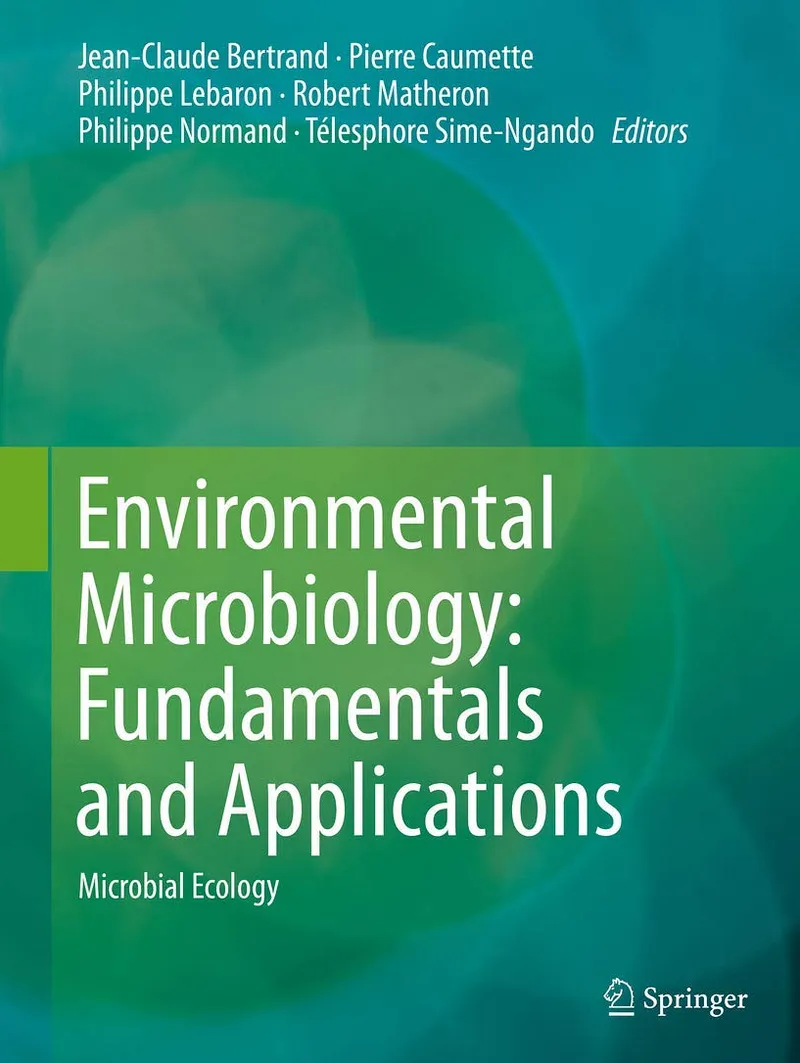

Environmental Microbiology: Fundamentals and Applications
Environmental Microbiology: Fundamentals and Applications is a comprehensive resource exploring the role of microorganisms in natural and engineered environments. Published by Springer in 2015, the book examines how microorganisms interact with soil, water, air, organic matter, and other components of the environment.
With 948 pages, it provides extensive coverage of environmental microbiology, microbial ecology, biogeochemistry, environmental biotechnology, and microbial processes.
About Environmental Microbiology
Microorganisms are essential components of virtually every ecosystem.
Bacteria, archaea, fungi, algae, and other microorganisms participate in processes that influence nutrient cycling, decomposition, soil fertility, water quality, and the transformation of organic and inorganic compounds.
Environmental microbiology studies these microorganisms and the processes through which they interact with their surroundings.
Microbial Ecology
Microbial ecology focuses on how microorganisms live and interact within different environments.
Microbial communities can be found in soil, freshwater, marine environments, sediments, wastewater, extreme environments, and many other habitats.
Studying these communities helps scientists understand how microorganisms contribute to ecosystem stability and environmental change.
Microorganisms and Biogeochemical Cycles
Microorganisms play major roles in the cycling of important elements.
Microbial processes are involved in the transformation of carbon, nitrogen, sulfur, phosphorus, and other elements between different chemical forms.
These processes influence ecosystem productivity and are also important for understanding global environmental systems.
Soil Microbiology
Soil contains diverse microbial communities that contribute to nutrient availability and organic matter decomposition.
Microorganisms can break down complex compounds and participate in processes that influence soil fertility, plant growth, carbon cycling, and nutrient transformation.
Environmental microbiology therefore provides an important foundation for understanding the biological processes occurring beneath our feet.
Aquatic and Marine Microbiology
Microorganisms are also abundant in aquatic environments.
Microbial communities in rivers, lakes, groundwater, oceans, sediments, and wastewater systems contribute to nutrient cycling and the transformation of pollutants and organic materials.
Understanding these communities is important for studying water quality and environmental health.
Environmental Pollution and Bioremediation
Some microorganisms can transform or degrade contaminants in the environment.
This property has led to the development of bioremediation, an approach that uses biological processes to help reduce or remove certain pollutants.
Microorganisms can participate in the transformation of hydrocarbons, organic pollutants, and other environmental contaminants, making them valuable in environmental biotechnology.
Wastewater and Waste Treatment
Microbial processes are fundamental to many wastewater treatment systems.
Microorganisms help break down organic matter and transform nutrients and other compounds during treatment.
Understanding microbial metabolism and community behavior is therefore important for designing and managing systems for wastewater treatment and environmental pollution control.
Environmental Biotechnology
Environmental microbiology is closely connected with biotechnology.
Knowledge of microbial metabolism and ecological interactions can be applied to waste treatment, pollution remediation, resource recovery, water management, and sustainable environmental technologies.
These applications demonstrate how fundamental microbiology can be translated into practical solutions.
Microbial Diversity and Molecular Methods
Modern environmental microbiology increasingly uses molecular and genomic approaches to study microorganisms that may be difficult to cultivate in the laboratory.
Methods involving DNA analysis, microbial community profiling, genomics, and molecular identification have expanded our understanding of microbial diversity and environmental processes.
Who Is This Book For?
Environmental Microbiology: Fundamentals and Applications can be useful for:
- Environmental microbiology students
- Microbiology students
- Environmental science students
- Biology students
- Biotechnology students
- Soil science students
- Water and wastewater professionals
- Environmental researchers
- Agricultural science students
- Students studying microbial ecology
It can also serve as a reference for readers interested in the relationship between microorganisms and environmental systems.
Why Study Environmental Microbiology?
Environmental microbiology helps explain many of the biological processes that maintain ecosystems.
From decomposition and nutrient cycling to pollution degradation and wastewater treatment, microorganisms influence both natural environments and human-designed systems.
Understanding these processes is increasingly important as researchers and environmental professionals address issues involving pollution, resource management, climate change, and environmental sustainability.
Final Thoughts
Environmental Microbiology: Fundamentals and Applications provides an extensive exploration of microorganisms and their roles in environmental systems.
The book covers important areas related to microbial ecology, soil microbiology, aquatic microbiology, biogeochemical cycles, environmental pollution, bioremediation, wastewater treatment, microbial diversity, and environmental biotechnology.
With 948 pages, it offers a substantial resource for students, researchers, and professionals seeking a deeper understanding of environmental microbial processes.
For readers interested in microbiology, environmental science, biotechnology, microbial ecology, soil science, and water management, this book provides a valuable foundation for exploring how microorganisms shape and influence the environment.
Book Information
Title: Environmental Microbiology: Fundamentals and Applications
Edition: 2015 Edition
Publisher: Springer
Publication Date: February 10, 2015
Language: English
Print Length: 948 pages
ISBN-10: 9401791171
ISBN-13: 978-9401791175
Subject: Environmental Microbiology / Microbial Ecology / Environmental Biotechnology / Bioremediation / Soil Microbiology / Aquatic Microbiology
Environmental Microbiology: Fundamentals and Applications explores the role of microorganisms in soil, water, ecosystems, nutrient cycling, pollution degradation, wastewater treatment, bioremediation, and environmental biotechnology, making it a useful reference for students and professionals in environmental and biological sciences.
Support the Creators!
If you enjoy this book, please consider supporting the author and publisher by purchasing a physical or digital copy. Buying official copies ensures authors can keep writing great books.