
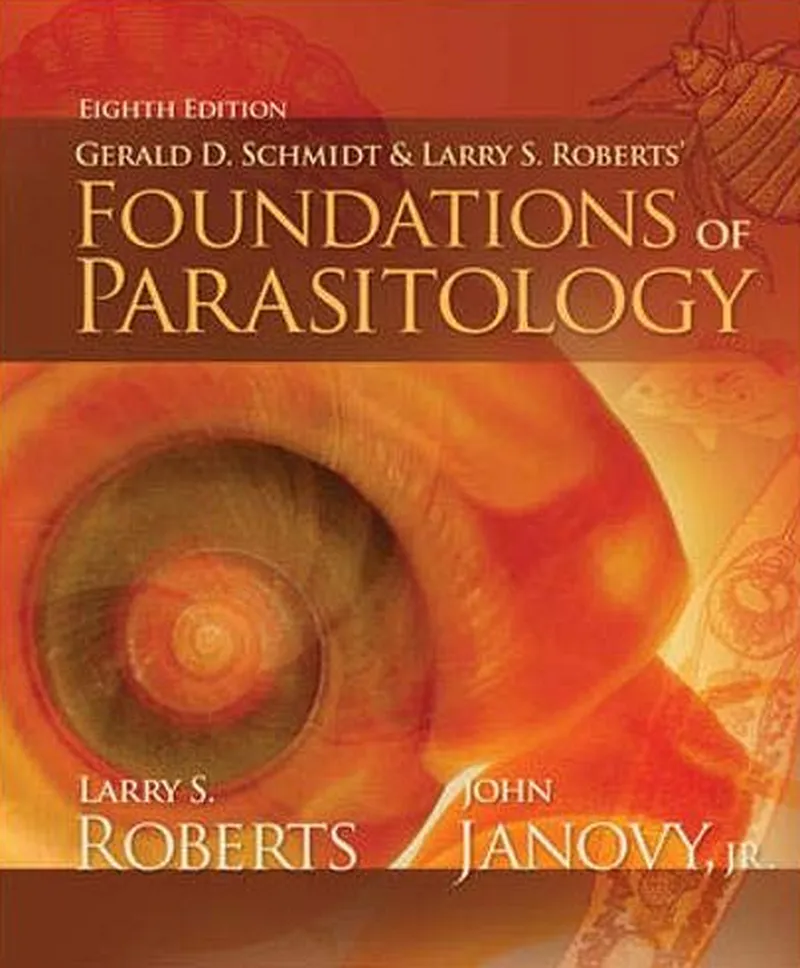

Foundations of Parasitology, 8th Edition
Foundations of Parasitology, 8th Edition is a comprehensive textbook that introduces the biology, diversity, ecology, and medical importance of parasites. Published by McGraw-Hill, the book provides a broad foundation in parasitology, covering parasite life cycles, host–parasite relationships, and the effects of parasitic infections.
With 701 pages, it offers detailed coverage suitable for undergraduate students and readers seeking a strong foundation in parasitology.
About the Book
Parasitology examines organisms that live in association with hosts and may cause disease or influence ecosystems.
Understanding parasites requires knowledge of their biology, morphology, life cycles, transmission, host interactions, and environmental relationships.
Protozoan Parasites
Protozoa include numerous organisms of medical and biological importance.
The study of protozoan parasites helps students understand their structure, reproduction, life cycles, transmission, and interactions with their hosts.
Helminths and Other Parasites
Parasitology also encompasses major groups of parasitic worms, including nematodes, trematodes, and cestodes.
Learning their distinctive morphology and life cycles helps explain how these parasites develop, spread, and interact with their hosts.
Parasite Life Cycles
Life cycles are central to understanding parasitic organisms.
Many parasites require specific hosts, vectors, or environmental conditions to complete their development. Understanding these stages helps explain transmission and provides a foundation for parasite control and prevention.
Host–Parasite Relationships
Parasites and their hosts interact in complex ways.
The study of host defenses, parasite adaptations, immune responses, and mechanisms of infection helps explain how parasites survive within their hosts and how disease can develop.
Medical and Environmental Parasitology
Parasitology has applications in both medicine and environmental biology.
Medical parasitology focuses on parasites that affect humans, while broader parasitological studies consider animal hosts, ecological relationships, transmission cycles, and the role of parasites in ecosystems.
Who Is This Book For?
Foundations of Parasitology, 8th Edition can be useful for:
- Parasitology students
- Biology students
- Microbiology students
- Zoology students
- Medical students
- Veterinary science students
- Biomedical science students
- Environmental biology students
- Students studying infectious diseases
Final Thoughts
Foundations of Parasitology, 8th Edition provides a broad introduction to the science of parasitology, combining parasite biology, taxonomy, life cycles, host–parasite relationships, transmission, and medical importance.
With 701 pages, it offers substantial coverage for students seeking to understand parasites from both biological and medical perspectives.
For students studying parasitology, microbiology, biology, medicine, veterinary science, and related disciplines, this book can serve as a comprehensive foundation and reference.
Book Information
Title: Foundations of Parasitology
Edition: 8th Edition
Publisher: McGraw-Hill
Publication Date: October 13, 2008
Language: English
Print Length: 701 pages
ISBN-10: 0073028274
ISBN-13: 978-0073028279
Subject: Parasitology / Parasite Biology / Medical Parasitology / Host–Parasite Relationships
Foundations of Parasitology, 8th Edition provides a comprehensive introduction to parasite biology, taxonomy, life cycles, host–parasite relationships, transmission, and medical importance, making it a valuable resource for students of parasitology, microbiology, biology, medicine, and related sciences.
Support the Creators!
If you enjoy this book, please consider supporting the author and publisher by purchasing a physical or digital copy. Buying official copies ensures authors can keep writing great books.