
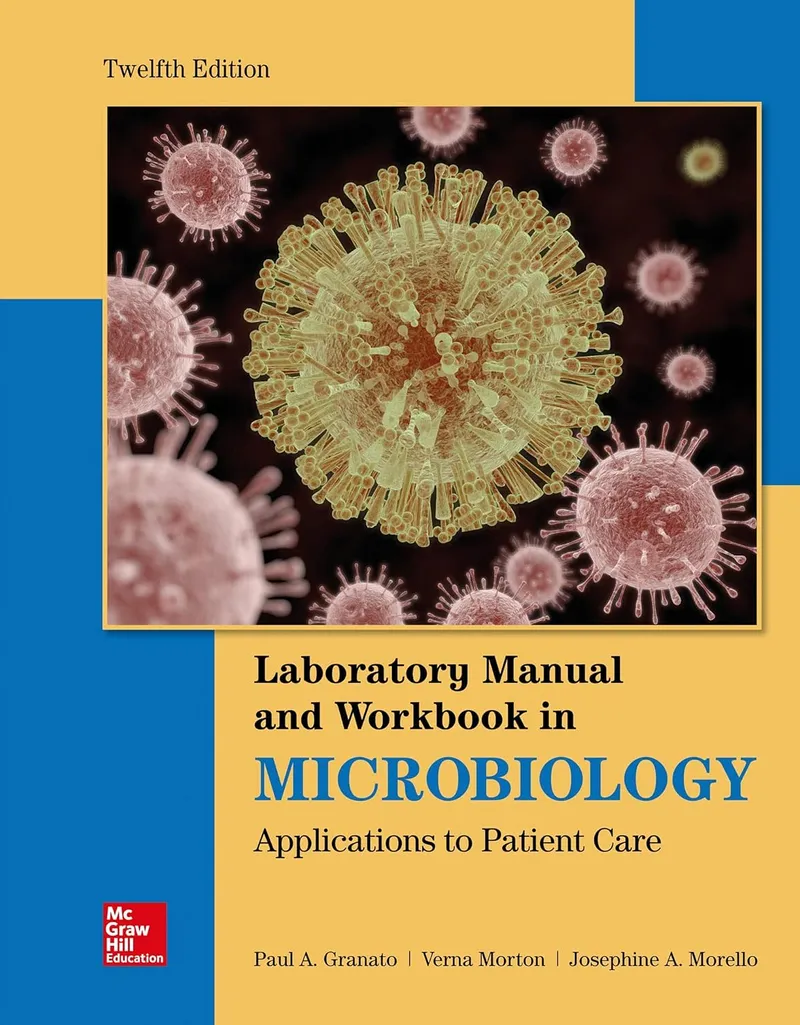

Lab Manual and Workbook in Microbiology: Applications to Patient Care, 12th Edition
Lab Manual and Workbook in Microbiology: Applications to Patient Care, 12th Edition is a practical laboratory resource designed to introduce students to the fundamental principles and techniques of diagnostic microbiology. Published by McGraw-Hill Higher Education, this 336-page manual emphasizes the application of microbiological knowledge to patient care and the clinical laboratory.
The book is particularly suited to students preparing for careers in allied health and healthcare professions, combining laboratory exercises with essential concepts in microbial identification, specimen collection, laboratory safety, aseptic technique, disinfection, sterilization, and infectious disease diagnosis.
About the Book
Clinical microbiology plays an important role in the diagnosis and management of infectious diseases. Healthcare professionals need to understand not only microorganisms themselves, but also how clinical specimens are collected, handled, examined, and processed in the laboratory.
Lab Manual and Workbook in Microbiology introduces these concepts through a series of practical exercises designed to develop basic microbiological laboratory skills while demonstrating how laboratory procedures relate directly to patient care.
Basic Microbiology Laboratory Techniques
The manual introduces students to fundamental techniques used in microbiology laboratories.
Practical exercises help learners develop an understanding of microbial examination, laboratory procedures, isolation techniques, identification methods, and safe handling of microorganisms.
Diagnostic Microbiology
A central focus of the workbook is the role of the clinical microbiology laboratory in diagnosing infectious diseases.
Students learn how microbiological procedures can be used to isolate and identify infectious agents and how laboratory findings contribute to the understanding of infections.
Laboratory Safety
Safe laboratory practice is an essential component of microbiology training.
The manual introduces principles of laboratory safety and appropriate handling of microorganisms, with particular attention to safety in both laboratory and healthcare environments.
Clinical Specimen Collection
Correct specimen collection is essential for obtaining reliable microbiological results.
The workbook highlights the role of healthcare professionals in the appropriate collection and handling of clinical specimens, helping students understand how specimen quality can influence laboratory diagnosis.
Isolation and Identification of Infectious Agents
The manual provides practical exercises illustrating the basic principles used to isolate and identify infectious microorganisms.
These exercises help students connect microbiological techniques with their applications in the diagnosis of infectious disease.
Aseptic Technique
Preventing unwanted microbial contamination is fundamental to microbiological laboratory work and patient care.
The book demonstrates the principles and applications of aseptic technique, helping students understand how proper procedures protect specimens, healthcare workers, patients, and the laboratory environment.
Disinfection and Sterilization
Microbial control is an essential part of healthcare practice.
The manual introduces the principles of disinfection and sterilization, explaining their importance in controlling microorganisms and preventing contamination and infection.
Microbiology and Patient Care
The distinctive feature of this laboratory manual is its emphasis on connecting microbiology with practical healthcare applications.
Students learn how microbiological principles relate to patient care, infectious disease diagnosis, specimen collection, infection prevention, and clinical laboratory procedures.
Clinical Microbiology Laboratory
The workbook helps students understand the purpose and function of the clinical microbiology laboratory.
By working through laboratory exercises, learners gain insight into how clinical laboratories support healthcare professionals through the detection, isolation, and identification of infectious agents.
Who Is This Book For?
Lab Manual and Workbook in Microbiology: Applications to Patient Care, 12th Edition can be useful for:
- Allied health students
- Medical laboratory science students
- Nursing students
- Healthcare students
- Clinical laboratory students
- Microbiology students
- Medical assisting students
- Students preparing for patient-care professions
- Healthcare professionals seeking foundational microbiology skills
It is especially appropriate for students who need to learn basic microbiology laboratory techniques and their practical relationship to patient care.
Final Thoughts
Lab Manual and Workbook in Microbiology: Applications to Patient Care, 12th Edition provides a practical introduction to diagnostic microbiology for students entering allied health and other healthcare fields.
Its exercises emphasize laboratory safety, basic microbiological techniques, clinical specimen collection, isolation and identification of infectious agents, aseptic technique, disinfection, sterilization, and the role of the clinical microbiology laboratory in infectious disease diagnosis.
By connecting laboratory procedures with real-world patient care, the manual helps students understand how microbiological principles are applied in healthcare settings.
Book Information
Title: Lab Manual and Workbook in Microbiology: Applications to Patient Care
Edition: 12th Edition
Publisher: McGraw-Hill Higher Education
Publication Date: January 16, 2018
Language: English
Print Length: 336 pages
Format: Print Replica
ISBN-13: 978-1260163988
ASIN: B078SSGZLP
Subject: Microbiology / Clinical Microbiology / Laboratory Medicine / Allied Health / Patient Care
Lab Manual and Workbook in Microbiology: Applications to Patient Care, 12th Edition provides practical training in diagnostic microbiology, laboratory safety, microbial isolation and identification, clinical specimen collection, aseptic technique, disinfection, sterilization, and clinical laboratory procedures, making it a useful resource for allied health and healthcare students preparing for patient-care professions.
Support the Creators!
If you enjoy this book, please consider supporting the author and publisher by purchasing a physical or digital copy. Buying official copies ensures authors can keep writing great books.