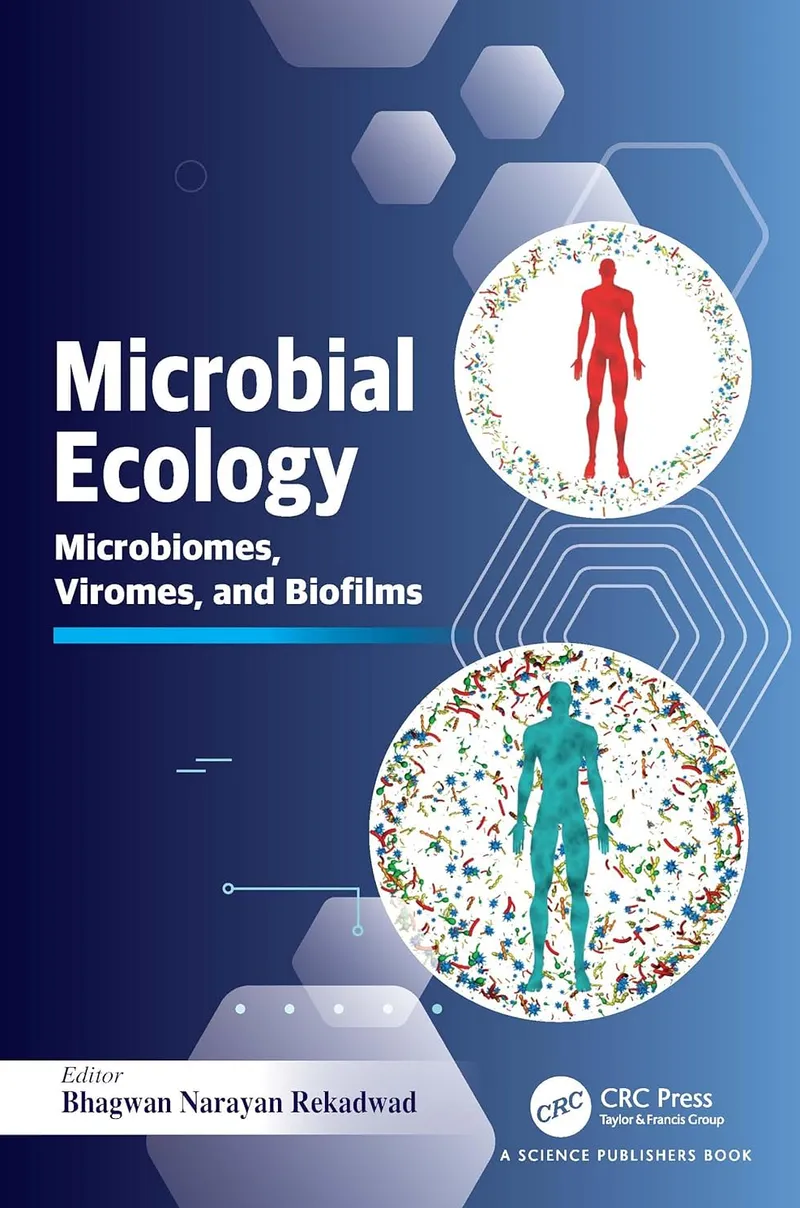

Microbial Ecology: Microbiomes, Viromes, and Biofilms, 1st Edition
Microbial Ecology: Microbiomes, Viromes, and Biofilms, 1st Edition is a modern introduction to the interactions between microorganisms and their environments, with particular emphasis on microbiomes, viromes, microbial communities, and biofilms. Published by CRC Press in 2024, the book explores how microorganisms coexist, communicate, adapt, and influence biological and environmental systems.
With 222 pages, this focused resource provides an accessible overview of contemporary microbial ecology and is useful for students, researchers, and professionals interested in microbiology, environmental microbiology, microbial ecology, biotechnology, and microbiome science.
About the Book
Microorganisms rarely exist in isolation. They live as complex communities in environments ranging from soil and water to plants, animals, and the human body.
Microbial Ecology: Microbiomes, Viromes, and Biofilms examines these microbial communities and the ecological relationships that shape their structure and function. The book introduces modern concepts used to understand how microorganisms interact with one another and with their surroundings.
Microbial Communities
Microbial ecosystems contain diverse populations of organisms that interact through competition, cooperation, resource exchange, and environmental adaptation.
The book explores the organization and dynamics of microbial communities, helping readers understand how environmental conditions influence microbial diversity and activity.
Microbiomes
Microbiomes consist of complex communities of microorganisms and their genetic material within particular environments.
The text introduces microbiome structure, diversity, interactions, and functions, providing a foundation for understanding microbiomes in environmental, animal, plant, and human-associated systems.
Viromes
Viruses are important components of microbial ecosystems.
The book examines the concept of viromes, including the diversity and ecological roles of viruses within microbial communities and their interactions with microbial hosts.
Biofilms
Biofilms are structured microbial communities that develop on surfaces and within diverse environments.
The text explores biofilm formation, organization, microbial interactions, environmental adaptation, and ecological significance, highlighting why biofilms are important in natural, industrial, and clinical settings.
Microbial Interactions
Microorganisms influence one another through a wide range of ecological relationships.
The book introduces concepts such as competition, cooperation, predation, symbiosis, commensalism, and microbial communication, showing how these interactions contribute to community structure.
Microbial Diversity
Microbial ecosystems contain extraordinary biological diversity.
The text discusses factors that influence microbial diversity, community composition, ecological niches, and environmental adaptation.
Environmental Microbiology
Microorganisms are essential components of ecosystems.
The book connects microbial ecology with environmental processes involving soil, water, nutrient cycling, decomposition, and ecosystem function.
Human-Associated Microbiomes
Microbial communities are also closely associated with multicellular organisms.
The text provides a foundation for understanding how microbial communities interact with hosts and contribute to host-associated ecosystems and biological processes.
Microbial Ecology and Biotechnology
Understanding microbial communities has important practical applications.
The principles discussed in the book can contribute to applications involving biotechnology, environmental management, industrial microbiology, and microbial resource utilization.
Biofilms in Clinical and Industrial Environments
Biofilms can have significant practical consequences.
The book provides an ecological perspective on biofilms and their relevance to healthcare, industrial systems, surfaces, and environmental environments.
Modern Approaches to Microbial Ecology
Contemporary microbial ecology increasingly relies on molecular and genomic approaches to investigate microbial communities.
The subject encompasses methods used to characterize microbial diversity, community composition, microbial interactions, microbiomes, and viromes, providing a foundation for understanding modern microbiological research.
Who Is This Book For?
Microbial Ecology: Microbiomes, Viromes, and Biofilms, 1st Edition can be useful for:
- Microbiology students
- Microbial ecology students
- Environmental microbiology students
- Biotechnology students
- Biology students
- Molecular biology students
- Microbiome researchers
- Environmental scientists
- Biotechnology researchers
- Graduate students
- Researchers in microbial science
It is particularly suitable for readers interested in the ecology of microbial communities and the emerging science of microbiomes, viromes, and biofilms.
Final Thoughts
Microbial Ecology: Microbiomes, Viromes, and Biofilms, 1st Edition provides a contemporary overview of microbial communities and their ecological relationships.
Its focus on microbial ecology, microbiomes, viromes, biofilms, microbial diversity, community interactions, environmental microbiology, and applied microbial science makes it a useful resource for students and researchers seeking to understand the increasingly important role of microbial communities in biological and environmental systems.
Book Information
Title: Microbial Ecology: Microbiomes, Viromes, and Biofilms
Edition: 1st Edition
Publisher: CRC Press
Publication Date: July 19, 2024
Language: English
Print Length: 222 pages
ISBN-10: 1032506059
ISBN-13: 978-1032506050
Subject: Microbial Ecology / Microbiology / Microbiomes / Viromes / Biofilms / Environmental Microbiology
Microbial Ecology: Microbiomes, Viromes, and Biofilms, 1st Edition provides an introduction to microbial communities, microbiomes, viromes, biofilms, microbial diversity, ecological interactions, environmental microbiology, and applied microbial ecology, making it a valuable resource for students and researchers exploring modern microbial science.
Support the Creators!
If you enjoy this book, please consider supporting the author and publisher by purchasing a physical or digital copy. Buying official copies ensures authors can keep writing great books.