
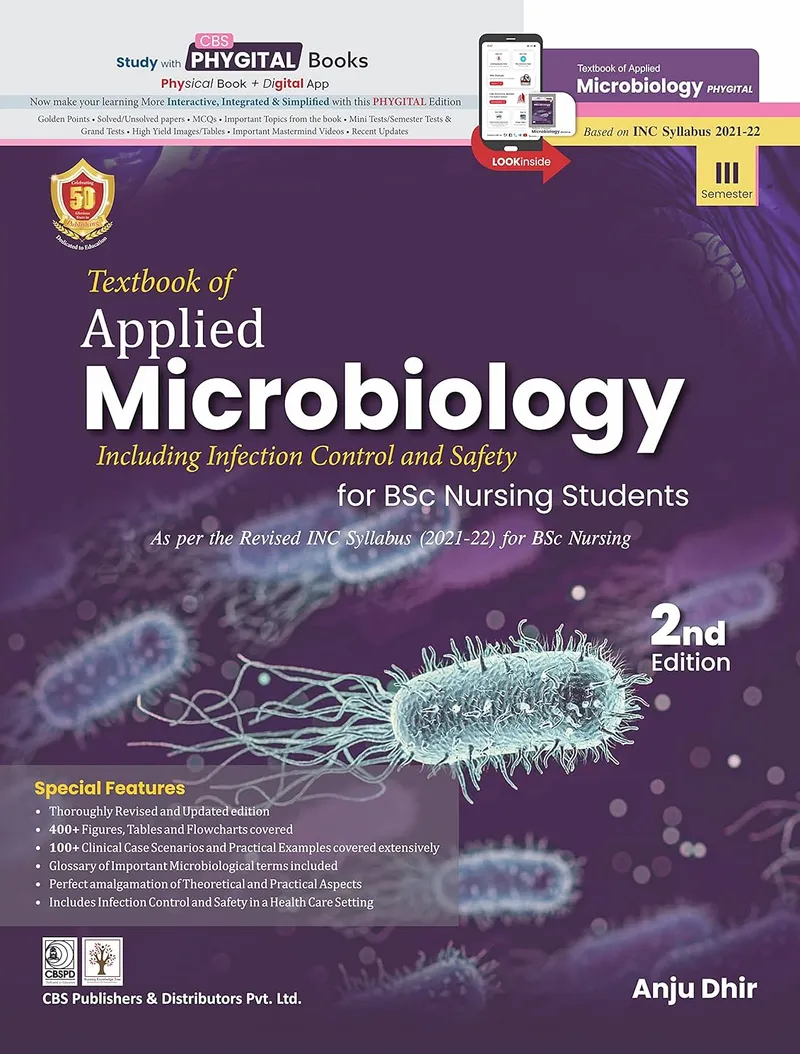

Textbook of Applied Microbiology: Including Infection Control and Safety, 2nd Edition
Textbook of Applied Microbiology: Including Infection Control and Safety, 2nd Edition is a practical microbiology resource that connects fundamental microbiological concepts with their applications in healthcare, infection prevention, laboratory practice, and safety. Published by CBS Publishers and Distributors Pvt. Ltd., this second edition is particularly relevant for students and healthcare learners who need to understand how microbiology is applied in real-world settings.
The book combines the study of microorganisms with important principles of infection control, laboratory safety, contamination prevention, and healthcare-associated infections, making it a useful companion for courses in applied and medical microbiology.
About Textbook of Applied Microbiology
Applied microbiology focuses on how knowledge of microorganisms can be used to solve practical problems.
In healthcare and laboratory environments, microbiological knowledge is essential for understanding how infections develop, how microorganisms are transmitted, and how contamination can be prevented.
This book provides a foundation for connecting microbiology theory with practical applications in healthcare and related environments.
Understanding Microorganisms
Microorganisms such as bacteria, viruses, fungi, and parasites have different structures, biological characteristics, and methods of transmission.
Understanding these differences helps students recognize how microorganisms interact with humans and the environment and why different approaches are required to control them.
Basic microbiology therefore provides the foundation for understanding infection prevention and laboratory safety.
Applied Microbiology in Healthcare
Microbiology has a direct role in healthcare.
Healthcare professionals encounter microorganisms during patient care, laboratory testing, environmental monitoring, and infection-control activities.
Understanding microbial growth, contamination, transmission, and identification can help healthcare workers recognize potential risks and follow appropriate preventive measures.
Infection Control
Infection control is one of the most important applications of microbiology in healthcare.
Effective infection prevention depends on understanding how microorganisms move between people, surfaces, equipment, and the surrounding environment.
Important practices include:
- Hand hygiene
- Personal protective equipment
- Environmental cleaning
- Disinfection
- Sterilization
- Safe handling of clinical materials
- Proper waste management
- Prevention of cross-contamination
These measures help reduce the transmission of infectious microorganisms.
Sterilization and Disinfection
Sterilization and disinfection are fundamental techniques used to control microorganisms.
Different methods are appropriate for different materials and situations. Understanding the principles behind these processes helps students recognize the differences between eliminating microorganisms completely and reducing microbial contamination to safer levels.
These concepts are especially important in healthcare and laboratory environments.
Laboratory Safety
Microbiology laboratories require careful handling of biological materials and laboratory equipment.
Good laboratory practices help reduce exposure to microorganisms, prevent accidental contamination, and protect both laboratory personnel and the surrounding environment.
Understanding laboratory safety also encourages students to develop responsible habits that are essential for practical microbiology.
Healthcare-Associated Infections
Healthcare-associated infections are an important concern in hospitals and other healthcare facilities.
Microorganisms can potentially spread through patients, healthcare workers, equipment, surfaces, and contaminated materials.
Understanding the mechanisms of transmission and the principles of infection prevention helps healthcare professionals reduce these risks and improve patient safety.
Microbial Contamination
Contamination can occur in many environments where microorganisms are present.
In healthcare and laboratory settings, identifying possible sources of contamination is an important step toward controlling them.
Understanding microbial growth requirements, environmental conditions, and transmission pathways helps students recognize how contamination occurs and how it can be prevented.
Microbiological Laboratory Methods
Applied microbiology relies on laboratory techniques for observing, culturing, identifying, and studying microorganisms.
Common approaches include:
- Microscopy
- Staining
- Microbial culture
- Identification methods
- Biochemical testing
- Microbial enumeration
- Environmental monitoring
- Antimicrobial susceptibility testing
These methods help translate microbiological theory into practical laboratory knowledge.
Antimicrobial Resistance
Antimicrobial resistance is an increasingly important issue in healthcare and public health.
Microorganisms can develop or acquire mechanisms that reduce their susceptibility to antimicrobial drugs. Understanding resistance highlights the importance of appropriate antimicrobial use, laboratory testing, infection prevention, and effective surveillance.
Applied microbiology therefore plays an important role in addressing this growing challenge.
Who Is This Book For?
Textbook of Applied Microbiology can be useful for:
- Nursing students
- Medical students
- Microbiology students
- Medical laboratory science students
- Pharmacy students
- Allied health students
- Biotechnology students
- Healthcare professionals
- Students studying infection control
- Students preparing for microbiology examinations
Its focus on practical applications makes it particularly suitable for readers who want to understand how microbiological principles are used in healthcare and laboratory environments.
Why Study Applied Microbiology?
Applied microbiology demonstrates how fundamental scientific knowledge can be translated into practical procedures.
Learning about microorganisms is only one part of microbiology education. Students also need to understand how microorganisms are detected, controlled, transmitted, and prevented from causing contamination or infection.
This makes applied microbiology especially valuable for students preparing for careers in healthcare, laboratory science, and related fields.
Final Thoughts
Textbook of Applied Microbiology: Including Infection Control and Safety, 2nd Edition provides a practical approach to microbiology, connecting the study of microorganisms with healthcare applications and safety practices.
The book focuses on important areas including microbial contamination, infection control, sterilization, disinfection, laboratory safety, healthcare-associated infections, microbiological techniques, and antimicrobial resistance.
Published in 2024, this second edition can serve as a useful study resource for students who need to understand both the scientific foundations and practical applications of microbiology.
For students in microbiology, nursing, medicine, pharmacy, medical laboratory science, biotechnology, and allied health disciplines, the book provides relevant background for understanding how microbiological principles contribute to infection prevention, laboratory safety, and healthcare quality.
Book Information
Title: Textbook of Applied Microbiology: Including Infection Control and Safety
Edition: 2nd Edition
Publisher: CBS Publishers and Distributors Pvt. Ltd.
Publication Date: October 26, 2024
Language: English
ASIN: B0DL2RRWT3
Subject: Applied Microbiology / Infection Control / Laboratory Safety / Medical Microbiology / Healthcare
Textbook of Applied Microbiology: Including Infection Control and Safety, 2nd Edition provides a practical foundation in applied microbiology, infection control, sterilization, disinfection, laboratory safety, microbial contamination, and healthcare-associated infections, making it a useful resource for students and healthcare professionals.
Support the Creators!
If you enjoy this book, please consider supporting the author and publisher by purchasing a physical or digital copy. Buying official copies ensures authors can keep writing great books.