
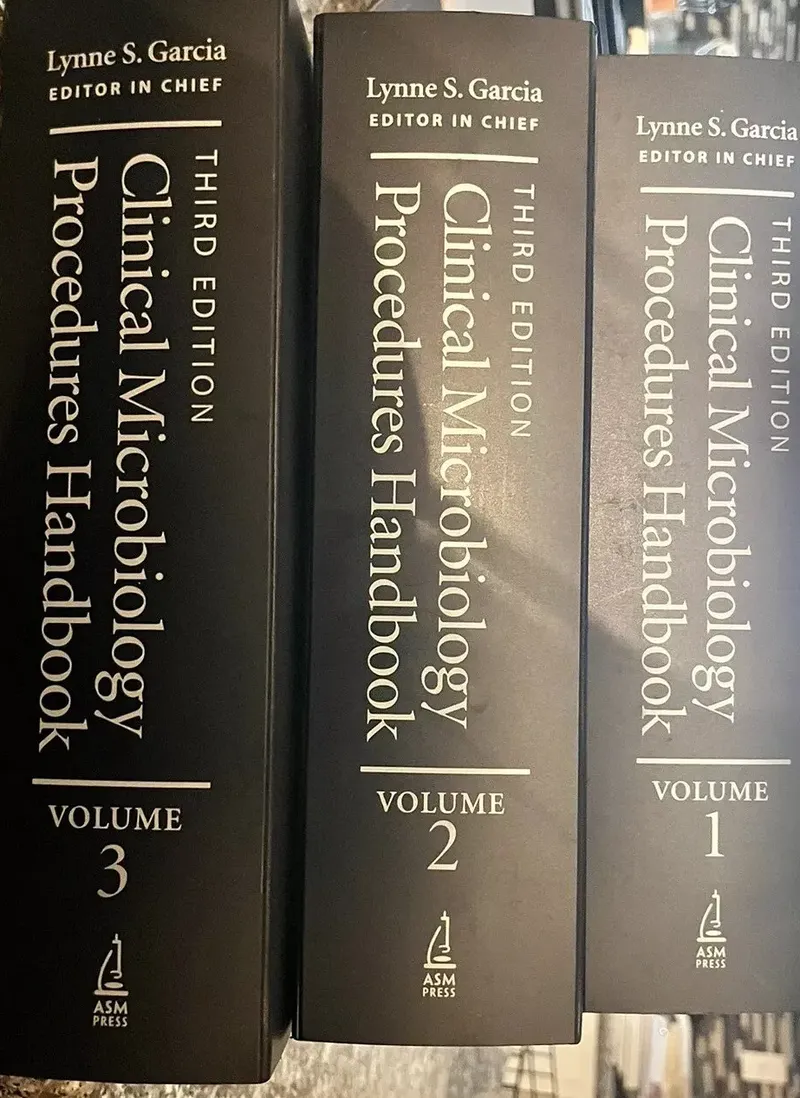

Clinical Microbiology Procedures Handbook, Volumes 1–3, 3rd Edition
Clinical Microbiology Procedures Handbook, Volumes 1–3, 3rd Edition is an extensive laboratory reference published by ASM Press for students, laboratory professionals, and researchers working in clinical microbiology. This three-volume set brings together a wide range of procedures used to investigate microorganisms associated with human infections.
With 2,540 pages, the handbook provides detailed material covering clinical specimen processing, microbiological testing, organism identification, antimicrobial susceptibility testing, and laboratory quality practices.
About Clinical Microbiology Procedures Handbook
Clinical microbiology laboratories play an important role in the diagnosis and investigation of infectious diseases.
Reliable laboratory results depend on appropriate specimen collection, careful processing, accurate testing, and proper interpretation. A comprehensive procedures handbook can help readers understand the practical methods used throughout the diagnostic microbiology workflow.
Clinical Specimen Processing
The laboratory investigation of an infection begins with an appropriate clinical specimen.
Proper collection, transportation, storage, and processing are essential for obtaining meaningful microbiological results. Poor specimen quality or contamination can affect the reliability of laboratory findings.
Understanding these steps is therefore fundamental to clinical microbiology.
Microbial Culture and Identification
Culture-based methods remain an important component of microbiological investigation.
Laboratory professionals may evaluate growth characteristics, colony morphology, microscopic appearance, biochemical reactions, and other characteristics to help identify microorganisms.
These procedures provide a practical connection between microbiological theory and diagnostic laboratory work.
Bacteriology and Diagnostic Microbiology
The identification of bacterial pathogens requires a combination of laboratory methods.
Procedures may include microscopy, staining, isolation, biochemical testing, identification methods, and antimicrobial susceptibility testing.
Understanding these processes helps laboratory professionals investigate bacterial infections and produce useful diagnostic information.
Fungi and Other Microorganisms
Clinical microbiology extends beyond bacterial pathogens.
Laboratories may also investigate fungi, parasites, and other infectious organisms, each of which can require specialized methods for detection and identification.
A multi-volume reference provides space for covering these diverse laboratory applications in greater depth.
Antimicrobial Susceptibility Testing
Antimicrobial susceptibility testing helps determine how microorganisms respond to antimicrobial agents.
These laboratory results can provide important information for clinical management and contribute to surveillance of antimicrobial resistance.
Understanding appropriate susceptibility testing methods is therefore an important part of clinical microbiology laboratory practice.
Laboratory Quality and Accuracy
Diagnostic laboratory procedures require consistency and quality control.
Proper laboratory practices help ensure that procedures, reagents, equipment, and testing methods perform as expected.
Quality assurance is particularly important because microbiological results can contribute directly to clinical decisions.
Molecular and Specialized Techniques
Clinical microbiology has increasingly incorporated molecular approaches alongside traditional methods.
Techniques involving nucleic acid detection, amplification, molecular identification, and other specialized procedures provide additional tools for detecting infectious organisms.
These methods complement established approaches such as microscopy and culture.
Who Is This Book For?
Clinical Microbiology Procedures Handbook, Volumes 1–3 can be useful for:
- Clinical microbiologists
- Medical laboratory scientists
- Microbiology students
- Medical laboratory students
- Biomedical science students
- Laboratory professionals
- Healthcare professionals
- Clinical microbiology researchers
- Laboratory educators and instructors
It can also serve as a reference for academic and diagnostic laboratories.
Why Use a Clinical Microbiology Procedures Handbook?
Clinical microbiology combines scientific knowledge with practical laboratory skills.
Professionals need to understand not only the characteristics of microorganisms but also how specimens are handled, how organisms are detected and identified, how susceptibility is tested, and how laboratory quality is maintained.
A comprehensive procedures handbook provides a practical reference for these activities.
Final Thoughts
Clinical Microbiology Procedures Handbook, Volumes 1–3, 3rd Edition is a substantial reference covering practical approaches to clinical microbiology and diagnostic laboratory work.
The three-volume set addresses areas related to specimen processing, microscopy, culture, microbial identification, antimicrobial susceptibility testing, laboratory quality, and specialized diagnostic techniques.
With 2,540 pages, it offers extensive material for readers who require a detailed laboratory reference rather than a short introductory textbook.
For students and professionals in clinical microbiology, medical laboratory science, biomedical science, and diagnostic laboratory medicine, this handbook can be a useful resource for studying and reviewing clinical microbiology procedures.
Book Information
Title: Clinical Microbiology Procedures Handbook
Edition: 3rd Edition
Format: Volumes 1–3
Publisher: ASM Press
Publication Date: August 1, 2010
Language: English
Print Length: 2,540 pages
ISBN-10: 1555815278
ISBN-13: 978-1555815271
Subject: Clinical Microbiology / Diagnostic Microbiology / Laboratory Procedures / Medical Laboratory Science
Clinical Microbiology Procedures Handbook, Volumes 1–3, 3rd Edition provides an extensive reference covering clinical specimen processing, culture, microscopy, microbial identification, antimicrobial susceptibility testing, quality control, and diagnostic microbiology procedures, making it a useful resource for students and laboratory professionals.
Support the Creators!
If you enjoy this book, please consider supporting the author and publisher by purchasing a physical or digital copy. Buying official copies ensures authors can keep writing great books.