
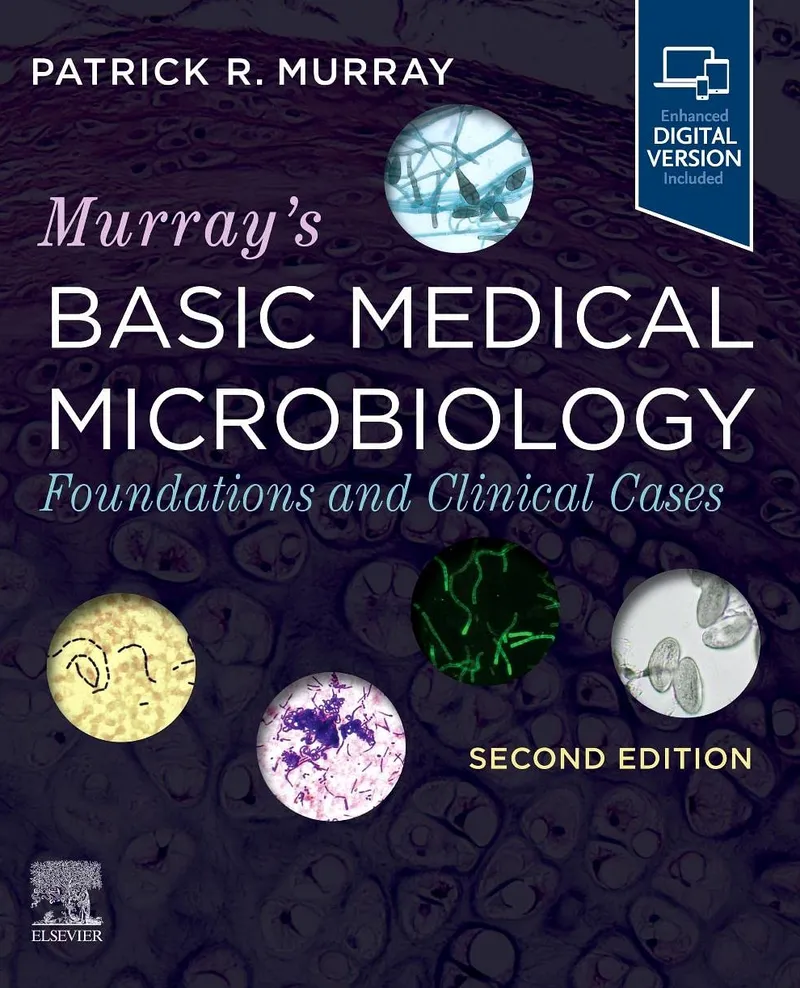

Murray’s Basic Medical Microbiology: Foundations and Clinical Cases, 2nd Edition
Murray’s Basic Medical Microbiology: Foundations and Clinical Cases, 2nd Edition is a concise medical microbiology textbook that connects the fundamental principles of microbiology with clinical situations. Published by Elsevier, the book is designed to help students understand microorganisms, infectious diseases, and the laboratory and clinical concepts needed to recognize and manage microbial infections.
With 304 pages, this second edition provides a relatively compact approach to medical microbiology, making it suitable for students who want to build a strong foundation without working through an extremely large reference textbook.
About Murray’s Basic Medical Microbiology
Medical microbiology focuses on microorganisms that affect human health, including bacteria, viruses, fungi, and parasites.
A good understanding of the subject requires more than memorizing individual organisms. Students need to understand how microorganisms cause disease, how the immune system responds, how infections are diagnosed, and how antimicrobial treatments work.
This book approaches these concepts by combining foundational microbiology with clinical cases, helping readers connect basic science with real-world medical situations.
Foundations of Medical Microbiology
The fundamentals of microbiology provide the foundation for understanding infectious diseases.
Important concepts include microbial structure, growth, genetics, metabolism, pathogenicity, and host-microbe interactions. These principles help explain why particular microorganisms cause specific diseases and how they survive within or outside the human host.
Building this foundation makes it easier to understand the clinical characteristics of infectious diseases.
Bacteriology
Bacteria represent a major part of medical microbiology.
Students need to recognize the characteristics of clinically important bacteria and understand how they are identified in the laboratory.
Topics such as bacterial morphology, staining, culture, virulence factors, and antimicrobial susceptibility help connect bacterial biology with diagnosis and treatment.
Virology
Viruses have unique biological characteristics because they depend on host cells for replication.
Understanding viral structure, replication, transmission, and host interactions provides the foundation for studying viral diseases.
Medical virology also connects with important clinical topics such as vaccination, antiviral therapy, and laboratory diagnosis.
Mycology and Parasitology
Fungi and parasites can cause a wide range of human infections.
Understanding their biology, transmission, clinical manifestations, and laboratory diagnosis helps students distinguish between different types of infectious diseases.
These organisms also demonstrate the diversity of mechanisms through which microorganisms can interact with the human host.
Microbial Pathogenesis
Pathogenesis explains how microorganisms produce disease.
Microbial pathogens may attach to tissues, invade cells, produce toxins, evade immune responses, or damage host tissues through different mechanisms.
Understanding these processes helps students connect the biological characteristics of a microorganism with the symptoms and clinical manifestations of infection.
Host Defense and Immunity
The outcome of an infection depends not only on the microorganism but also on the host response.
The immune system uses multiple mechanisms to recognize and eliminate invading microorganisms. Understanding these responses provides important context for infectious diseases, vaccination, inflammation, and susceptibility to infection.
Clinical Cases
The clinical case approach is particularly useful for medical students.
Instead of studying microorganisms as isolated facts, case-based learning encourages readers to consider how microbiological information relates to symptoms, clinical findings, laboratory results, and possible diagnoses.
This approach can help students develop the habit of connecting basic science with clinical reasoning.
Laboratory Diagnosis
Clinical microbiology laboratories provide essential information for identifying infectious agents.
Common diagnostic approaches include:
- Microscopy
- Staining
- Culture
- Biochemical testing
- Antigen detection
- Serological testing
- Molecular diagnostics
- Antimicrobial susceptibility testing
Understanding these methods helps students interpret laboratory findings and appreciate the role of microbiology in patient care.
Antimicrobial Therapy and Resistance
Antimicrobial therapy is an important component of medical microbiology.
Students need to understand how antimicrobial agents affect microorganisms and why some organisms may be resistant to particular drugs.
The increasing prevalence of antimicrobial resistance makes knowledge of microbial susceptibility and appropriate antimicrobial use especially important in modern healthcare.
Who Is This Book For?
Murray’s Basic Medical Microbiology can be useful for:
- Medical students
- Dental students
- Pharmacy students
- Nursing students
- Biomedical science students
- Medical laboratory students
- Microbiology students
- Healthcare students
- Students preparing for microbiology examinations
- Readers seeking a concise medical microbiology reference
Its relatively short length also makes it suitable for students looking for a focused review resource.
Why Use a Clinical Approach?
Medical microbiology becomes easier to understand when basic microbiological concepts are connected to clinical situations.
A clinical case can demonstrate how the characteristics of a microorganism influence its transmission, disease mechanism, clinical presentation, laboratory diagnosis, and treatment.
This approach encourages students to understand the relationships between different areas of medical microbiology rather than memorizing them separately.
Final Thoughts
Murray’s Basic Medical Microbiology: Foundations and Clinical Cases, 2nd Edition provides a concise introduction to medical microbiology while emphasizing the connection between fundamental science and clinical practice.
The book covers important areas including bacteriology, virology, mycology, parasitology, microbial pathogenesis, immunity, laboratory diagnosis, antimicrobial therapy, and infectious diseases.
With 304 pages, it offers a manageable format for students who need to review the major principles of medical microbiology while developing an understanding of their clinical applications.
For students in medicine, dentistry, pharmacy, nursing, biomedical science, medical laboratory science, and related disciplines, this book can serve as a useful resource for learning, revision, and examination preparation.
Book Information
Title: Murray’s Basic Medical Microbiology: Foundations and Clinical Cases
Edition: 2nd Edition
Publisher: Elsevier
Publication Date: March 13, 2023
Language: English
Print Length: 304 pages
ISBN-10: 0323878105
ISBN-13: 978-0323878104
Subject: Medical Microbiology / Infectious Diseases / Clinical Microbiology / Microbiology / Medical Education
Murray’s Basic Medical Microbiology: Foundations and Clinical Cases, 2nd Edition provides a concise foundation in medical microbiology, microbial pathogenesis, clinical cases, laboratory diagnosis, immunity, and antimicrobial therapy, making it a practical study resource for students preparing for courses and examinations in the health sciences.
Support the Creators!
If you enjoy this book, please consider supporting the author and publisher by purchasing a physical or digital copy. Buying official copies ensures authors can keep writing great books.