
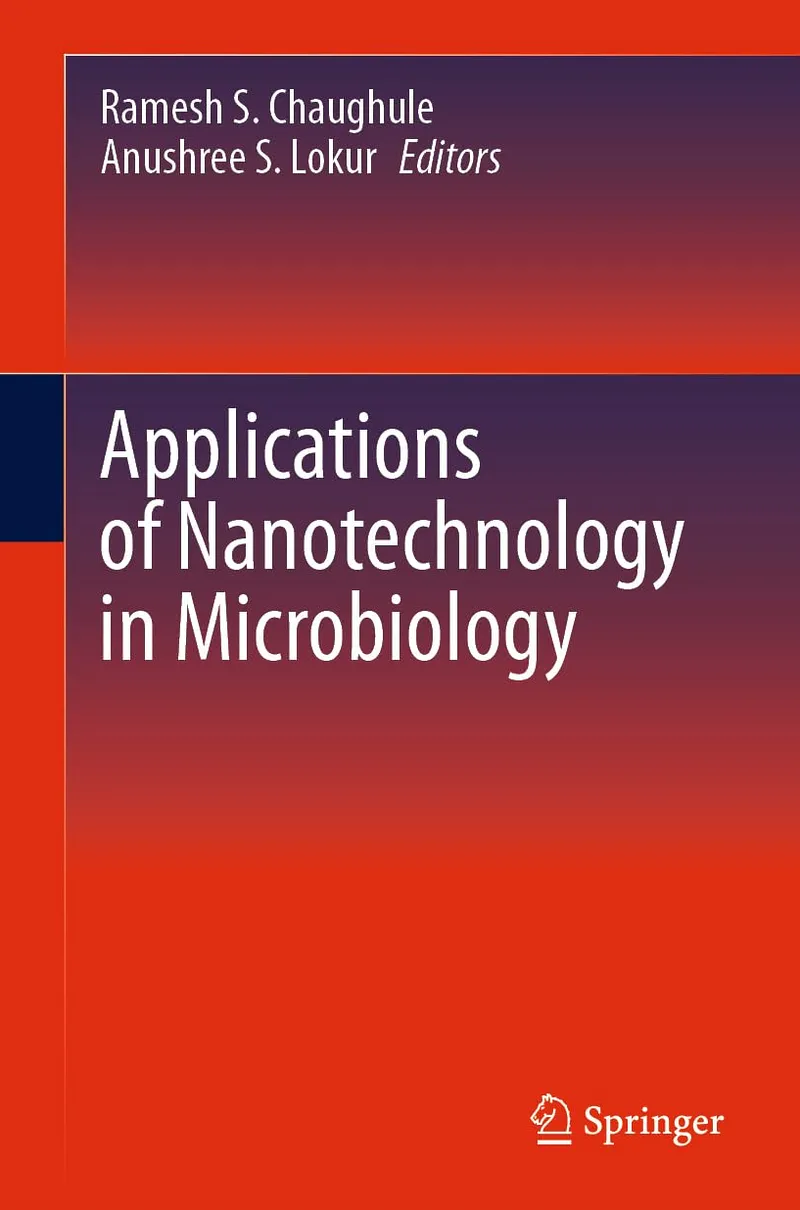

Applications of Nanotechnology in Microbiology
Applications of Nanotechnology in Microbiology is a specialized academic resource that explores the growing intersection between nanotechnology and microbiology. Published by Springer, the book brings together concepts from microbiology, nanoscience, biotechnology, materials science, and related areas to examine how nanoscale materials and technologies can be applied to the study, detection, control, and utilization of microorganisms.
Nanotechnology has introduced new possibilities for working with biological systems at dimensions comparable to many cellular and microbial structures. At this scale, materials can exhibit physical, chemical, and biological properties that differ significantly from their bulk forms. Understanding these properties has opened new research directions in areas such as antimicrobial materials, microbial detection, drug delivery, biosensors, environmental applications, and biotechnology.
For students and researchers interested in the relationship between microorganisms and nanomaterials, this book provides a useful perspective on how developments in nanoscience can contribute to modern microbiological research.
About Nanotechnology in Microbiology
Microbiology traditionally focuses on microorganisms and their interactions with living and non-living environments. Nanotechnology adds another dimension to this field by allowing researchers to design and manipulate materials at the nanoscale.
Nanoparticles and other nanostructured materials can interact with microbial cells in highly specific ways. Their small size, large surface-area-to-volume ratio, surface chemistry, optical properties, electrical characteristics, and catalytic activity can make them useful in applications that are difficult to achieve with conventional materials.
The combination of these properties has attracted considerable interest in microbiology and biotechnology. Researchers are investigating how nanomaterials can be used to inhibit microbial growth, detect microorganisms, deliver active compounds, improve analytical techniques, and develop new approaches to environmental and industrial microbiology.
Applications of Nanotechnology in Microbiology provides an academic perspective on this developing field and helps illustrate how principles from two rapidly advancing scientific disciplines can be brought together.
What Is Nanotechnology?
Nanotechnology generally involves the design, characterization, manipulation, and application of materials and structures at extremely small dimensions. At the nanoscale, materials may display properties that are substantially different from those observed at larger scales.
For microbiologists, these properties are particularly interesting because many microorganisms, biological molecules, membranes, and cellular structures exist at dimensions where nanoscale interactions become highly relevant.
Nanotechnology can therefore provide new tools for observing, interacting with, and influencing biological systems. In microbiology, this can include the development of nanoscale sensors, antimicrobial surfaces, diagnostic technologies, and materials designed to interact with microbial cells.
Nanomaterials and Microorganisms
One of the important areas at the intersection of nanotechnology and microbiology is the interaction between nanomaterials and microorganisms.
Different types of nanoparticles can interact with microbial cell walls and membranes, intracellular components, enzymes, proteins, and genetic material. The nature of these interactions depends on characteristics such as particle size, morphology, composition, surface properties, concentration, and the surrounding environment.
Studying these interactions can help researchers understand both the potential applications and limitations of nanomaterials in biological systems.
This area is particularly important when investigating antimicrobial nanomaterials. Certain nanoparticles have demonstrated the ability to inhibit or damage microorganisms, creating interest in their possible use in antimicrobial coatings, medical materials, water treatment, food-related applications, and other technologies.
Nanotechnology for Antimicrobial Applications
The emergence of antimicrobial resistance has increased interest in approaches that can complement conventional antimicrobial agents. Nanotechnology offers several possible strategies for controlling microorganisms.
Nanostructured materials may possess antimicrobial properties because of their physical or chemical interactions with microbial cells. Some nanomaterials can interfere with cellular membranes, generate reactive species, release biologically active ions, or interact with essential cellular components.
Understanding these mechanisms is important for researchers developing new antimicrobial technologies. It also highlights the importance of evaluating factors such as microbial species, exposure conditions, nanoparticle characteristics, toxicity, environmental persistence, and potential effects on beneficial microorganisms.
Nanotechnology in Microbial Detection
Rapid and reliable detection of microorganisms is important in clinical microbiology, food safety, environmental monitoring, and public health.
Nanotechnology can contribute to microbial detection through the development of highly sensitive nanoscale sensors and detection platforms. Nanomaterials can be incorporated into systems designed to recognize microbial cells, proteins, nucleic acids, toxins, or other biological markers.
Because nanomaterials can possess distinctive optical, electrical, magnetic, or chemical properties, they can provide mechanisms for translating a biological interaction into a measurable signal.
These technologies have potential applications in situations where conventional microbial detection methods may require considerable time or laboratory infrastructure.
Nanobiosensors and Microbiology
Biosensors combine a biological recognition component with a physical or chemical detection system. Nanotechnology can improve certain biosensor designs by providing materials with high surface areas and favorable electrical, optical, or catalytic characteristics.
In microbiology, nanobiosensors may be developed for detecting microorganisms or microbial products. Such technologies can have applications in disease diagnosis, environmental analysis, food monitoring, and biotechnology.
The development of nanoscale biosensors demonstrates one of the central advantages of combining nanotechnology with microbiology: biological recognition can be paired with engineered materials to produce new analytical tools.
Nanotechnology and Drug Delivery
Nanotechnology is also closely connected with research into controlled and targeted delivery of therapeutic compounds.
Nanostructured carriers can be designed to transport active molecules and influence how those molecules interact with biological systems. In microbiology and infectious-disease research, this concept has attracted attention for the delivery of antimicrobial compounds and other therapeutic agents.
The goal is not simply to make a drug smaller, but to use nanoscale engineering to modify characteristics such as solubility, stability, distribution, release, and interaction with biological targets.
This area connects microbiology with pharmaceutical science, materials science, and biomedical engineering.
Nanotechnology in Environmental Microbiology
Microorganisms are fundamental components of environmental systems. They participate in nutrient cycling, decomposition, bioremediation, wastewater treatment, and many other ecological processes.
Nanotechnology can provide new materials and approaches for environmental applications involving microorganisms. Nanomaterials may be investigated for pollutant detection, water purification, antimicrobial treatment, and the enhancement or monitoring of microbial processes.
At the same time, the environmental behavior of nanoparticles must be carefully considered. Nanomaterials released into ecosystems may interact with microorganisms that are essential for environmental health. Understanding these effects is therefore an important part of responsible nanotechnology research.
Nanotechnology and Biotechnology
Microorganisms are widely used in biotechnology because of their ability to produce enzymes, metabolites, pharmaceuticals, biofuels, and other valuable products.
Nanotechnology can complement microbial biotechnology by providing new tools for monitoring biological processes, immobilizing biomolecules, improving separation methods, and developing engineered surfaces and sensors.
The combination of microbial systems with nanoscale materials therefore creates opportunities for research across industrial microbiology, biotechnology, bioprocessing, and bioengineering.
Why Is Nanotechnology Important in Microbiology?
The significance of nanotechnology in microbiology comes largely from the ability to investigate biological interactions at scales that are directly relevant to microorganisms and their cellular components.
Traditional microbiological techniques remain essential, but nanoscale approaches can provide additional ways to manipulate materials, improve detection, engineer surfaces, and study microbial interactions.
This interdisciplinary perspective is particularly valuable because many modern scientific problems do not fit neatly within a single discipline. Questions involving antimicrobial resistance, infectious diseases, environmental contamination, biosensing, and biotechnology may require knowledge of microbiology together with chemistry, materials science, physics, and engineering.
Who Can Benefit from This Book?
Applications of Nanotechnology in Microbiology can be relevant to readers working or studying across several scientific disciplines, including:
- Microbiology
- Biotechnology
- Nanotechnology
- Nanobiotechnology
- Molecular biology
- Biomedical sciences
- Materials science
- Pharmaceutical sciences
- Environmental microbiology
- Medical microbiology
- Bioengineering
- Food microbiology
- Environmental biotechnology
The book may be particularly useful for graduate students, postgraduate researchers, laboratory scientists, and academics interested in interdisciplinary applications of nanotechnology in biological systems.
It can also serve as supplementary reading for students who already have a basic understanding of microbiology and want to explore emerging technologies that are influencing contemporary research.
An Interdisciplinary Resource
One of the most interesting aspects of nanotechnology in microbiology is the interdisciplinary nature of the subject. A researcher studying antimicrobial nanoparticles, for example, may need to understand microbial physiology, surface chemistry, particle characterization, molecular interactions, toxicology, and materials science.
Similarly, the development of a nanoscale microbial sensor can involve microbiology, nanomaterials, electronics, analytical chemistry, and biotechnology.
This makes the subject particularly relevant to modern scientific research, where collaboration between traditionally separate disciplines is increasingly common.
Research Opportunities in Nanotechnology and Microbiology
The combination of nanotechnology and microbiology continues to provide opportunities for investigation in both fundamental and applied science.
Researchers can explore questions concerning the mechanisms through which nanomaterials interact with microbial cells, the development of more effective antimicrobial surfaces, rapid pathogen detection, environmental applications, nanoscale delivery systems, and the safe use of nanomaterials in biological and ecological environments.
The field also raises important questions about safety and sustainability. A nanomaterial that is effective against a harmful microorganism must also be evaluated for its effects on human cells, beneficial microorganisms, animals, plants, and ecosystems. Consequently, nanotechnology research in microbiology involves not only developing new applications but also understanding their biological and environmental consequences.
Final Thoughts
Applications of Nanotechnology in Microbiology represents an important area of interdisciplinary science where the principles of nanotechnology meet the complexity of microbial life.
The study of microorganisms at the nanoscale offers new possibilities for antimicrobial technologies, microbial detection, biosensors, drug delivery, environmental applications, and biotechnology. At the same time, it requires careful consideration of how engineered nanomaterials interact with living systems and the environment.
For students, researchers, and professionals interested in microbiology and nanotechnology, this book provides a valuable opportunity to explore how nanoscale science can contribute to solving problems in biological research and applied microbiology.
As nanotechnology continues to develop, its relationship with microbiology is likely to become increasingly important. Understanding this intersection can therefore provide readers with useful scientific background for exploring emerging research in nanobiotechnology, antimicrobial materials, microbial diagnostics, environmental biotechnology, and related fields.
Book Information
Title: Applications of Nanotechnology in Microbiology
Publisher: Springer
Subject Areas: Microbiology, Nanotechnology, Nanobiotechnology, Biotechnology, Biological Sciences
Type: Academic / Scientific Reference
Support the Creators!
If you enjoy this book, please consider supporting the author and publisher by purchasing a physical or digital copy. Buying official copies ensures authors can keep writing great books.